
After more than two decades of searching, scientists have finally observed a phenomenon in a hot and dense particle ‘soup’ similar to that which filled the cosmos moments after the Big Bang. The observation could help cosmologists better understand the incredibly hot and dense state of the universe in its earliest moments.
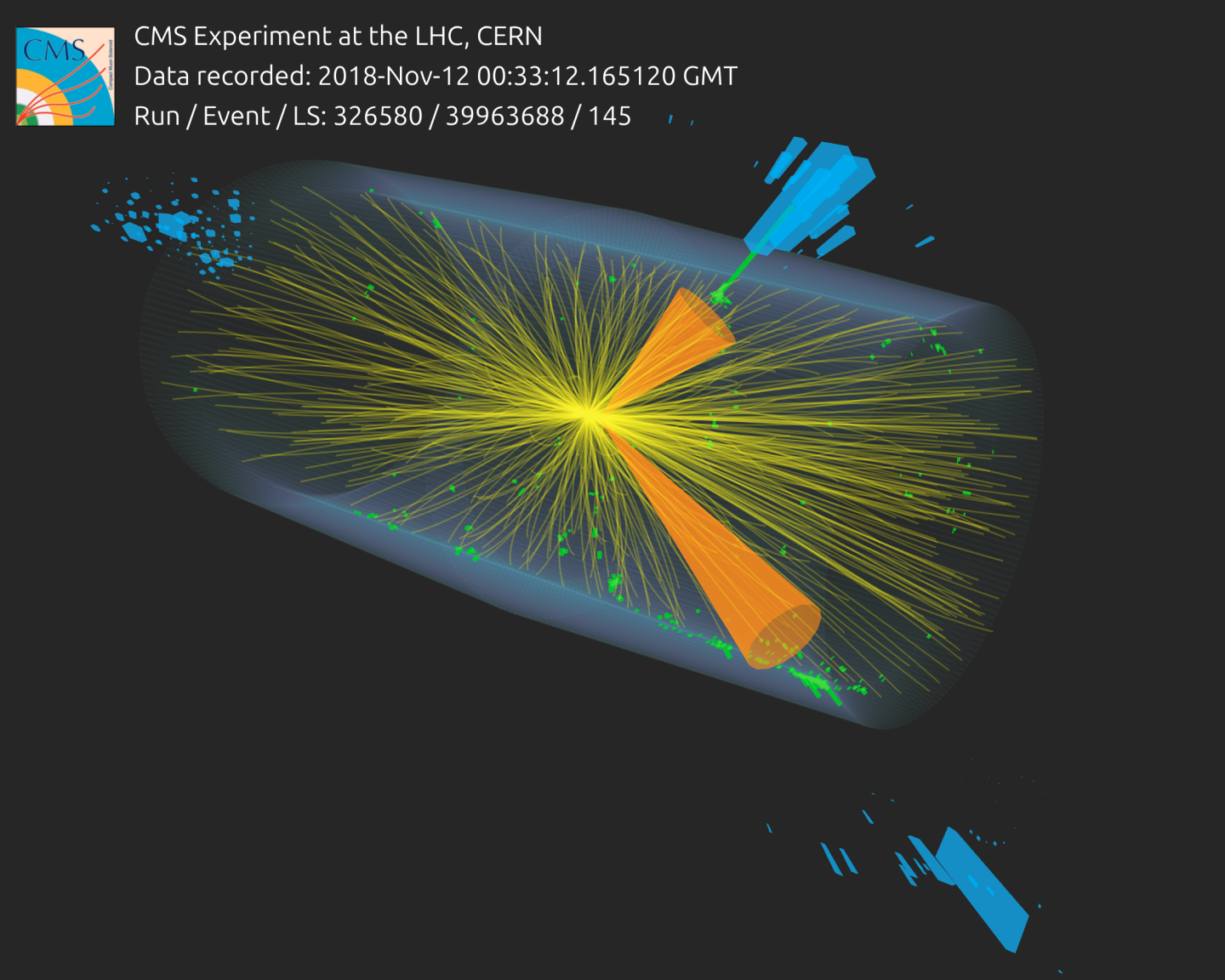
The world’s most powerful particle accelerator, the Large Hadron Collider (LHC), regularly creates this so-called quark-gluon plasma by smashing together the atomic nuclei of heavy elements like lead and generating sprays of particles called jets, from which this hot and dense particle soup emerges. This is necessary because in the modern universe, quarks and gluons, referred to as “partons,” are only ever found together comprising particles like protons and neutrons. Thus, it takes the kind of energy generated by smashing atoms together at near-light-speeds to free these partons and generate the hot ‘soup’ known as quark-gluon plasma.
As particles ripple through the quark-gluon plasma, they lose energy and momentum to this medium, which should create wakes in this primordial soup, much like that which is created when the hull of a boat pushes through the ocean. However, researchers had failed to see this so-called “diffusion wake” for two decades. That is, until now.
“Observing and quantifying the quark-gluon plasma diffusion wake opens the door to the new precision characterization of the properties and dynamics of the quark-gluon plasma, and promises new insights into the evolution of the early universe,” team leader Raghunath Pradhan of the University of Illinois Chicago (UIC) said in a statement.
A new approach in the hunt for particle wakes
Previously, the search for wave signals had involved generating events involving the production of a jet alongside a particle called a Z boson. However, while this had provided some evidence of particle wakes, signals from these wakes are subtle and easily drowned out by other jet-related effects, meaning these detections weren’t statistically significant enough to be classed as a confirmed detection.
To search for the wave signal, this team took a different approach and used the LHC to smash together two lead nuclei to create jets of particles that were back-to-back, called a dijet event. The unique shape of these events meant that signals from wakes could be more easily disentangled from surrounding noise.
The team’s measurement showed a clear lack of particles behind the direction of the jets, which was particularly prominent at relatively low momentum. That is exactly what would be expected for a diffusion wake. The strongest wake signals were detected in more centralised lead-lead collisions, which create more quark-gluon plasma.
“This observation is a culmination of a decades-long quest to observe the wake phenomenon; it has been predicted by theory over 20 years ago, but remained elusive in the experimental data,” team leader Olga Evdokimov of UIC said.
The team’s research was accepted for publication on June 25 in the journal Physical Review Letters.