
Reboots and remakes may be all the rage in Hollywood with mixed degrees of success (we don’t talk about the Nightmare on Elm Street reboot … ever), but they aren’t so popular in other forms of art such as painting. However, a recent cosmic rework of one of art’s most well-regarded pieces could be just as breathtaking as its original counterpart.
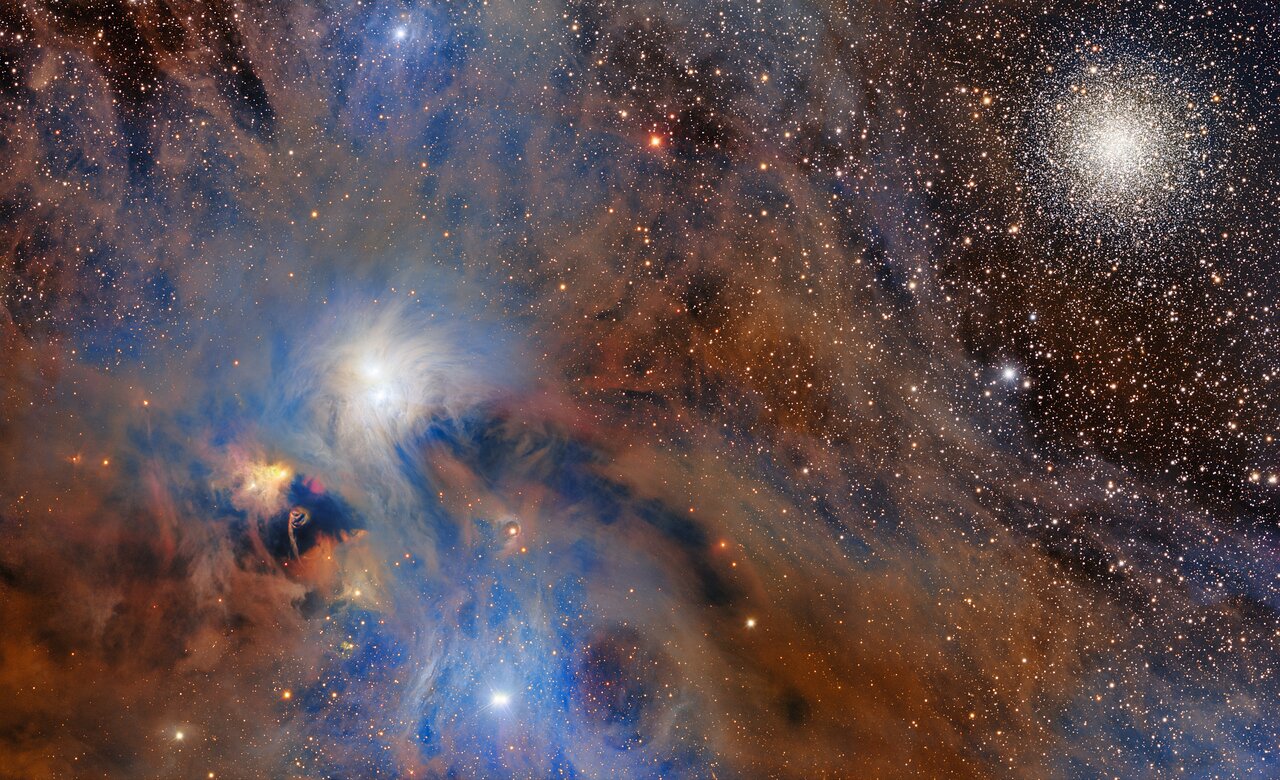
That’s all thanks to the Dark Energy Camera (DECam), which has captured a vibrant view of the Corona Australis molecular cloud, that shows the star-forming region resembling a cosmic take on Vincent Van Gogh’s iconic painting The Starry Night.
The Corona Australis Molecular Cloud measures around 16 light-years in diameter is located around 430 light-years from Earth, making it one of the closest star-birthing regions to our solar system. The molecular cloud and its dark lanes of gas and dust, the raw materials for star construction, are at the left of the DECam image.
Also prominent on the left of the image is the shining nebula NGC 6729, which is a reflection nebula of the Corona Australis Molecular Cloud. That means that it is a cloud of interstellar dust that is reflecting the light of the newborn stars embedded within this molecular cloud.
NGC 6729 is composed of different elements that can be seen on the left side of the image. This includes an orange cloud that is actually the binary star system R Coronae Australis. This binary consists of a pre-main-sequence star that has gathered mass but hasn’t yet triggered the fusion of hydrogen to helium in its core, and its companion, a red dwarf star. These stars orbit each other every 43 to 47 years and are incredibly bright, with their light also reflecting from nearby reflection nebulas. This light also ionizes nearby gas, creating glowing regions called emission nebulae, also part of NGC 6729.
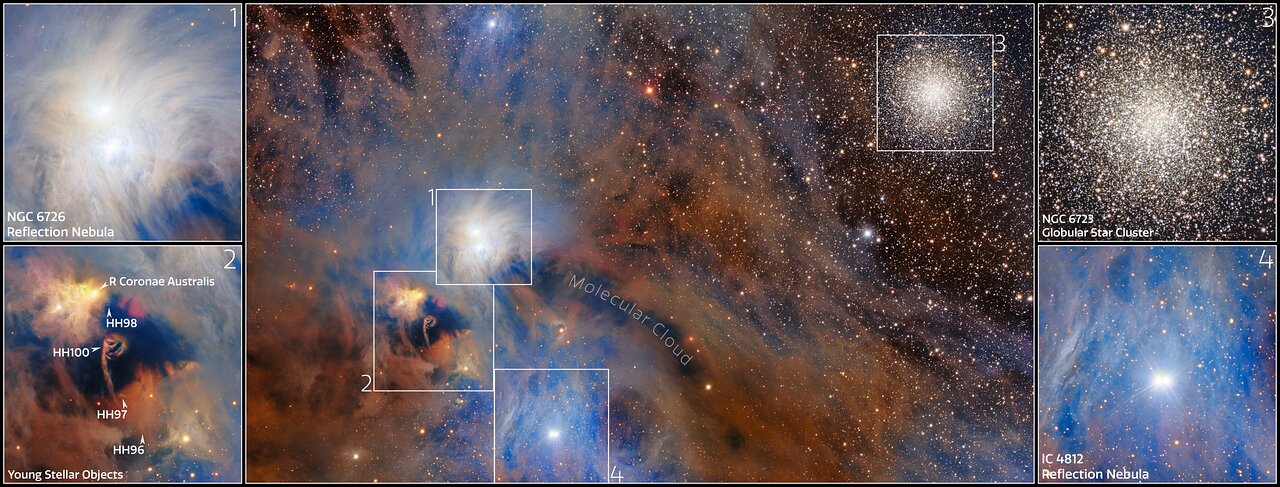
To the top-right of the image is the globular cluster NGC 6723, nicknamed the Chandelier Cluster. Located around 29,000 light-years from Earth, NGC 6723 is thought to contain some of the oldest stars in the Milky Way.
The Chandelier Cluster contains tens of thousands to millions of stars, which aren’t all ancient; within the spherically shaped globular cluster are more than a smattering of younger stars.
Astronomers and astrophotographers of all levels will be more than familiar with the Corona Australis Molecular Cloud and the Chandelier Cluster and this region as a whole.
But just as it took the artistic vision of Van Gogh to transform the night sky into a stunning painting, it has taken the observing power of the DECam, mounted on the Víctor M. Blanco 4-meter Telescope at Cerro Tololo Inter-American Observatory (CTIO) in Chile, to bring out the stunning beauty of this slice of the night sky.