
If you’re planning to watch the total solar eclipse on Aug. 12, knowing exactly when to look up is crucial.
While totality will be visible from parts of Greenland, Iceland and Spain, millions more people across Europe will experience a dramatic partial solar eclipse. Whether you’re chasing the moon‘s shadow in Reykjavik or watching the moon take a ‘bite’ out of the sun from London, Paris, or Berlin, timing is everything.
You can keep up with the latest total solar eclipse news and coverage with our total solar eclipse live blog.
Total solar eclipse timings
|
Location |
Totality begins (local time) |
Duration |
|---|---|---|
|
Scoresby Sund, Greenland |
4:35 p.m. |
1m 46s |
|
Reykjavik, Iceland |
5:48 p.m. |
1m 1s |
|
Snæfellsjökull, Iceland |
5:45 p.m. |
2m 10s |
|
Gijón, Spain |
8:26 p.m. |
1m 46s |
|
A Coruña, Spain |
8:27 p.m. |
1m 15s |
|
Burgos, Spain |
8:28 p.m. |
1m 44s |
|
Mallorca, Spain |
8:31 p.m. |
1m 36s |
Partial solar eclipse timings for major European cities
|
Location |
Local time (maximum coverage) |
% of sun’s disk covered |
|---|---|---|
|
New York City |
1:54 p.m. |
9% |
|
St. John’s, Newfoundland, Canada |
3:35 p.m. |
53% |
|
Nuuk, Greenland |
4:35 p.m. |
79% |
|
Oslo, Norway |
7:57 p.m. |
83% |
|
Berlin, Germany |
8:08 p.m. |
84% |
|
London, U.K. |
7:13 p.m. |
91% |
|
Paris, France |
8:17 p.m. |
92% |
|
Tangier, Morocco |
7:40 p.m. |
92% |
|
Dublin, Ireland |
7:10p.m. |
94% |
|
Lisbon, Portugal |
7:36 p.m. |
94% |
|
Nice, France |
8:24 p.m. |
95% |
|
Madrid, Spain |
8:32 p.m. |
99.96% |
|
Barcelona, Spain |
8:29 p.m. |
99.82% |
Looking for your own eclipse time? The interactive map and resources from Time and Date let you search by city and view detailed timing information for every stage of the eclipse.
What is a total solar eclipse?
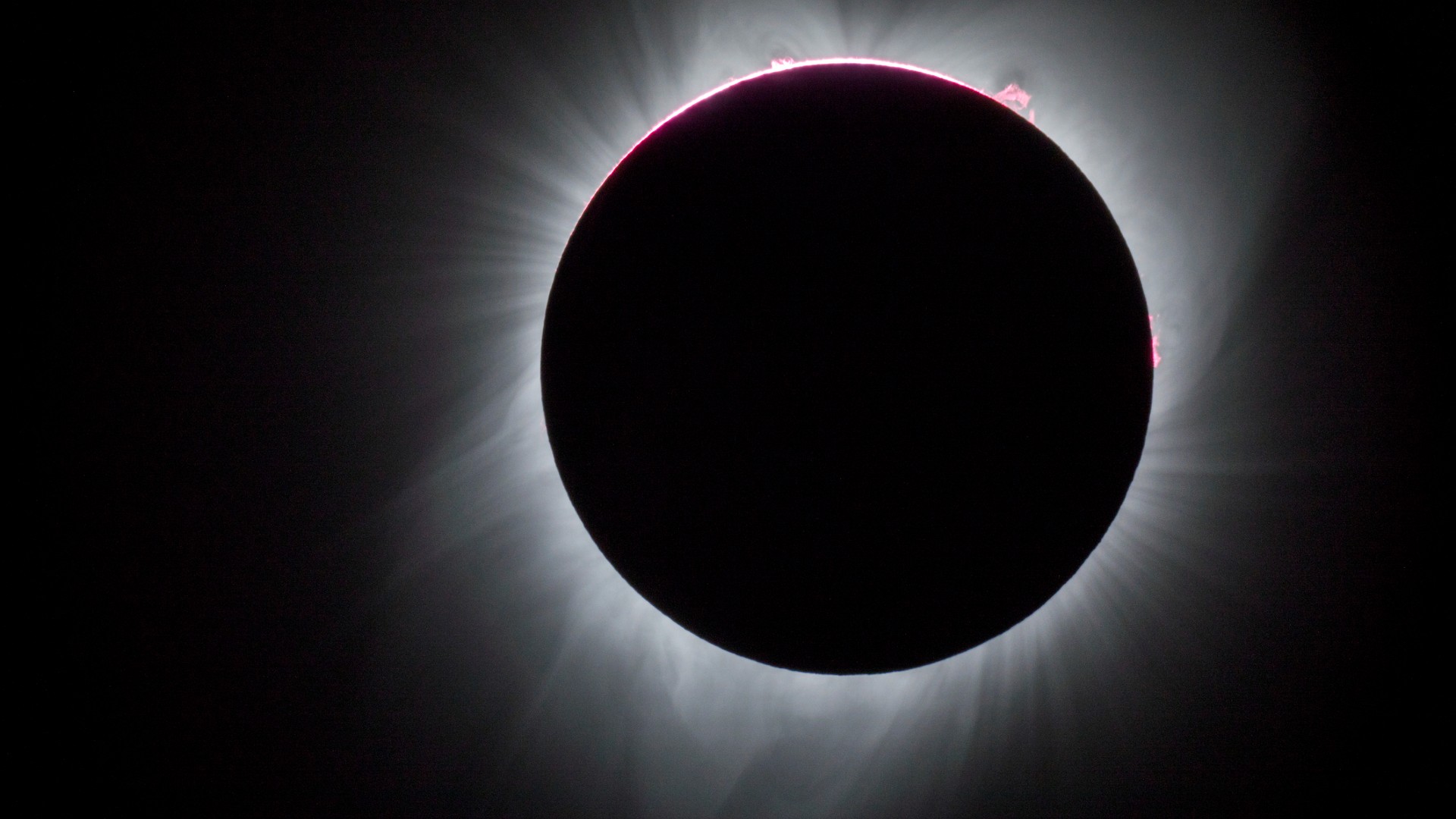
A total solar eclipse occurs when the moon moves directly between Earth and the sun, completely blocking the sun’s disk from view.
During totality, the sky darkens significantly, temperatures drop and bright stars and planets can even become visible. Observers can also catch a glimpse of the sun’s outer atmosphere, known as the corona, glowing around the silhouetted moon.
Totality — when the sun is completely obscured — is only visible within the narrow path of the moon’s shadow. Outside that path, observers may see a partial solar eclipse, whereby only a portion of the sun is covered.
REMEMBER to NEVER look directly at the sun. To view this solar eclipse safely, you must use solar filters. Only during the brief period of totality when the moon completely covers the sun, is it safe to look at the sun without protection. Observers will need to wear solar eclipse glasses, and cameras, telescopes and binoculars must have solar filters placed in front of their lenses at all other times.
Our how to observe the sun safely guide tells you everything you need to know about safe solar observations.
After this, when is the next solar eclipse?
After the total solar eclipse on Aug. 12, 2026, the next solar eclipse will be an annular solar eclipse on Feb. 6, 2027 visible across parts of Africa and South America. The next total solar eclipse will be a spectacular event on Aug. 2, 2027. Visible across North Africa, it will be the longest totality on land since 1991.