

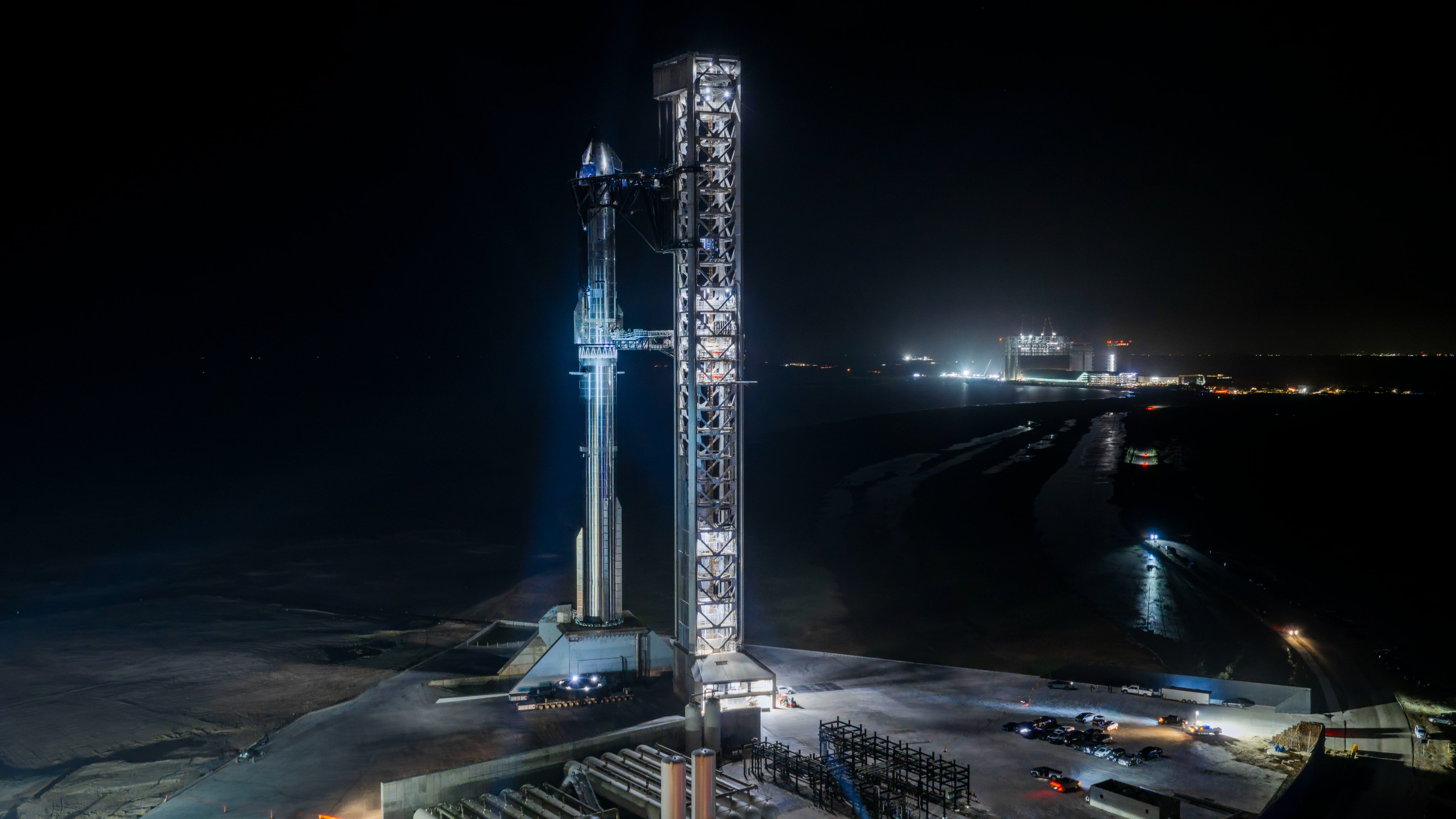
Starship is about to take to the skies on a bold new test flight of the world’s most powerful rocket.
After several days of testing, SpaceX has stacked and readied its massive Starship rocket for its 13th test flight. Liftoff is scheduled to occur today (July 16) during a 90-minute launch window that opens at 6:45 p.m. EDT (2245 GMT), from pad 2 at SpaceX’s facility in Starbase, Texas.
Both stages had been in their respective Starbase hangars for final checkouts following successful engine tests. Booster 40, the Super Heavy first stage launching on Starship Flight 13, was returned to the pad yesterday (July 15). Ship 40, the mission’s upper-stage spacecraft, was rolled from the hangar beginning yesterday evening. The rocket was stacked overnight, according to a SpaceX post on X, and now awaits prelaunch procedures ahead of the beginning of Flight 13’s launch countdown.
Flight 13 will launch the second “Version 3” (V3) Starship, a new iteration featuring extensive design upgrades to help mature the rocket toward clearing the vehicle for official operation. Compared to its Version 2 predecessor, V3 is taller, carries more propellant, and has lost significant mass around its engine section due to upgraded avionics systems. V3 is also equipped with 33 of SpaceX’s upgraded Raptor 3 engines on Super Heavy, and another six (three sea-level, three vacuum-optimized) Raptor 3s on Ship.
Starship is designed for full reusability, with both Super Heavy and Ship capable of returning to their launch site for landing and refurbishment, which means making sure there’s enough fuel in the tank to make the journey back. One critical upgrade for Starship V3 involves the propellant transfer docking ports that have been added to Ship’s dorsal side (opposite the heat-shield tiles on its belly, or ventral side). Ship uses the majority of its fuel getting to space and will therefore require propellant transfers from various refueling flights in order to fly beyond low Earth orbit.
NASA is eyeing the development progress of Starship very closely, with a vested interest in the spacecraft’s yet-unproven ability to transfer and maintain the types of cryogenic fuels that power its Raptor 3s. NASA has contracted SpaceX to design a lunar lander version of Starship to return astronauts to the moon as a part of the agency’s Artemis program, and effectively managing its onboard propellants is one of the requirements on NASA’s checklist to certify the vehicle to fly with crews.
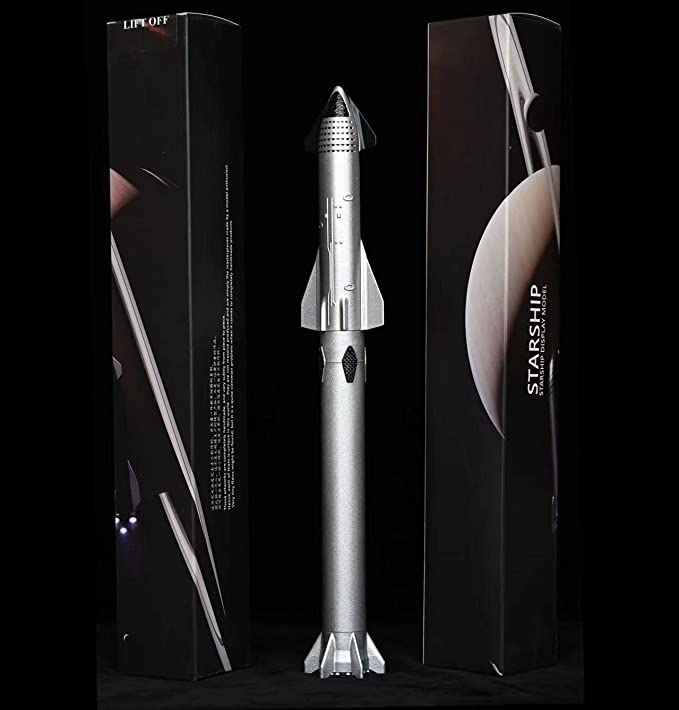
Starship Die Cast Rocket Model Was $47.99 Now $39.99 on Amazon.
Even if you can’t see SpaceX’s Starship in person, you can score a model of your own. Standing at 13.77 inches (35 cm), this is a 1:375 ratio of SpaceX’s Starship as a desktop model. The materials here are alloy steel and it weighs just 225g.View Deal
SpaceX plans to complete such a demonstration later this year in preparation for Artemis III, targeted for mid-to-late 2027, which will fly a crew of four aboard NASA’s Orion spacecraft to dock with Ship in Earth orbit ahead of the program’s first moon landing mission on Artemis IV in 2028. NASA contracted Blue Origin‘s Blue Moon spacecraft as an additional Artemis lander, which will also launch to Earth orbit for docking operations with Orion during Artemis III.
Starship’s readiness to fly those future missions will largely be determined by the rocket’s performance on Flight 13, and its subsequent test launches in the coming months. Today’s launch aims to smooth over a few rough patches that the vehicle ran into during V3’s debut on the mostly successful Flight 12, which occurred on May 22. Those hiccups included Super Heavy failing to steer itself back to Earth for a controlled splashdown and Ship not relighting one of its Raptor engines in space as planned.
Stacking Starship for Flight 13 pic.twitter.com/L4XN6gqgRtJuly 16, 2026
If all goes according to plan on today’s launch, Super Heavy will perform a boostback burn and soft splashdown in the Gulf of Mexico. Ship will carry on with a suborbital trajectory, and is expected to release 20 Starlink V3 satellites — the first of the upgraded Starlinks to fly to space. Six of those spacecraft are equipped with cameras to inspect Ship’s heat-shield tiles during flight. The satellites, though, will be on the same suborbital trajectory as Ship, and are expected to burn up during reentry through Earth’s atmosphere. Ship is scheduled to perform a landing burn and soft splashdown of its own a little more than an hour after liftoff, and will meet a watery demise in the Indian Ocean.
Live coverage of Starship Flight 13 will begin about 30 minutes prior to liftoff, and can be streamed here on Space.com or directly on SpaceX’s website and social media channels.