
Kathryn Paige Harden, an American psychologist, once received a letter from a man who had been imprisoned since he was 16. His crime was unconscionable: kidnapping and sexually assaulting a woman. He asked her, “What would drive a boy to do such a thing?” Most of us rush past such questions, assuming the answer lies in the boy’s willful malice.
But Harden has spent her career slowing down to consider them carefully. Her recent book, Original Sin, aims to show that traits linked to criminal behavior, such as impulsivity, aggression, and risk-taking, are shaped in part by genetic inheritance. Add to this the influence of family systems, economic conditions, and mental illness, and the answer to cases like the letter writer’s grows more complex still.
The question of moral responsibility is not an abstract one. Nor is it easily answered. More than 40 percent of jail inmates have a history of mental health problems. A significant portion of those experiencing chronic homelessness live with conditions like bipolar disorder, severe depression, or psychosis. These conditions can impair judgment, distort reality, and diminish a person’s ability to act. Harmful behavior is often entangled with circumstances people did not choose. Given these realities, we must frankly ask: If people’s perception of reality is distorted and if their choices are deeply conditioned, can we still consider them guilty?

This question has taken on a fresh, existential urgency. Growing awareness of addiction, trauma, mental illness, socioeconomic forces, and interpersonal power dynamics has made it harder to view human behavior as the result of unconstrained choice. We seem to be left with two unsatisfying options: Either people are fully responsible, “free” moral agents, or they are guiltless victims. Neither option does justice to reality.
How can we hold moral responsibility and the reality of behavioral constraint together? The answer is found in an unlikely place—a more robust account of sin as both a human action and as a nonhuman actor.
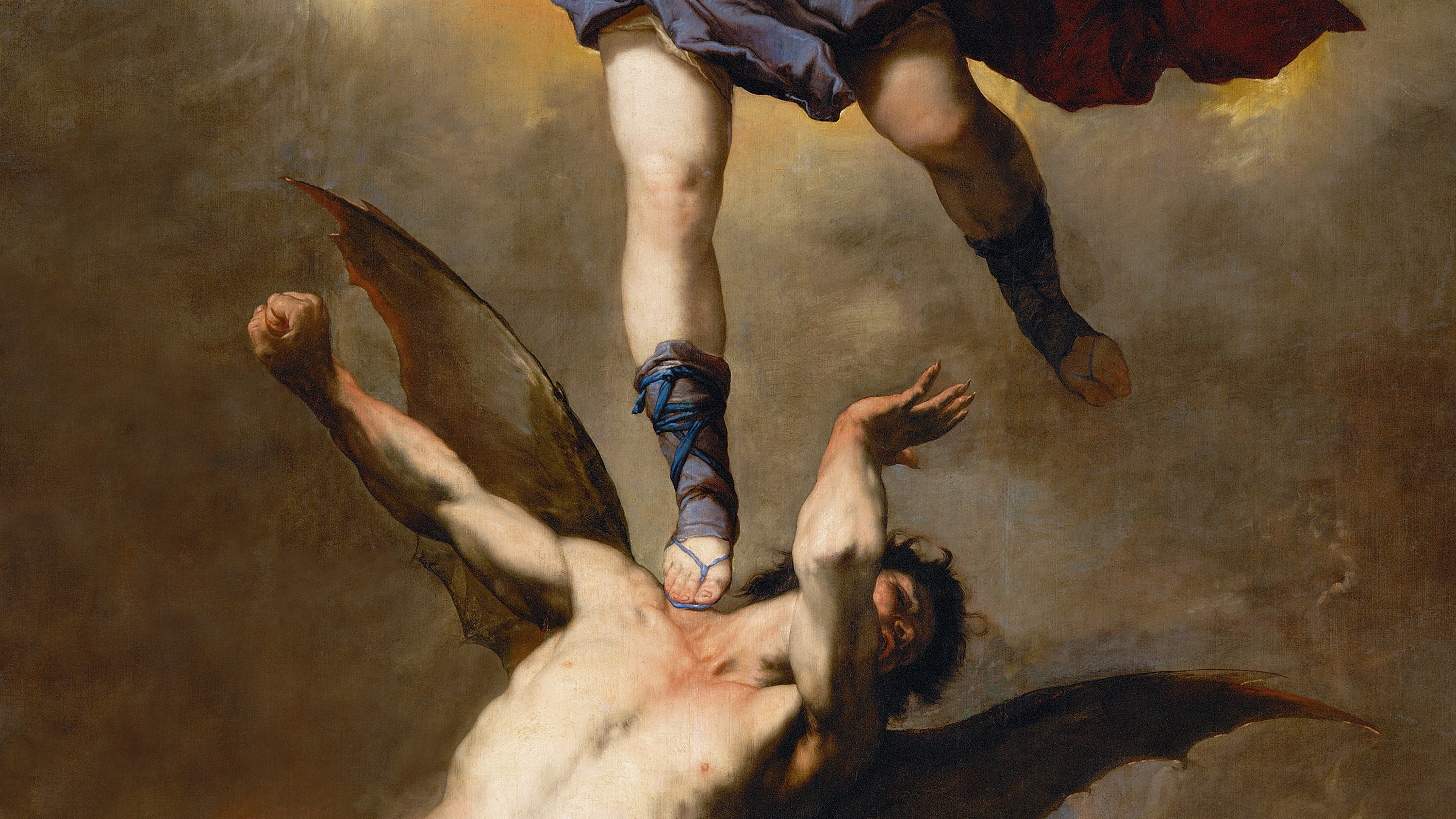
As a child, I thought of sin as a misdeed—something I did that violated a law. That is biblical, of course (Ps. 51:4; Matt. 18:15; 1 Cor. 6:18). Later, I learned to see sin as a nature—a personal condition or disposition. This is also biblical (Gen. 6:5; Ps. 51:5; Matt. 15:19; Eph. 2:3). What startled me as I studied the Book of Romans is that Paul treats sin as a tyrant. Sin reigns, seizes, deceives, and kills (5:12, 21; 6:12; 7:8, 11). In Paul’s language, sin is something we do and something we have, but it is also something that acts upon us—it is the subject of active verbs.
I shouldn’t have been surprised, since the Bible introduces sin when God warns Cain: “Sin is crouching at your door; it desires to have you, but you must rule over it” (Gen. 4:7). Sin is in us. It is also outside us—crouching at our doors—to overpower and govern us.
Sin also animates cultures and institutions and even corrupts creation (Gal. 4:3; Col. 2:20). As Galatians 3:22 says, “everything” is now “under the control of sin.” Sin utilizes everything to constrain how people think, relate, belong, and behave. This is why human behavior so often feels both chosen and constrained, both ours and yet not entirely ours (Rom. 7:14–20).
Some will object: Aren’t these just metaphors for human predilections or a premodern attempt to explain human behavior before the insights of psychology and neuroscience?


The objection isn’t new. Rudolf Bultmann, one of the most influential theologians of the mid-20th century, urged Christians to “demythologize” the New Testament, thus reducing biblical language of cosmic powers to personal experience. His student Ernst Käsemann initially followed him. But then Käsemann watched respectable neighbors nod politely in church, support the Nazis, and look away. Käsemann realized no psychological or sociological explanation could account for what had overtaken his country. Evil was transpersonal and had agency. The New Testament’s language wasn’t outdated mythology, but the only framework that made sense of what he had seen.
Käsemann’s assessment is just as necessary now as it was during World War II. And even when we dismiss such mythical language, our instincts betray us. We still talk as though forces larger than us are shaping us. We say, “The media is deceiving the public.” We worry social media is rewiring our attention spans or Hollywood is discipling our kids. Such statements admit systems and structures act on us in real ways. Paul pushes us further: Behind these systems and structures, there is an even greater power at work: capital-s Sin.


This brings us back to our question: If Sin is a power that enslaves, how can we be held responsible? Doesn’t that cast humans as victims rather than responsible moral creatures?
It’s an important and modern question. As Friedrich Nietzsche pointed out in The Genealogy of Morals, “That idea—‘the wrong-doer deserves punishment because he might have acted otherwise’ … is in point of fact an exceedingly late, and even refined form of human judgment and inference.” Nietzsche’s point is that what feels obvious to us—that people are blameworthy because they could have acted otherwise—is a framework that developed over time. He presents Christianity as the mature expression of that framework.
On this point, Nietzsche is both perceptive and mistaken. He rightly sees that our assumptions about responsibility are not as timeless as they seem. But he misreads the Christian framework. Scripture does not ground responsibility in unconstrained freedom. Instead, it portrays human beings as both bound and accountable at the same time.
The apostle Paul, writing long before our modern assumptions, insists on both the enslaving power of Sin and the reality of human responsibility. He writes, “The mind governed by the flesh is hostile to God; it does not submit to God’s law, nor can it do so” (Rom. 8:7). Sin, he says, dwells without and within—seizing, deceiving, and killing (7:11, 17, 20). In other words, we are both morally enslaved and constrained.
Yet Paul also declares, “We will all stand before God’s judgment seat” and “All who sin under the law will be judged by the law” (14:10; 2:12). We will be judged.
What feels to us like a paradox—that humans are both captive and culpable—was for Paul simply assumed. The Scriptures don’t imagine responsibility as autonomous independence. Conditions beyond our control always shape and bind our actions. We are accountable—but within a world already charged with forces we did not choose. This is the category we have largely lost: Yes, sin is something we do but it’s also a power that acts upon us. Only by holding both these aspects of sin together can we make sense of our experience.
As Simeon Zahl has argued, modern Christianity often reduces sin to moral choices, while contemporary therapeutic culture tends to explain human behavior in terms of psychological wounds. Scripture refuses both reductions. It speaks of humans as responsible for their actions and yet bound by evil forces they cannot will away.
Addiction can help us think through being both responsible and culpable. We call alcoholism a disease, acknowledging something larger than the will is at play. Yet alcoholics remain responsible for their actions. The same is true with mental illness, which causes an immense amount of unchosen suffering. Yet as Zahl points out, there are “very real consequences of our psychological problems on those around us. … Saying my brain is broken doesn’t change the fact that the children get hurt, feel unnoticed and unloved, and wonder if it is their fault.” In both examples, there is real constraint and devastation.
Something deep within us—I would say it is the image of God—tells us situations like this demand both that we have an immense amount of compassion on the sufferer and that the sufferer’s sin be named and judged. We must hold together compassion and culpability. Yet we feel as though we must choose between them.
A more comprehensive understanding of sin frees us to live with this tension. Sin doesn’t erase agency, but it does entangle it. We feel this every day as we make choices yet feel caught in currents we didn’t choose. We are all victims and offenders at once, in need of both mercy and judgment.


This fuller view of sin changes how we see ourselves and those closest to us. Even when we rightly understand sin as both guilt and corruption, we can still become overly focused on the individual and treat sin as a matter of personal failure or bad habits. But if Sin also operates as a ruling power, our responses to evil must expand.
People don’t just need punishment or pardon; they need rescue and healing. And they need Christians who will not reduce their deep struggles to a single cause, whether lack of discipline, personality clashes, chemical imbalance, or unjust policies. Above all, they need people who can point them to the gospel of Jesus Christ. At the cross, Christ breaks the forces that enslave us (Rom. 6:6; Rev. 1:5) and judges our wrongdoings (Rom. 3:24–25). Here and only here, Christ ultimately resolves the dilemma our offenses raise.
Kyle Wells is lead pastor at Christ Presbyterian Church in Santa Barbara, California. He writes on biblical theology and Christian ethics for both the church and the academy.
The post Sin Is a tyrant appeared first on Christianity Today.