
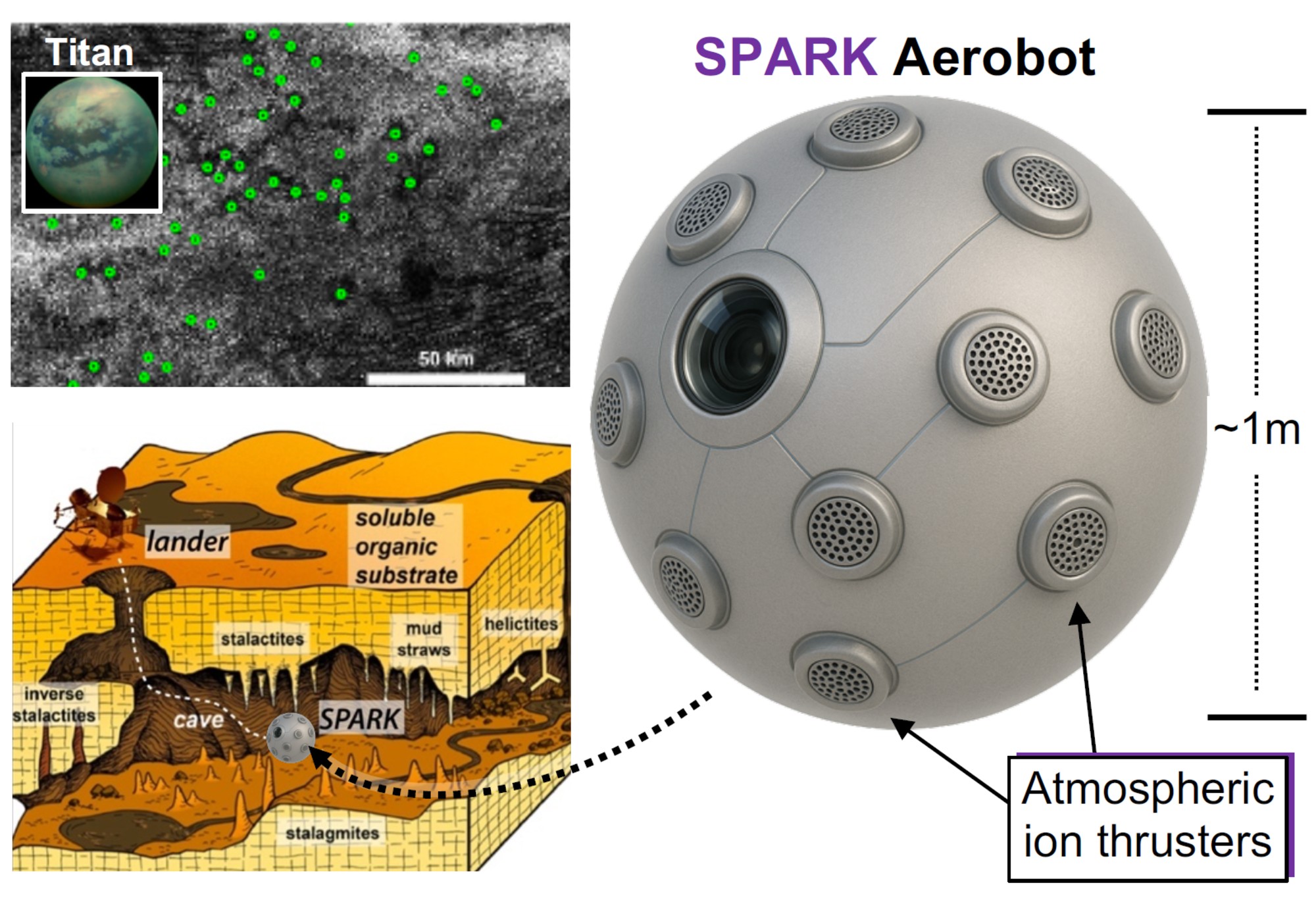
Spherical “Aerobots” may one day swarm the caves of Titan — a moon of Saturn that NASA says is one of the most Earthlike in our solar system.
Titan is covered in rivers, lakes and seas of hydrocarbons, like methane and ethane, as well as a strange “karst” terrain including underground sinkholes and caves. No rover could easily traverse this surface, but flying vehicles may have more success.
So a new grant, under the early-stage NASA Innovative Advanced Concepts (NIAC) program, aims to create small, flying vehicles that could explore those caves. It’s unclear if the aerobots — called SPARK, or Solid-state Propulsion for Autonomous Reconnaissance of Karst — would be ready in time for NASA’s Dragonfly mission to Titan, project lead Daniel Drew, an assistant professor at the University of Hawaii at Mānoa, told Space.com.
That’s because SPARK is beginning a nine-month Phase 1 grant and would need to at least get through the up-to-two-year Phase 2 before things look “more realistic” for a liftoff, he noted. Dragonfly, meanwhile, is targeted for a 2028 launch but if the mission is delayed, that provides more possibilities for late-mission additions.
“Where does that line up with the current Titan mission timeline, assuming we’ve missed the window for Dragonfly? I don’t know,” Drew said of SPARK. But whenever the mission lifts off, Drew said SPARK has a good chance of doing well on Titan with its novel ion (electric) thrusters.
Drew said his design could “provide persistence, maneuverability, robustness to the challenging near-cryogenic [icy] conditions, and minimize downwash disturbance of scientifically-important hydrocarbon layering.” He hopes that SPARK, he added, could be a cave-exploration forerunner at Titan similar to the Ingenuity helicopter on Mars that made 72 flights — more than tenfold what the Red Planet demo mission was supposed to do.
Drew has been working on a particular type of ion thrusters, called electrohydrodynamic (EHD) propulsion, since he did graduate school at the University of California, Berkeley. Thanks in part to a National Science Foundation (NSF) fellowship, Drew explored several designs for flying and became interested in creating robots that flap their wings in a way similar to real-life creatures.
While exploring, he stumbled on the hobbyist “lifter” community “pretty much by chance,” he said. “These [prototypes] are triangular balsa wood, magnet wire, and aluminum foil prototypes. You connect them to 40,000 volts from a flyback transformer that you rip out of a microwave or CRT monitor or whatever, and they can float above the table. There are plenty of examples of people making these on YouTube,” he said.
More plumbing the archives revealed early experiments and studies at NASA and the Air Force similar to what the hobbyists were using. And by coincidence, NIAC awarded funding to another research group, led by the Massachusetts Institute of Technology, that was interested in using EHD propulsion for Earthborne aircraft. As such, Drew sensed a fruitful direction for research.
“Long story short, I ran with that idea,” Drew said, “and wrote a bunch of papers where I created microfabricated centimeter-scale flying robots propelled by atmospheric ion thrusters.” His accomplishments prior to the NIAC grant included what he says is the first demonstration of microfabricated EHD actuators (mechanical devices), and other firsts such as a centimeter-scale “ionocraft” taking off and subsequently, carrying a payload.
“We recently published the design and takeoff of the first ion-propelled micro-hovercraft,” he added, referring to a paper on preprint server arXiv. “That may seem like a pretty decent list of significant milestones, but it’s really not a crowded space of people working on this topic. I’m mostly racing against myself here.”
Now with the NIAC support, Drew said he hopes to dive deeper into the benefits of EHD propulsion, such as its scalability, the fact that it’s virtually silent, and its simplicity (being solid state, there are fewer parts to worry about).
More applications could come outside of Titan, he noted: all-electric aircraft, indoor drones, and mini-flying swarms are just some ideas, but he said the utility will be limited. “The huge weakness is that it just isn’t very efficient,” he said of EHD propulsion. “Barring a major breakthrough, it will be impossible to really compete with more conventional propulsion techniques, like rotors and jet engines, for the vast majority of terrestrial applications.”
As Phase 1 only encompasses about nine months, Drew and his collaborators—including Ethan Schaler and Jacob Izraelevitz from NASA’s Jet Propulsion Laboratory, as well as Michael Malaska from the Blue Marble Space Institute of Science—plan to quickly design experiments, perform a “trade study” of which subsystems are best to prioritize for aspects like power, and model matters like the thermal effects on the power system.
“I think the idea of ‘standing on the shoulders of giants’ is very much ingrained into the NIAC culture,” Drew noted. “Our major contribution at the end of this process is a comprehensive, public report. Leveraging past related reports, and other open research in the field, is critical for doing a good job with this.”