
For over half a century, director Steven Spielberg has dramatized the advent of the extraordinary as either a transformative blessing or a death-dealing curse. In one class of film, humans flee from unimaginable threats they lack the means to resist. Giant sharks, dinosaurs, Nazis, and invaders from Mars terrorize the impotent masses. Rescue arrives only after much bloodletting.
For nearly as long, a separate strain of Spielbergian narrative has moved in a more hopeful direction—often with big-eyed, long-limbed extraterrestrials in tow. In these tales, the uncanny and possibly dangerous gradually resolves into the actively beneficent. A squat visitor from another world heals a fractured family with compassion and a glowing finger. Advanced androids tend to an abandoned Pinocchio-like robot. In another tale developed (though not directed) by Spielberg, tiny flying saucers safeguard an aging couple’s ailing restaurant business.
The film that set the standard for such otherworldly optimism, Close Encounters of the Third Kind (1977), shares much with Spielberg’s latest contribution to the genre. Disclosure Day is outperforming box office predictions 49 years after its predecessor did the same.
Before considering the newest movie, it’s useful to reexamine the blockbuster that prefigured it, alongside an animated feature that lies roughly midway between the two live-action hits.
DreamWorks Animation’s The Prince of Egypt (1998), our very first DVD, landed on our shelf the same year our first daughter arrived. Determined to minimize our kids’ exposure to the sort of TV commercials that shaped our own upbringings in the ’70s, my wife and I collected family friendly titles to sit alongside our growing contingent of VeggieTales disks.
Though Spielberg refused screen credit for Prince of Egypt, he conceived the central premise involving Moses’ Egyptian brother, shaped the film’s style, and even helped out with song lyrics. He also made sure the movie ended with Moses holding the Ten Commandments above a valley filled with Israelites. The Jewish heritage that, because of antisemitism, made Spielberg ashamed in his youth became an inheritance publicly reclaimed with projects like Schindler’s List (1993), and it took primacy in The Prince of Egypt.
This moment on Mount Sinai had appeared, though transmuted into sci-fi spectacle, two decades earlier in Close Encounters. Whereas Star Wars: A New Hope (released earlier in 1977) offers audiences a whimsical romp through a faraway galaxy, Spielberg’s film brings the mysteries of space down to our own planet in sobering fashion. He test-drives what will become stock fare in later horror: eerie lights pushing through keyholes, electronic toys that awaken mysteriously, and gale-force winds that vanish as swiftly as they appear. Once a child is abducted, wonder takes a backseat to terror, stoking smoldering fears about alien invasion.
All of this proves to be smoke and mirrors. What emerges from the billowing clouds above Devil’s Tower in Wyoming, where aliens converge for an interspecies tête-à-tête, both echoes and diverges from the Exodus account. Instead of the voice of God accompanied by thunder and lightning (Ex. 19:9, 16), flashing lights linked to musical tones establish a friendly rapport. Instead of trembling in fear as a smoke-covered mountain shakes, a crowd of scientists and commoners drawn by strange visions of the mountain stand in awe, rapture on every face. In place of stone tablets, the mother ship disgorges abductees taken over the years, no worse for wear (and miraculously unaged), then invites volunteers to journey with them into the great beyond.
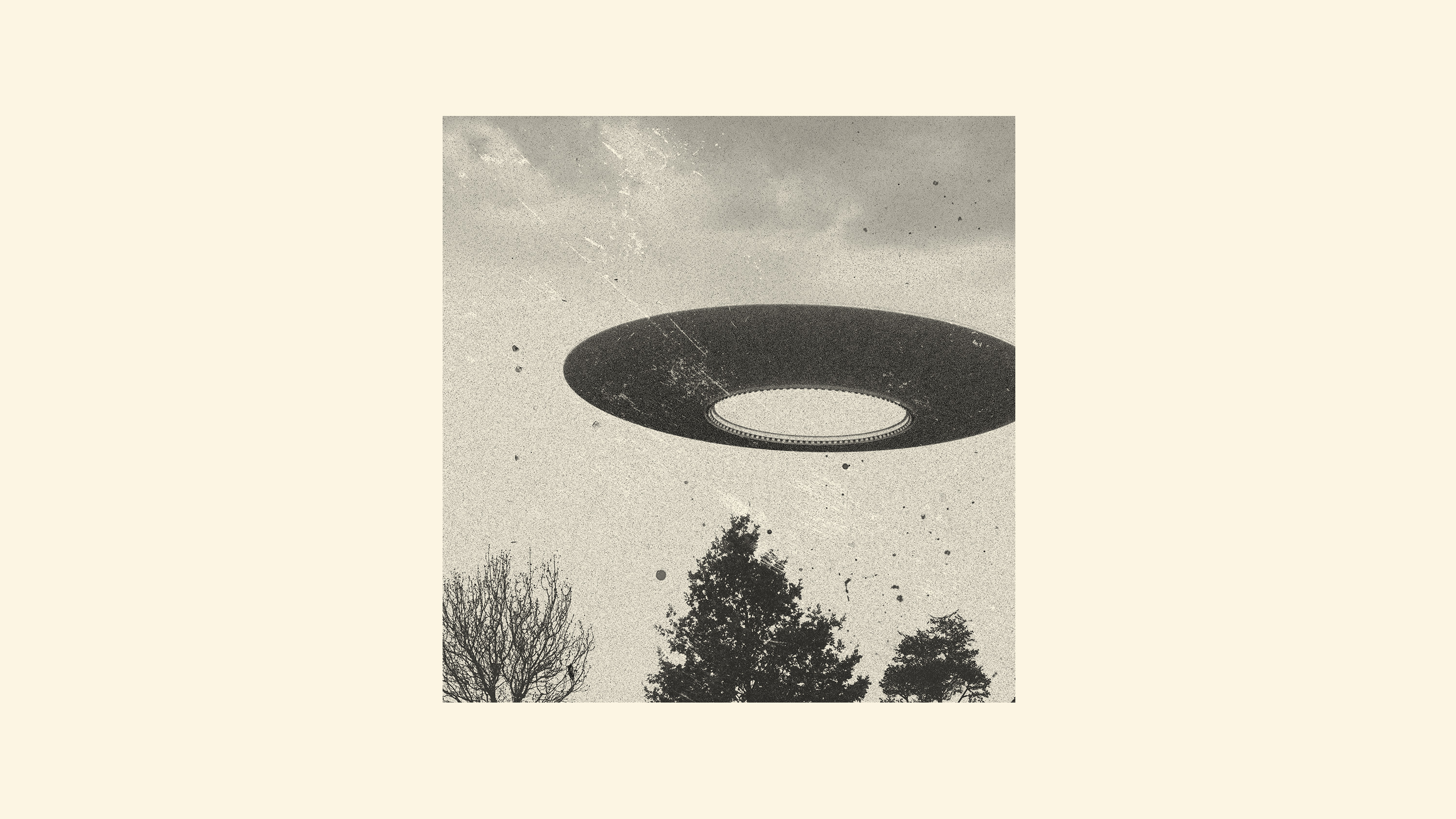

This first-contact scenario involves no fear or trembling and no moral directives, only benign exchange. The film captures a longing for transcendence scrubbed clean of hard choices. (Unlike those who ask Jesus if they can take care of family business before joining him in Luke 9:59–62, Roy, our central character, doesn’t give his wife and kids a second thought before heading to space.)
When it was announced that Spielberg would return to space with Disclosure Day—advertised with a trailer that adopts a similarly serious tone, declaring that “people are starved for the truth” and presenting a room of nuns listening to an announcement about UAPs—I had no idea what to expect. Would the director again position extraterrestrials as an alternative to a divine Creator? Would he continue the critique of evangelical Christianity that he played for comic effect in The Fabelmans (2022)?
Though Disclosure Day appropriates New Testament motifs, it neither parodies nor dismisses the power of Christian faith. Maggie Fairchild gains the ability to speak in tongues she never studied and, Christ-like, reads others’ minds before granting them tailored, compassionate truths. She does not, however, set herself up as a replacement for Jesus. When a Catholic kneels and makes the sign of the cross in front of her, Maggie shrinks: “No! I will not be anyone’s religion!”
Spielberg does not suggest that this human intermediary or the aliens who gave her powers are divine any more than he intimates—as some indeed do—that UFOs are demons. By the film’s close, it’s clear that these telepathic, technologically advanced extraterrestrials are even more physically vulnerable than humans.
related


C. S. Lewis seemed quite ready to accept the existence of other sentient species (possibly fallen, possibly redeemed). One of the nuns we can glimpse in the trailer appears similarly prepared. A novitiate, afraid that proof of aliens would precipitate a mass exodus from the church, reaches out to Sister Maura to ask, “Does He love only us?” Maura responds without missing a beat. Humanity’s distinction as God’s supreme creation on Earth does not preclude the existence of like beings elsewhere. “The universe,” she notes, “is big.”
Not nearly as big, one might add, as our God.
Paul Marchbanks is a professor of English at California Polytechnic State University. His YouTube channel is “Digging in the Dirt.”
The post ‘Disclosure Day’ Doesn’t Discount Belief appeared first on Christianity Today.