

NASHVILLE, TENN. — Mark Adams stood in his office at the Tusculum Church of Christ, quietly rehearsing vocal exercises as worship hymns echoed from the sanctuary on a Sunday morning.
In a few moments, he would step into the pulpit — but first, the minister paused to pray that his voice would not fail him. As the father of two stood before the congregation, the possibility of “locking up” lingered in the back of his mind.
“I wasn’t thinking about what I was preaching,” Adams said. “I was thinking about how I was going to get the words out.”
“I wasn’t thinking about what I was preaching. I was thinking about how I was going to get the words out.”
For more than two and a half years, the preacher has lived with spasmodic dysphonia, a neurological disorder that causes spasms in the vocal cords. The condition affects about 1 in 100,000 people, causing speech to sound strained and gravelly — especially under stress.
Through quarterly Botox injections, Adams has experienced periods of vocal improvement, though the disorder remains incurable.
‘My voice wasn’t doing what I needed it to do’
The first signs of the disorder appeared in late 2023, about a year after Adams’ arrival at Tusculum Church of Christ in 2022. He and his wife, Carolina, had recently welcomed their second child and were navigating a period of leadership transition within the church.
As stress mounted, subtle changes in his voice emerged. The pitch would rise unexpectedly, sometimes to the point of breaking or clenching.
“You don’t really know what’s going on, but it just keeps getting gravelly or kind of clenching up,” Adams said.
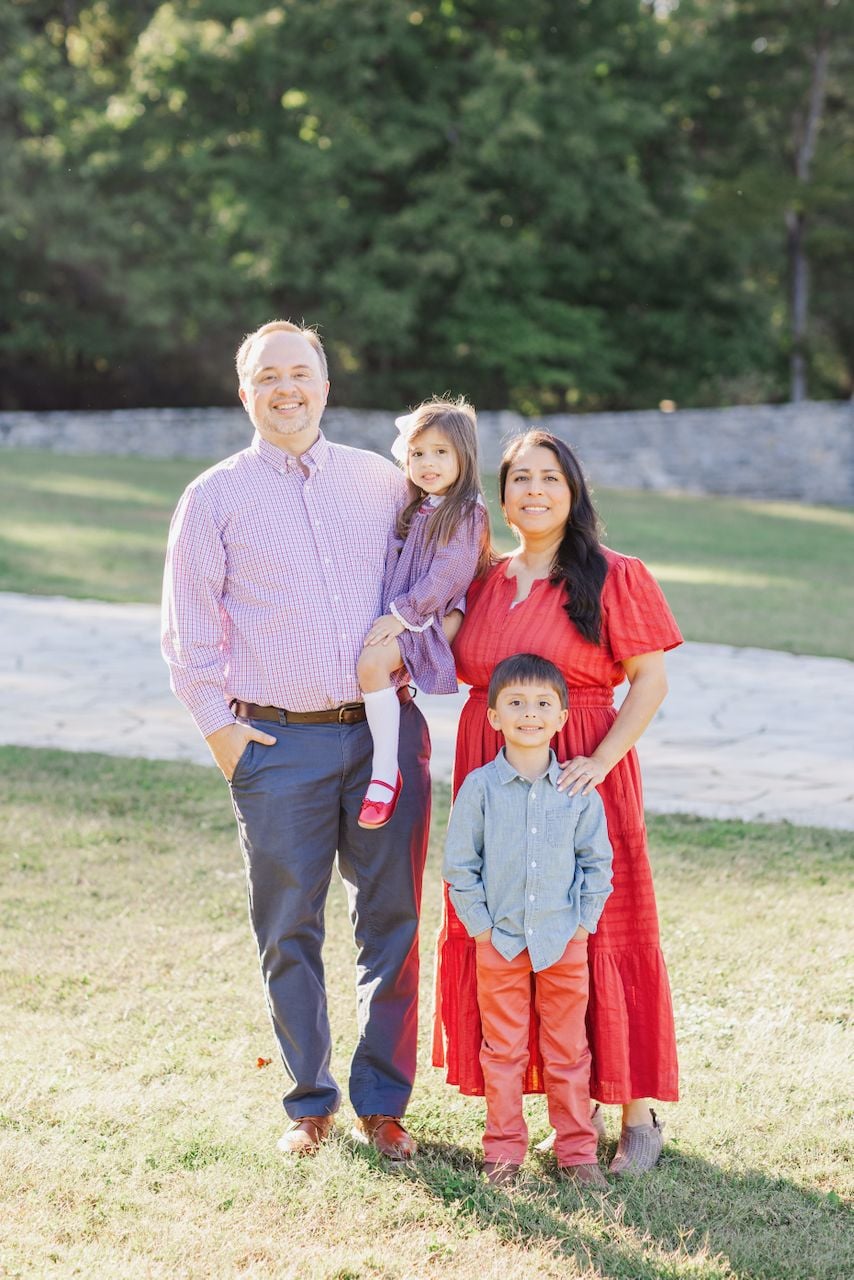
Mark Adams, his wife Carolina, son Xoaquincito and daughter Olivia pose for a family photo.
Adams scheduled a laryngoscopy to examine his vocal cords and voice box. The exam found no signs of cancer, but doctors initially diagnosed him with muscle tension dysphonia, a disorder in which tension around the larynx affects vocal output.
The minister then entered six months of speech therapy from January to June 2024, working through exercises designed to reduce strain. The therapy temporarily improved his voice, allowing stable preaching through the summer.
But the improvement would prove short-lived.
As fall approached, Adams noticed vocal spasms and breaks while he stood before the Tusculum congregation.
“It just felt like my voice wasn’t doing what I needed it to do,” he said.
‘What good is a preacher who can’t talk?’
As summer gave way to fall, the stability Adams had described as “mostly OK-ish” was upended by a personal tragedy involving a friend, which intensified the strain on his voice. He returned to speech therapy and mental health counseling to help manage stress.
By late fall, Adams said, the spasms had become like a “vice grip.”
“It was getting to the point where I could hardly say anything,” he said.
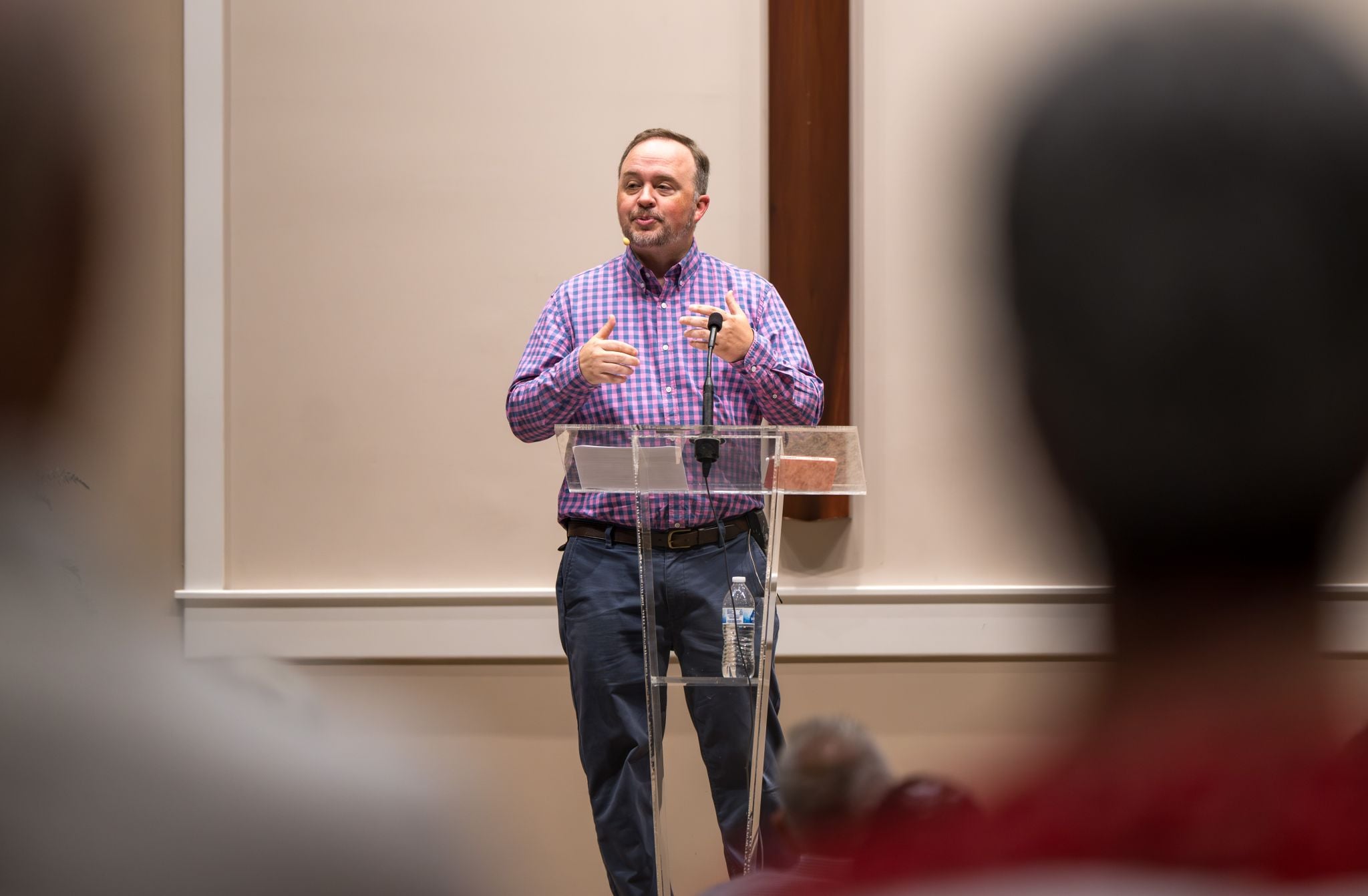
Mark Adams preaches at Tusculum Church of Christ.
With the strain at its highest, six months of voice therapy followed. Outside of therapy sessions, Adams made a point to consistently practice vocal exercises in his daily routine.
“Every Saturday night, he would spend like an hour practicing exercises to get his voice going for Sunday,” Carolina Adams said. “He would come out saying, ‘I feel very good,’ and then on Sunday, when he would get up there, it would lock.”
The preacher relied on a mix of technology and vocal techniques to support his voice on Sundays. He used tools like ChatGPT to edit paragraphs in his sermons, adding certain sounds to open his vocal cords, and wrote notes in his outlines to lower his pitch, in an effort to prolong his ability to preach.
“Every Saturday night, he would spend like an hour practicing exercises. … He would come out saying, ‘I feel very good,’ and then on Sunday, when he would get up there, it would lock.”
Before Sunday morning services, Adams took time to rehearse vocal exercises in his office, not entering the sanctuary until the Lord’s Supper directly before the sermon began.
At Tusculum, the ministry God had called him to felt increasingly uncertain. If speaking itself became unreliable, then preaching — built on his voice — was now in question.
“What good is a preacher who can’t talk?” Adams wondered.

Mark Adams shows a slide of the Plessy v. Ferguson case on the projector screens during a sermon.
As the minister began preaching the Gospel, he recalled members of the congregation wincing as the sermon progressed. Although the condition itself isn’t painful, the hoarseness worried members, such as church elder Greg Petree.
“You just felt for him,” Petree said. “You could tell he wanted to finish and deliver a strong message of Christ.”
Regardless of struggles in the pulpit, the elders and members of the congregation rallied around their minister. The elders met with Adams and assured him that he would have a ministry role within the church, with or without his ability to preach.
“My fish may feel rotten, and my loaves may feel dried up and old, but I’m just going to keep bringing them to Jesus.”
Sunday after Sunday, despite constant vocal exercises and preparation, no upward trend in his voice was observed. With progress stalled — and at his lowest point — he began to reshape his self-perception while holding onto his faith in God.
“My fish may feel rotten, and my loaves may feel dried up and old, but I’m just going to keep bringing them to Jesus,” Adams said.
As months passed without answers, he found refuge in knowing that God was present even as uncertainty persisted.
‘A walk-by-faith process’
The Adams family decided to get a second opinion and made an appointment at the Vanderbilt Voice Center, one of the nation’s leading clinics for voice disorders.
In spring 2025, pathology specialists identified what months of therapy and exercises had failed to uncover. Adams did not have muscle tension dysphonia. Instead, doctors diagnosed him with spasmodic dysphonia.
“The diagnosis did have the immediate effect of liberating me from the guilt trip I was placing on myself,” Adams said. “I could do speech therapy for 10 years, and I wouldn’t get any better.”
Spasmodic dysphonia has no cure, and the only treatment options include Botox treatments that weaken overactive vocal cord muscles. According to the National Library of Medicine, Botox treatments result in an average improvement of speech quality in 65% of cases.
Through the uncertainty, members of the Tusculum congregation and its elders continued to support Adams and his family, leading to a churchwide announcement of his diagnosis in June 2025. The elders joined him on stage as the congregation prayed for the minister.
“It was such a uniting thing to be able to go to God together for someone,” said Lara Lasher, a friend of the Adams family and a Tusculum member. “At a time when our world is so divisive, it was refreshing to come together and pray for something.”
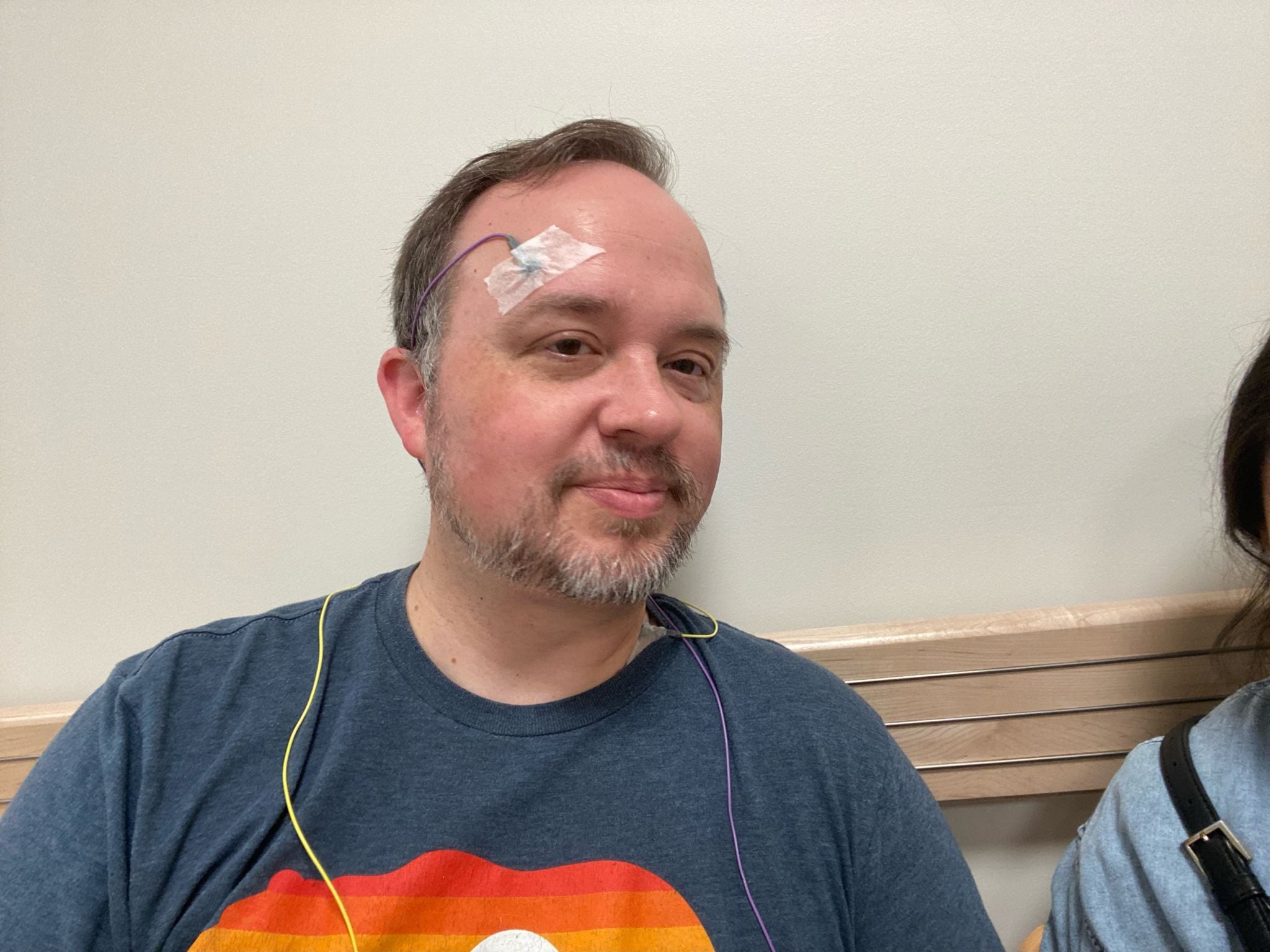
Mark Adams wears an EKG electrode attached to his head moments before receiving a Botox injection as part of his treatment.
With prayers of the congregation behind him and his family, the minister pursued Botox treatments in the weeks following his diagnosis. At Vanderbilt, patient appointments backed up for months. But a spot opened up, and the minister’s first Botox injection was scheduled within two weeks.
The results of the first injection brought noticeable improvement. Although his voice was no longer as booming as before, speaking became smoother, restoring the confidence lost in the months of ambiguity.
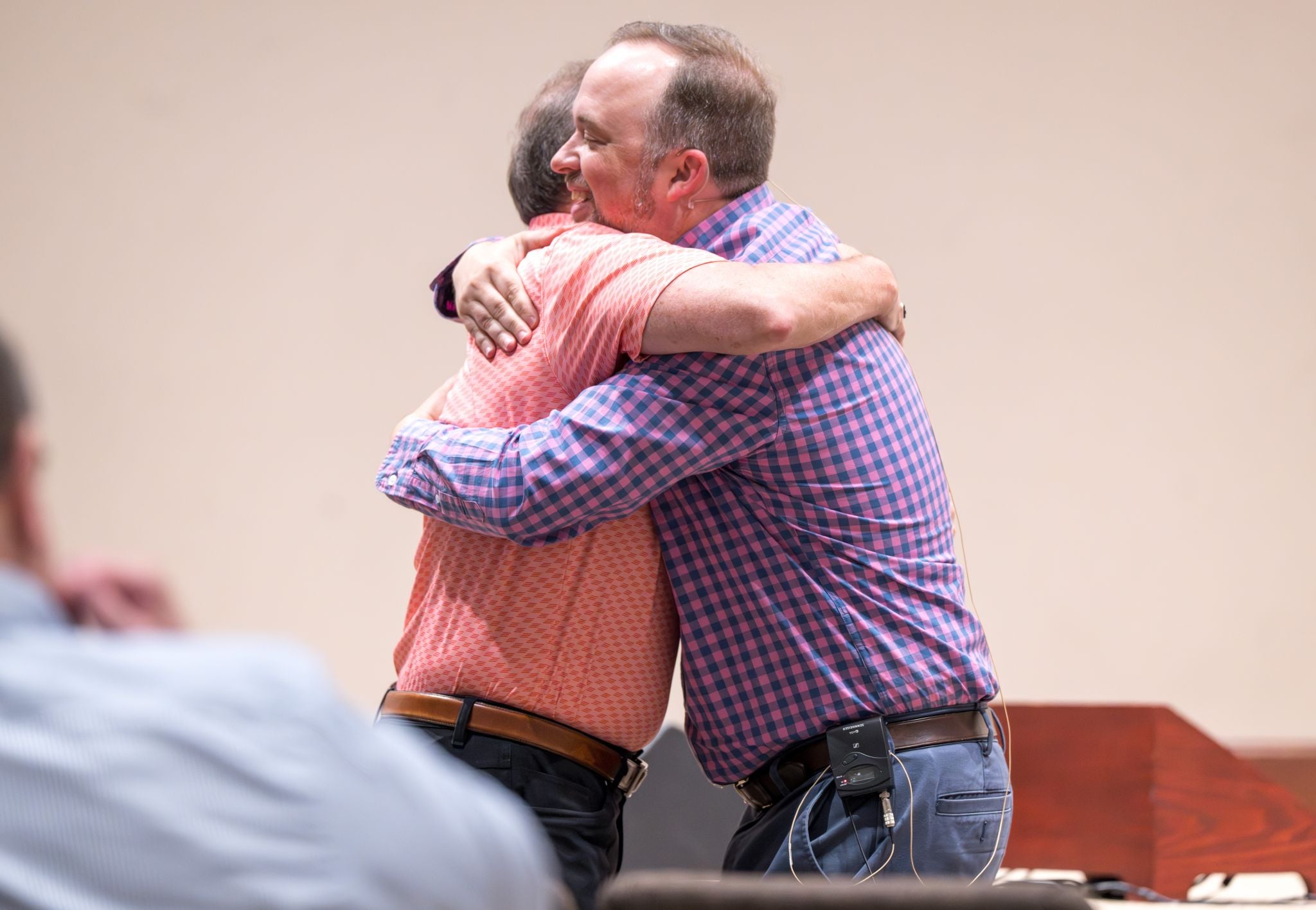
Mark Adams hugs a member of the congregation during a Sunday sermon.
Alongside his Botox injections, the minister takes a lead role in the Nashville Dysphonia Support Group, which provides a space for discussion and community for people with dysphonia and related voice disorders. The group meets at Tusculum Church of Christ quarterly.
“It continues to be kind of a walk-by-faith process,” Adams said. “I’ve now had four injections, and every one has been a little different.”
Today, the Tusculum minister continues to receive quarterly Botox treatments to maintain his voice and avoid vocal spasms. Most Sundays, he can preach without noticeable symptoms, and he no longer walks into the pulpit wondering if he will be able to finish his message.
“So if this is the voice God has given me to express His love to the world, then I’m going to keep speaking, as best I can, even in my weakness.”
He no longer measures his ministry by his voice alone — but by faithfulness.
“So if this is the voice God has given me to express His love to the world, then I’m going to keep speaking, as best I can, even in my weakness,” Adams said.
EPHRAIM RODENBACH, a sports journalism major at Middle Tennessee State University in Murfreesboro, Tenn., is a Christian Chronicle intern. Contact ephraim@christianchronicle.org.