

BOURBON COUNTY, KY. — By the thousands, the believers came — Baptists, Methodists and Presbyterians among them.
In covered wagons and carriages, pioneer settlers traveled to the backwoods of Kentucky for a weeklong camp meeting orchestrated by a 28-year-old Presbyterian clergyman named Barton W. Stone.
The Cane Ridge Revival of 1801 — dubbed “America’s Pentecost” by the late historian Paul Conkin — emerged as a pivotal moment in the birth of the Restoration Movement.
This is part of a series exploring the identity of Churches of Christ. Read more here.
In the second week of August, Stone and other ministers who spoke at Cane Ridge, about 20 miles east of Lexington, endeavored to put aside confessions and creeds and simply preach Christ.
To celebrate the revival’s 225th anniversary, a crowd of about 200 filled the Cane Ridge Meeting House, where the Stone Memorial Building now encases the restored one-room log church originally built in 1791. Attendees parked in the grass alongside State Highway 537, surrounded by tobacco, soybean and corn fields.
The gathering this past Saturday drew members of a cappella Churches of Christ, independent Christian Churches and the Christian Church (Disciples of Christ). All three groups trace their modern-day roots to the Restoration Movement, also known as the Stone-Campbell Movement.
“We are so glad that you have made the journey here, where 225 years ago … on this very ground, something happened that changed the shape of American religious life and gave birth to the movement that many of us in this room call our faith home,” said Joel Brown, president of the Disciples of Christ Historical Society in Bethany, W.Va., the event’s organizer. “We are here today to remember that moment, to learn from it and to let it speak to us again.”
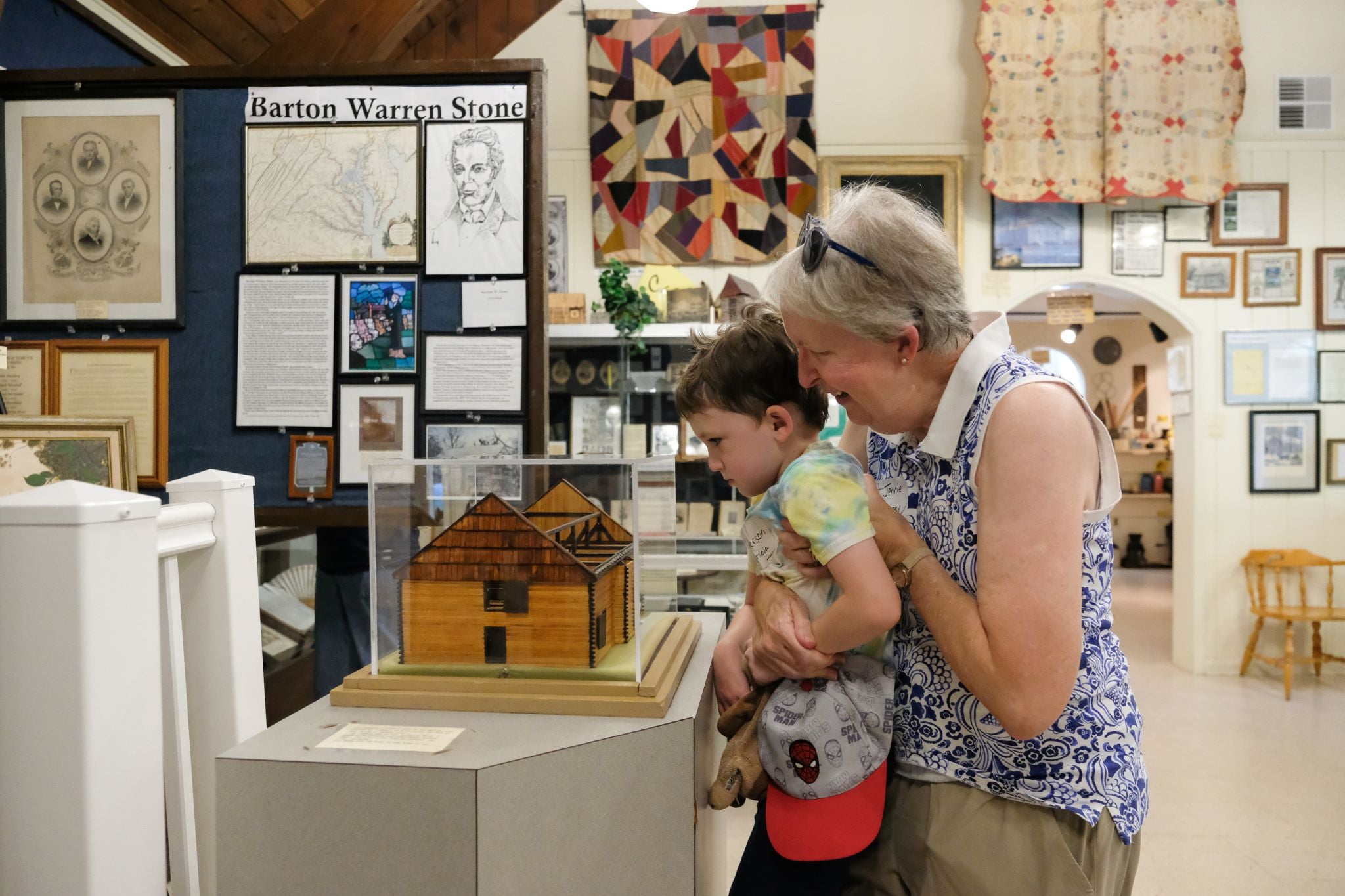
Jennie Shirey lifts Emerson Marsala, her 4-year-old grandson, so he can view a miniature replica of the Cane Ridge Meeting House in the Barton Warren Stone Museum in Bourbon County, Ky.
The a cappella Churches of Christ and the independent Christian Churches each comprise roughly 1 million baptized members in the U.S., according to national surveys. Precise numbers are difficult to ascertain because of the autonomous nature of the individual congregations.
The Christian Church (Disciples of Christ) denomination claims 600,000 members in the U.S. and Canada, according to its website.
Kentucky Gov. Andy Beshear, who has served as a deacon for the Beargrass Christian Church, a Disciples of Christ congregation in Louisville, sent a video message on Cane Ridge’s significance.
“This was an event that crossed denominational lines, uniting different groups in shared worship and communion, and it happened in a rural community just outside of Paris, Ky.,” Beshear said. “That unity of the revival is just as important now as it was in 1801.”

Attendees return to the Cane Ridge Meeting House after lunch during the 225th anniversary celebration in Bourbon County, Ky.
‘Our original sense of unity’
A quarter-century after the Cane Ridge Revival, Stone reflected on it in an 1827 article in the Christian Messenger, a magazine he started.
“The doctrine preached by all was simple, and nearly the same,” wrote Stone, who in 1832 fused his Christian unity movement with that of another reform-minded minister, Alexander Campbell. “Free and full salvation to every creature was proclaimed. All urged faith in the gospel, and obedience to it, as the way of life.
“All appeared deeply impressed with the ruined state of sinners, and were anxious for their salvation,” the author added. “The spirit of partyism, and party distinctions, were apparently forgotten. . . The spirit of love, peace, and union, were revived. You might have seen the various sects engaged in the same spirit, praying, praising, and communing together, and the preachers in the lead. Happy days!”
Related: Why the Cane Ridge Revival still matters
Scholars representing all three major branches of the Restoration Movement spoke at the 225th anniversary event.
The two from Churches of Christ were John Mark Hicks, a retired theology professor at Lipscomb University in Nashville, Tenn., and James L. Gorman, director of the Center for Restoration Studies at Abilene Christian University in Texas.
Cane Ridge “still matters to our fellowship for several reasons,” Hicks told The Christian Chronicle.
“The event formed our original sense of unity that transcends partyism, provides an alternative vision of the Holy Spirit’s work than what came to dominate Churches of Christ in the 20th century and reminds us of the constant need for evangelistic revival and renewal among disciples of Jesus,” he said.
By partyism, Hicks explained that he meant “a sectarian denominationalism, allegiance to the party (specific denomination) that draws lines of fellowship and communion table as hard boundaries.”
Mac Ice, director of special collections and archives at ACU, put it this way in an email: “It is not too much to say there is no Restoration Movement without Cane Ridge.”
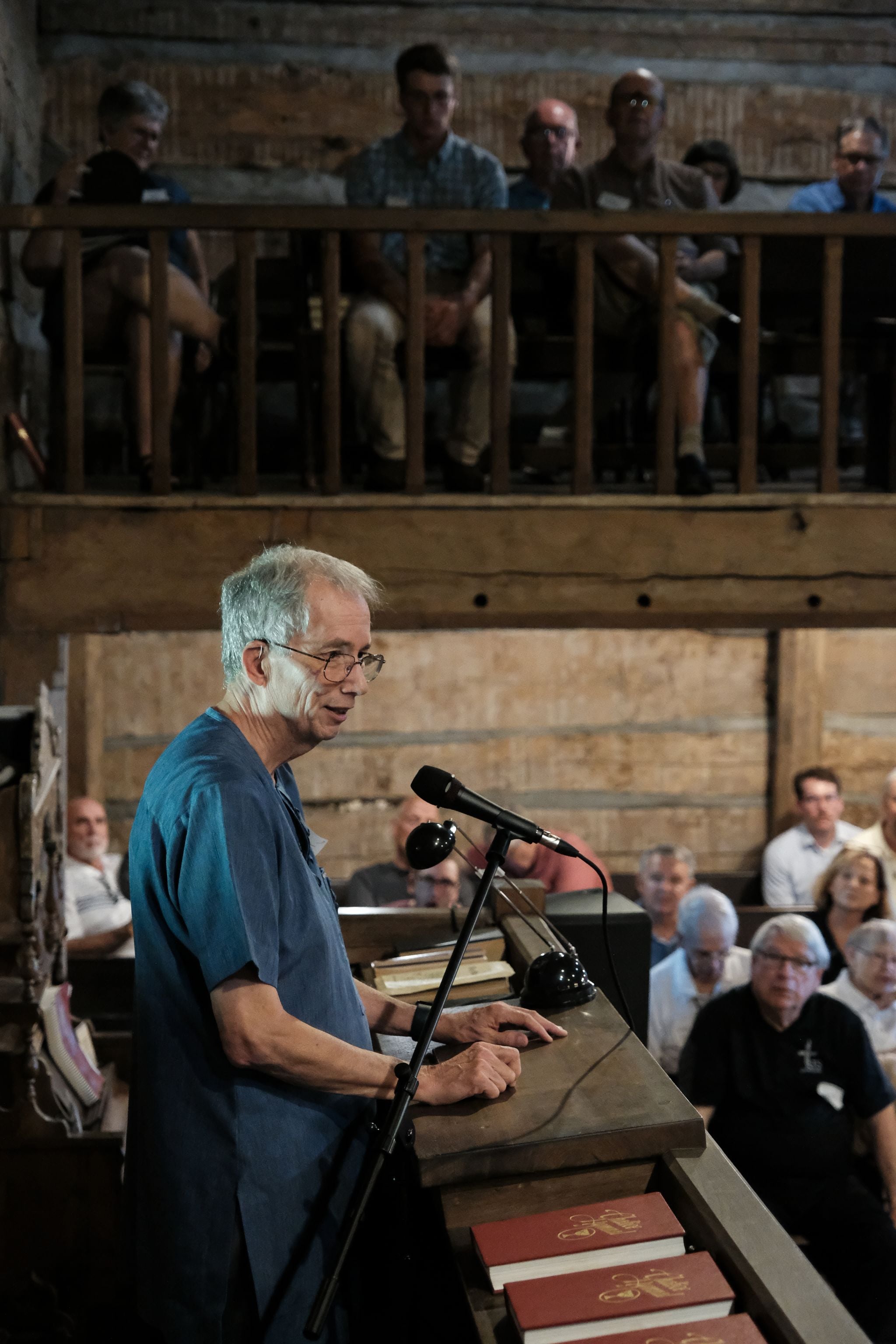
John Mark Hicks, a retired theology professor at Lipscomb University in Nashville, Tenn., speaks during the 225th anniversary celebration at the Cane Ridge Meeting House in Bourbon County, Ky.
Differences and connections
Inside the Cane Ridge Meeting House, the anniversary crowd waved handheld fans in the steamy old church, which has no air conditioning.
At lunchtime, attendees enjoyed box lunches in the 89-degree heat — in the shadow of Stone’s gravestone — and perused the artifacts and exhibits in the nearby Barton Warren Stone Museum.
Roughly three-quarters of the participants came from the Christian Church (Disciples of Christ), but a few from Churches of Christ made it a point to attend.
Greg and Kathy Pauley met at Harding University in Searcy, Ark., over a half-century ago and attend the Southside Church of Christ in Lexington.
“I literally do not know when I started reading about the Cane Ridge encampment and all the things that flowed from that,” said Kathy Pauley, 76, a grandmother of 11. “I don’t remember any particular professor at Harding bringing it up. … But I always knew that it was important.”
Despite living in Kentucky for 24 years, she’d never made it to Cane Ridge.
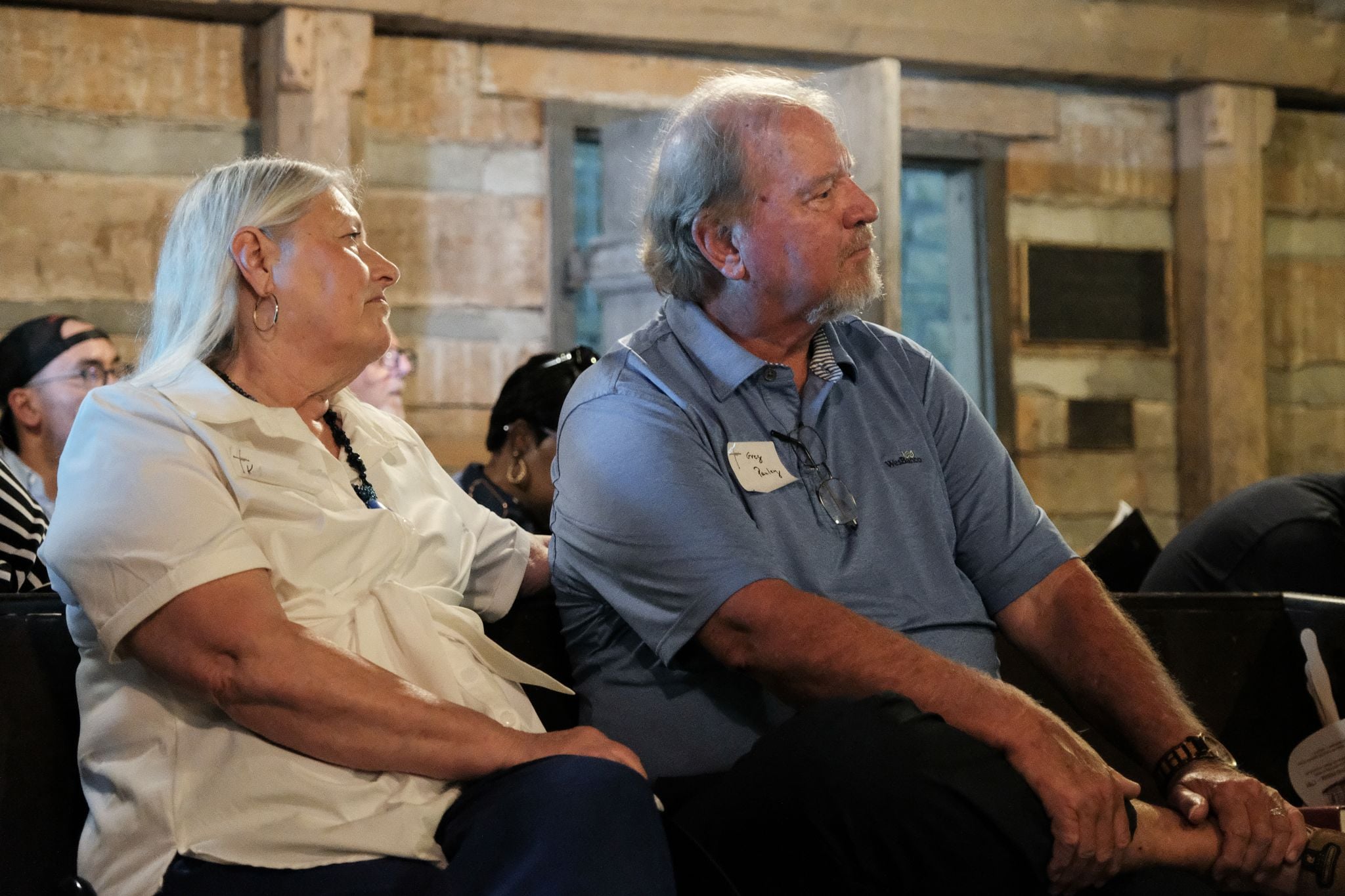
Kathy Pauley and her husband, Greg, listen to speakers delving into the Cane Ridge Revival at the 225th anniversary celebration in Bourbon County, Ky.
“I knew it was right down the road, but this is our first time,” she said, “and my husband is here because I said, ‘Honey, I signed us up.’”
Greg Pauley said he welcomed learning more about Cane Ridge and gathering with fellow believers, even those with whom he has theological differences.
“It’s just so important to me to understand both sides,” he said, “and these presentations today, it was just like, ‘This is good.’”
Two ministers from the Canadian province of Ontario — Murray Hibbard of the Guelph Church of Christ and Glen Robins of the Stoney Creek Church of Christ — drove roughly 550 miles to attend.
Hibbard picked up Robins that Friday afternoon at Camp Omagh, where Hibbard had taught children’s Bible classes all week. Then the ministry friends returned home in time for each to preach Sunday morning.
“I’ve just always loved our history,” Robins said of why he wanted to mark the Cane Ridge anniversary.
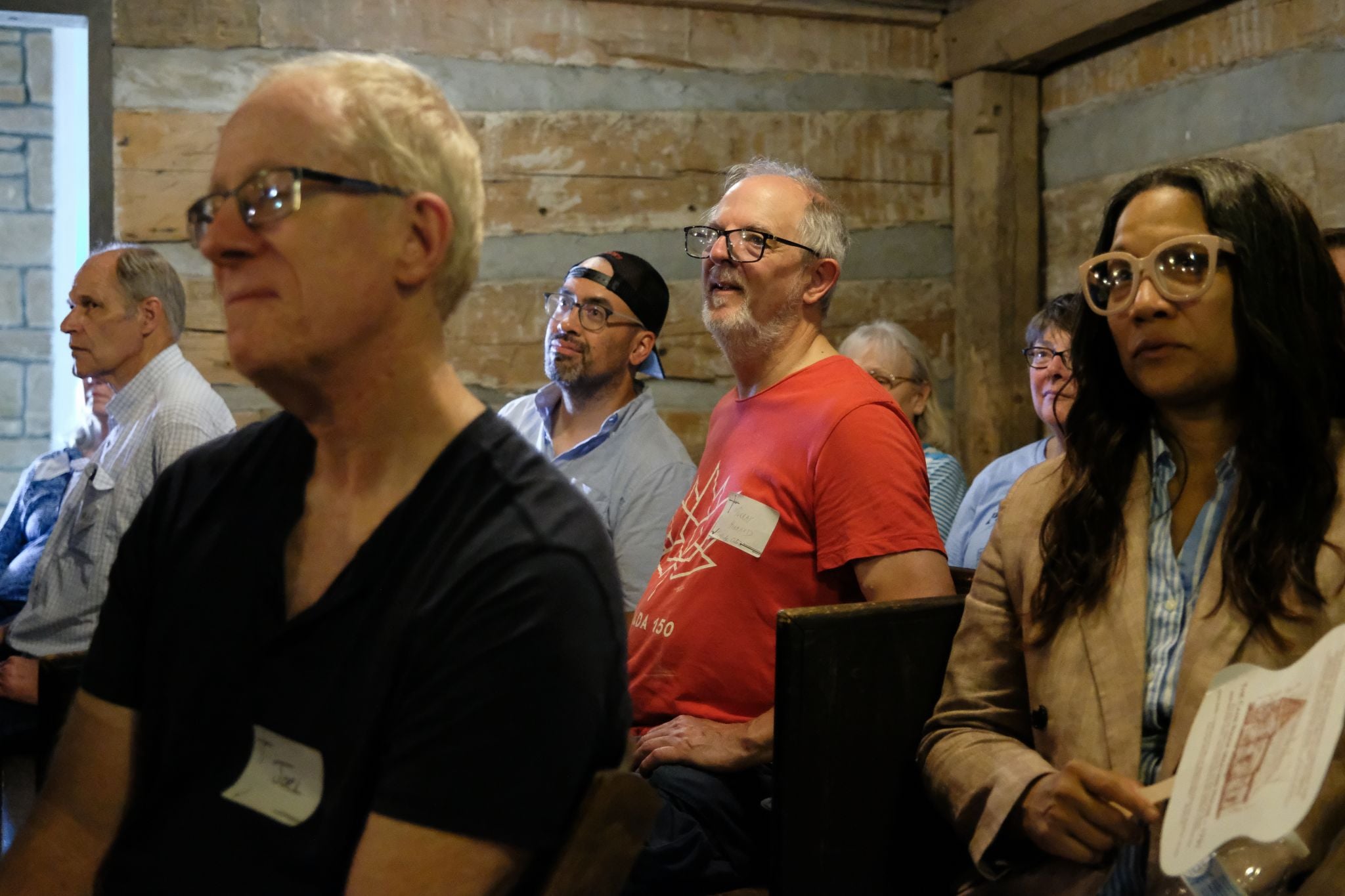
Revival in Bourbon County, Ky.
“It’s been great,” he added. “I appreciate that they were intentional about representing all three major streams.”
Hibbard echoed his fellow Canadian’s sentiments.
“I kind of wish our own had more attendance,” he said, “but it is what it is.”
For what it’s worth, connections among those of the differing streams often overlap.
Brown, the Disciples of Christ Historical Society president, grew up in the a cappella Vancouver Church of Christ in Washington state, where his father, Craig, served as the preaching minister for 20 years.

The Christian Chronicle’s Bobby Ross Jr. interviews Joel Brown, president of the Disciples of Christ Historical Society, outside the Cane Ridge Meeting House in Bourbon County, Ky.
The younger Brown attended Columbia Christian School in Portland, Ore., across the Columbia River from Vancouver, and later earned undergraduate and graduate degrees at ACU.
“I think in my experience, having been in Churches of Christ and the Disciples, the Disciples who have been Disciples for a long time have more of a recognition of a place like Cane Ridge,” Joel Brown told the Chronicle. “But I will say that … there is a much more robust group of scholars who are studying Stone-Campbell history in Churches of Christ than there is in Disciples of Christ.”
BOBBY ROSS JR. is Editor-in-Chief of The Christian Chronicle. He traveled to Kentucky to report this story. Reach him at bobby@christianchronicle.org.
More photos
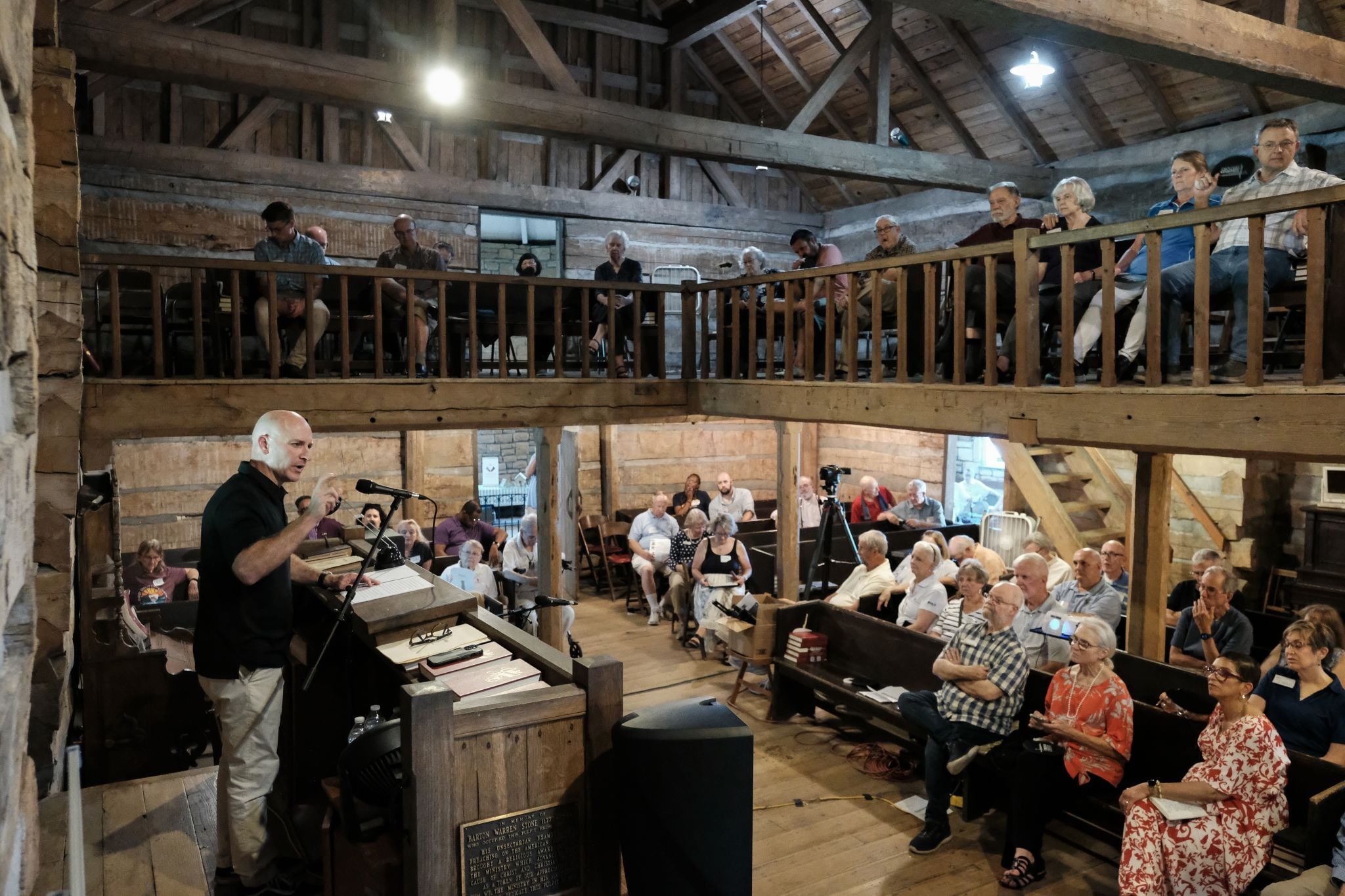
James L. Gorman, director of the Center for Restoration Studies at Abilene Christian University, gives a lecture on interracial revivalism and women exhorters at the 225th anniversary celebration of the Cane Ridge Revival in Bourbon County, Ky.

Don Reynolds rests inside the Barton Warren Stone Museum between speakers at the 22th anniversary celebration.

James Trader, curator of the Cane Ridge Meeting House, exits the 18th century wooden building.
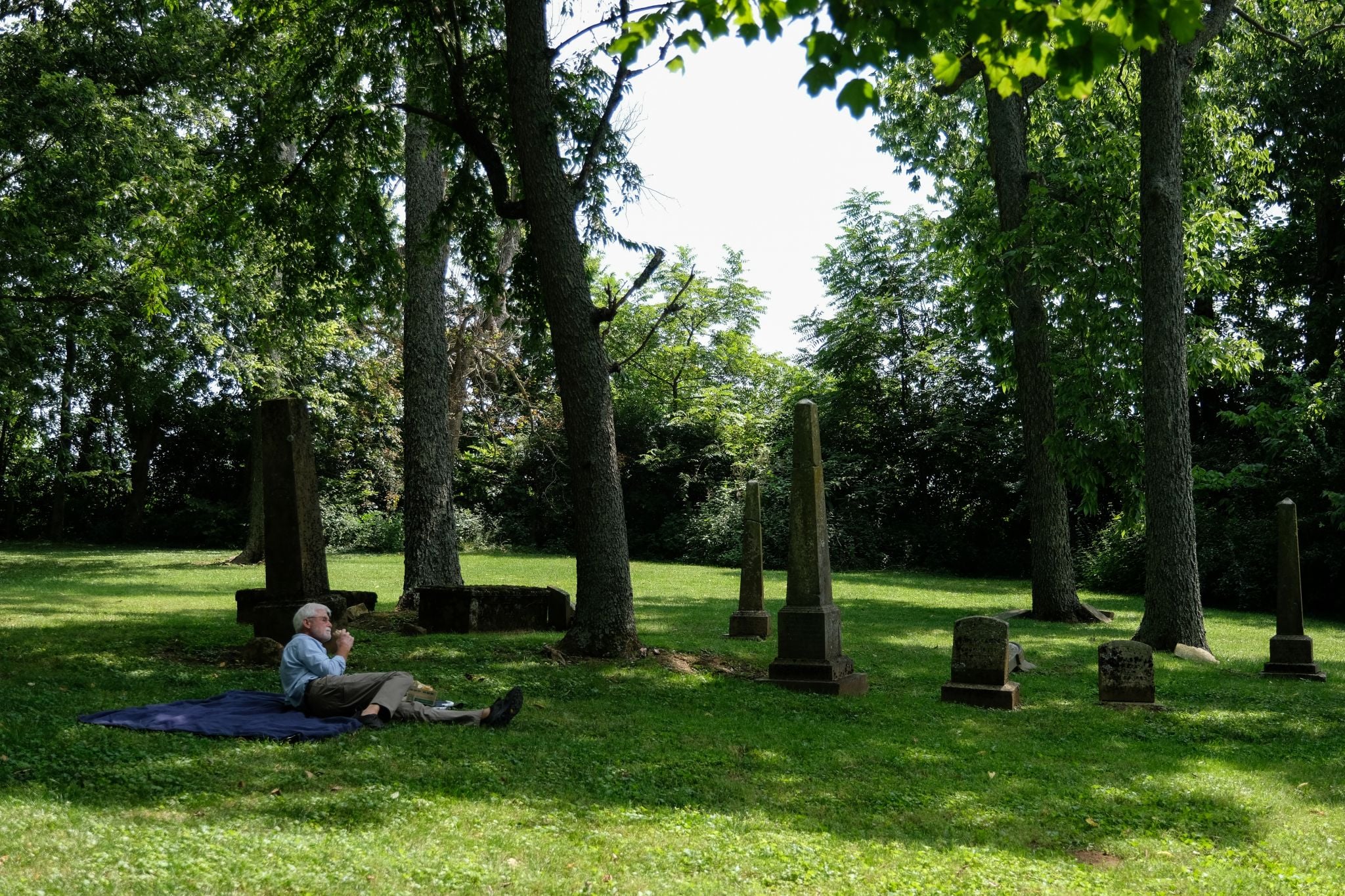
A man picnics amongst 19th century obelisk gravestones during lunch at the anniversary event.

Kelly Johns and Dave Carr talk in front of the building that encases the Cane Ridge Meeting House.
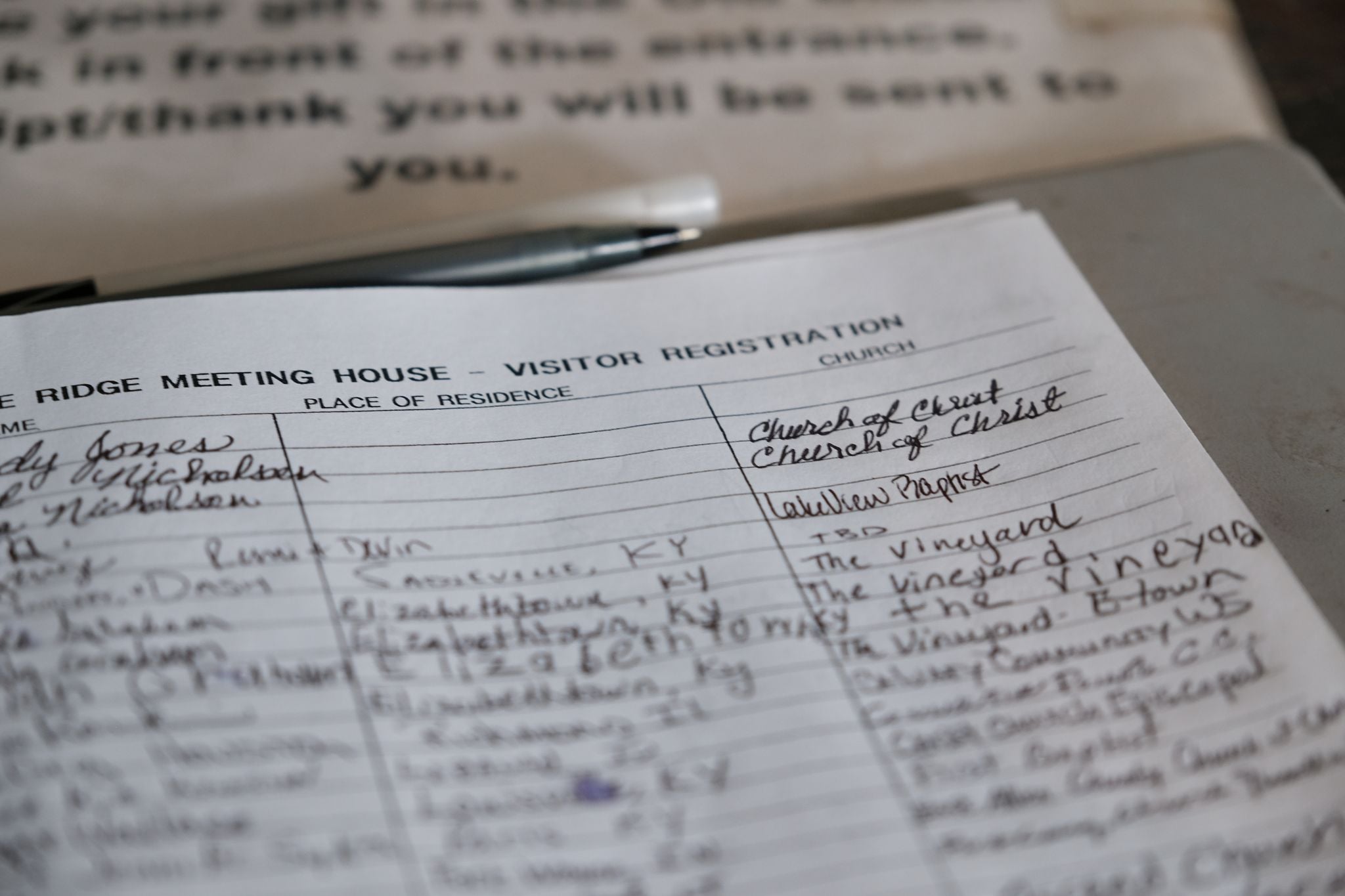
A sign-in sheet greets guests who visit the Cane Ridge Meeting House.

The lobby of the Stone Memorial Building, which encases the restored Cane Ridge Meeting House, a log church originally built in 1791.