
Rocket Lab has completed a major qualification test for its formidable Archimedes engine, which will power the company’s next-gen Neutron launch vehicle.
As Rocket Lab continues with regular launches of its workhorse small-lift Electron rocket, development of Neutron has carried on in the background, progressing toward a possible debut later this year. The company recently completed a full-duration burn of a second-stage Archimedes, paving the way for integration with Neutron in the coming months.
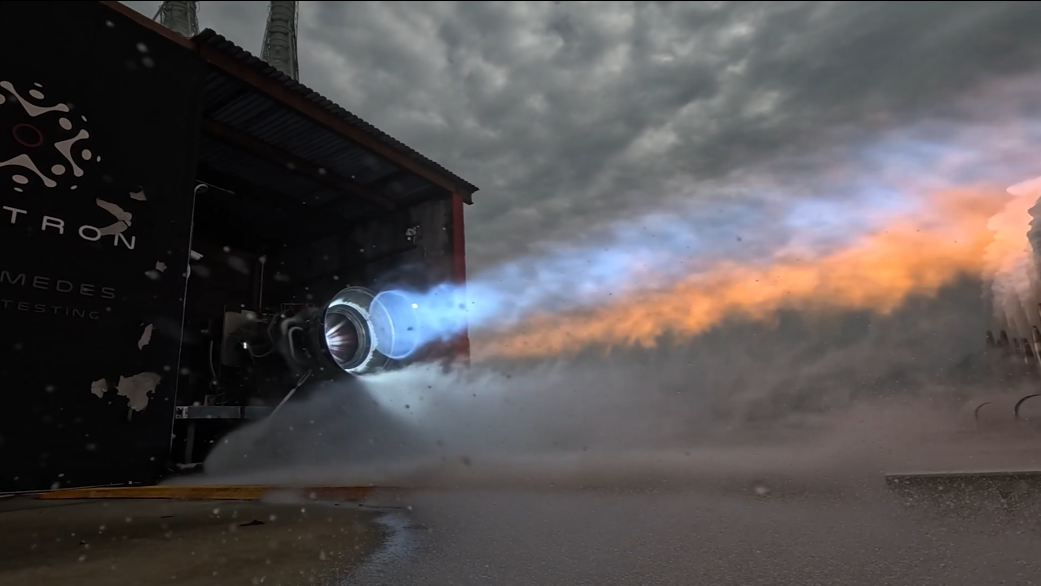
The burn took place at Rocket Lab’s Archimedes Test Complex, housed at NASA’s Stennis Space Center in Mississippi. The full-duration test aimed to simulate flight-like requirements and lasted just under 5.5 minutes. “What a thing of beauty,” the company said in a July 13 social media post announcing the success, calling it a “critical preparation for Neutron’s first flight.”
Neutron is equipped with eight Archimedes engines on its first stage, which together provide nearly 1.5 million pounds of thrust at liftoff. The output of each is comparable to that of each Merlin 1D engine, which powers the first stage of SpaceX‘s Falcon 9 rocket. Like the Falcon 9, Neutron is also designed for partial reusability: Its first stage will be capable of returning for landing back at its launch site or on droneship vehicles stationed at sea.
The vehicle’s second stage, however, is unique compared to other rockets. Conventional launch vehicles secure their payloads inside protective fairings that fall away from the rocket completely once damaging aerodynamic forces disappear in the vacuum of space. But Neutron’s fairing halves separate like a clam shell. Rocket Lab has dubbed the system the “Hungry Hippo,” after the popular children’s game.
Neutron’s fairings are also unique in the way they house the rocket’s second stage, which emerges from the open fairing jaws to provide its payload a final push into orbit. A single vacuum-optimized Archimedes (AVac) powers Neutron’s second stage. It features an engine bell that stretches about eight feet (2.5 meters) taller than the rocket’s first-stage engines and produces 1.2 times the thrust of its first-stage counterparts in a vacuum.
Archimedes second stage engine full duration burn – complete ✅ (and what a thing of beauty). The AVac (Archimedes Vacuum) engine produces 1.2x lbf of its Stage 1 variant and stands ~2.5m taller thanks to its extended nozzle optimized for the vacuum conditions of space.Recent… pic.twitter.com/zFb6cKNy1gJuly 14, 2026
For the recent engine test, Rocket Lab installed a shorter sea-level variant skirt on the AVac to compensate for its grounded altitude, which can expose the full-length nozzle to “flow separation and instability,” the company’s post said. “Stub skirts are used to anchor our engineers’ analysis for how the engine will perform with the full nozzle in vacuum conditions.”
Rocket Lab had targeted late 2025 for Neutron’s debut but pushed that date to the first half of 2026 as last calendar year was approaching its end with the rocket far from being ready for launch. Neutron’s timeline suffered another blow in January, when the main stage tank ruptured during a pressure test taking place at the company’s Wallops, Virginia, launch facility.
Setbacks aside, Rocket Lab founder and CEO Peter Beck has repeatedly voiced his stance that the Neutron team is focused on reaching orbit when the vehicle is ready, not meeting an arbitrary target date.