

If you still picture Mars as a monotonous red desert, it may be time for an update.
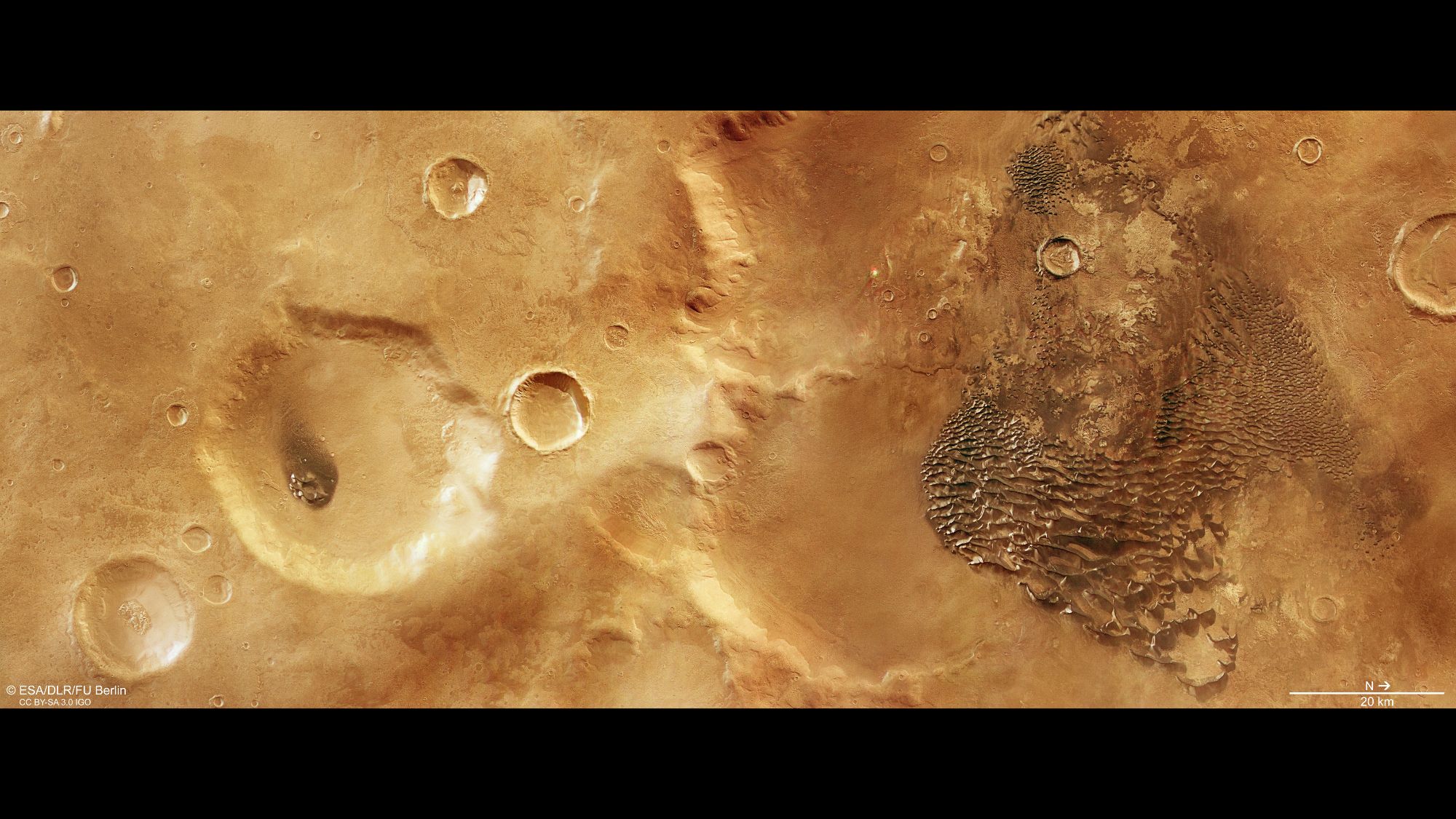
The European Space Agency’s Mars Express orbiter has been capturing some of the Red Planet’s most surreal landscapes, and its latest images reveal a sprawling field that looks like molten metal frozen across the floor of an ancient Mars crater.
The shimmering “waves” aren’t metal at all, however. They are dark sand dunes dusted with seasonal frost, much of it carbon dioxide, or “dry ice,” that settles on the surface during Martian winters, giving the dunes their uncanny chrome-like sheen, according to ESA.
The rest is a trick of light and contrast. Because the dark sand absorbs light and the white frost reflects it, the interplay transforms the landscape into something that looks more like a scene from a sci-fi movie than a windswept Martian plain.
Over thousands of years, Martian winds have sculpted this volcanic sand into dunes that now ripple through the floor of Kaiser Crater, a 129-mile-wide (207-kilometer-wide) impact basin in the planet’s southern highlands. The bowl-shaped crater acts as a giant sand trap that prevents the sand from escaping, according to NASA.
The dunes themselves are darker than much of Mars‘ surface because they are made of fine, basaltic sand rich in volcanic minerals such as pyroxene and olivine, rather than the iron-oxide dust that gives the planet its familiar rusty-red appearance and its famous moniker, the Red Planet.
Because the crater floor remains visible between the ridges, scientists think there is a relatively limited sand supply shaping the field. Still, these ripples of sand are massive, extending for several kilometers and towering more than 100 meters (320 feet) above the surrounding terrain.
The landscape isn’t just visually dramatic, it also preserves clues to a time when Mars was a very different world.
Today, Mars is wrapped in an atmosphere little more than a thin veil that is 100 times thinner than Earth’s and slowly leaking into space. That makes it harder for winds to lift and transport sand than it is on our own planet. Yet the soaring dunes inside Kaiser Crater show that Martian winds have nonetheless been powerful enough to sculpt vast landscapes over time, perhaps during a period when the Martian atmosphere was thicker a few billion years ago.
The new image adds to a growing collection of striking Martian scenes captured by Mars Express, which has been orbiting the Red Planet since 2003. Just last month, the probe tracked a frenetic cluster of 30 dust devils swirling through the canyons of Mamers Valles, also in the northern hemisphere.
Over the spring and summer, the orbiter similarly spotlighted the planet’s vast and complex geological history, from Shalbatana Vallis — carved by groundwater floods about 3.5 billion years ago into winding valleys that span the length of Italy — to a massive blanket of dark volcanic ash elsewhere on the world that has spread across a large chunk of the terrain over just the last 50 years, having either been redistributed by Martian winds or exposed as the overlying dust was blown away.
However desolate Mars may appear from afar, there is certainly no shortage of activity on its surface — or discoveries still waiting to be made.