

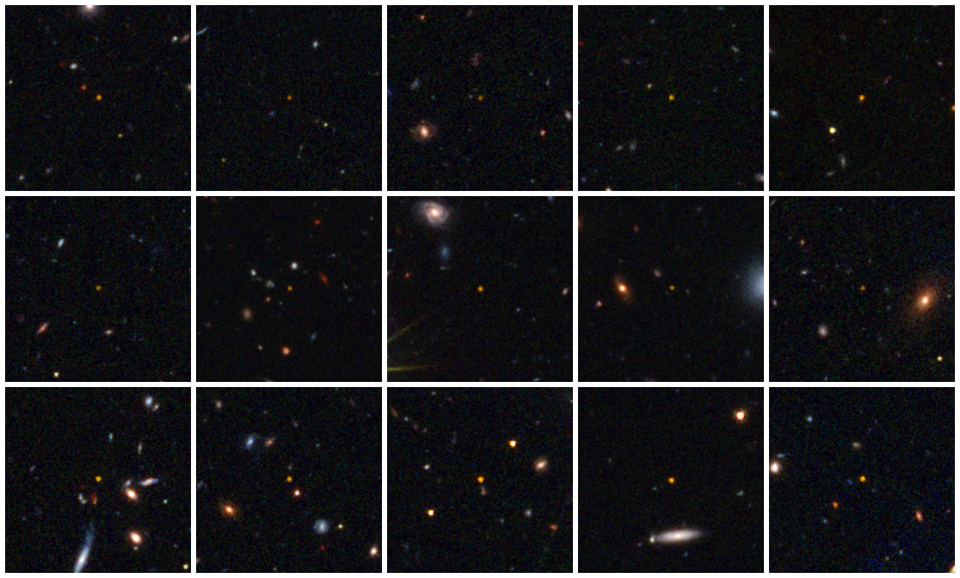
Using the European Space Agency’s Euclid space telescope, astronomers have discovered a treasure trove of 31 black-hole-powered quasars in the early universe. The most impressive of these new discoveries is the most ancient and distant quasar ever seen, shining with the light of a trillion suns just 670 million years after the Big Bang.
Quasars occur when supermassive black holes with masses millions or even billions of times that of the sun are surrounded by swirling disks of matter called accretion disks. As accretion disks gradually feed these central cosmic titans, the immense gravity of the black holes generates intense friction, causing this matter to glow so brightly that their luminosity can exceed the combined light of every star in their host galaxies.
Despite this, quasars can still be difficult to spot at vast cosmic distances, with their light difficult to distinguish from the light of much more proximate stars. Thus, the hunt for the earliest quasars has been on for decades, with scientists hoping that the discovery of these bodies could help explain how supermassive black holes grew so rapidly so shortly after the Big Bang. Launched in 2023, Euclid has fulfilled its promise in its mission to discover early quasars, with this hitherto unprecedented haul of 31 of these black hole engines.
“These early quasars date back to the Universe’s infancy,” team leader Daming Yang of Leiden University in the Netherlands said in a statement. “By finding and studying them, we can better understand how these enormous systems formed and grew so quickly — one of the greatest mysteries in astrophysics.”
Previously, astronomers took around a decade to discover the first ten or so quasars at distances like this, which makes it incredibly impressive that Euclid has managed to detect more than three times that many ancient black hole engines in just a single year of observations.
The tip of the iceberg
Thanks to this new treasure trove of quasars discovered when the 13.8 billion-year-old universe was merely 5% of its current age includes not just the brightest examples of these objects, but also some fainter quasars. That now means scientists can finally study these objects as a population.
“Euclid is a true game-changer,” Yang continued. “Before, we could only find a handful of the very brightest ancient quasars, but Euclid lets us search far more efficiently across huge areas of sky to capture much fainter light. It’s a unique tool for quasar hunting.”
Of the 31 new quasars, 12 existed when the universe was around 770 million years old, but the two that really stand out are the quasars designated EUCL J172902.75+641018.1 and EUCL J125308.55+705432.3, which are around 13 billion light-years away and existed just 670 million years after the Big Bang. That makes them the most ancient quasars ever documented.
“This finding more than doubles the number of quasars we know of that are so ancient,” Antonio La Marca , a European Space Agency (ESA) Research Fellow on the Euclid team, said in the statement. “The Euclid team has taken a true ‘census’ of quasars at the dawn of the Universe for the first time. It’s a big step towards understanding these fascinating objects on a more fundamental level.”
The quasars date back to a period of the cosmos known as the epoch of reionization, which lasted from around 680 million years after the Big Bang to 1.1 billion years after the Big Bang. During this period, the universe’s “dark ages” drew to a close with photons, particles of light, suddenly free to traverse the cosmos. Thus, these 31 quasars offer a unique opportunity to study this vital period in cosmic history.
“Ancient quasars are rare discoveries,” ESA Euclid Project Scientist Valeria Pettorino said in the statement. “They’re interesting in themselves, but also time machines that enable us to explore the early universe and understand how the first generation of galaxies came to be.”
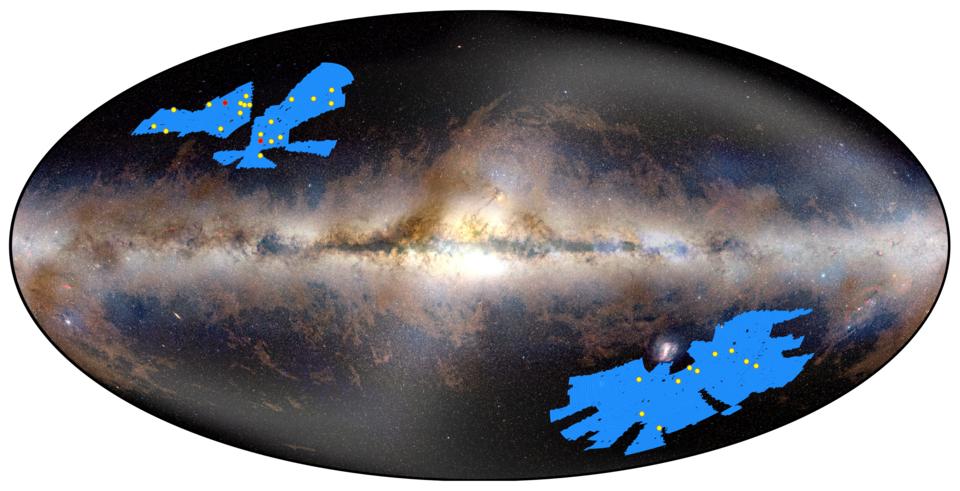
The 31 quasars were discovered as part of the Euclid Wide Survey, which will eventually cover around one-third of the total sky over Earth.
Scientists hope that this survey will shed light on the so-called “dark universe” comprised of two of the most pressing cosmic mysteries: dark energy, the puzzling force driving the acceleration of the expansion of the universe, and the nature of dark matter, the most abundant “stuff” in the cosmos which remains effectively invisible.
“Euclid’s capabilities are unrivalled,” Pettorino concluded. “The telescope combines a large area, depth, sharp imaging, and unique space-based infrared vision in a way that lets us pick out rare, extremely distant objects far more efficiently than before.”
The team’s research was published on Monday (July 6) in the journal Astronomy & Astrophysics.