
We didn’t realize it at the time — nobody ever does — but the ’90s were a vintage era in Hollywood.
It was a time when major studios were happy to take a punt on original scripts, knowing that people would, as often as not, buy theater tickets to watch quality releases. Good movies will always be made, of course — just as even the most golden of ages produce their fair share of stinkers — but this was a time when the Venn diagram circles labelled ‘acclaimed’ and ‘popular’ intersected on a satisfyingly regular basis.
But beyond the critic-friendly fare produced by the likes of Quentin Tarantino, the Coen Brothers, Paul Thomas Anderson, and Martin Scorsese, this was also a peak period for popcorn-friendly action movies… and especially sci-fi action movies. Highbrow reviewers didn’t always appreciate their brilliance back then, but looking back all these decades later, many of the best examples still stand up now.
“Independence Day” — which turned 30 last week — isn’t even the best entry in the genre, but it repeatedly shows why the end of the 20th century was the perfect time to experience blockbuster thrills and spills in a multiplex. And, spoiler, there was barely a superhero in sight.
The ’80s had teed up the subsequent decade’s action explosion perfectly. On one side was the family-friendly fare championed by George Lucas and Steven Spielberg, timeless movies like the “Star Wars” sequels, “ET”, “Back to the Future,” and “Indiana Jones” that produced a generation of budding cinephiles. They were complemented by the more rugged, violent, and grown-up adventures popularized by the likes of “Aliens”, “Predator”, and “Die Hard”.
Anything less than spectacular would no longer cut it in the blockbuster stakes, as the kids of the ’80s got that little bit older and decided to take their new favorite genre with them.
It’s easy to dismiss this kind of filmmaking as simplistic and dumbed down. Its poster boys were uber-producers Jerry Bruckheimer and his late filmmaking partner Don Simpson, whose “high concept” ethos distilled movies down to a pithy elevator pitch you could squeeze into a single sentence.
But the company’s undisputed classics of the era make it obvious they were on to something — “Crimson Tide” (feuding submariners try to avert World War III), “The Rock” (rogue marines capture Alcatraz to hold San Francisco to ransom) and “Con Air” (a bunch of prisoners capture their transport plane). It’s a formula that also worked for “Speed” (a bomb will explode if a bus goes under 50mph), “Twister” (scientists chase tornadoes across America), and “Under Siege” (“Die Hard” on a boat).
The director/producer duo of Roland Emmerich and Dean Devlin were clearly paying attention when they made “Independence Day”, their follow-up to 1994’s “Stargate”. Let’s start with their own high concept, easily summed up as a modern-day spin on HG Wells’ “The War of the Worlds“, but with bigger spaceships and a more pronounced fetish for major landmarks.
Speaking to the Guardian, Devlin recalled Emmerich’s original idea. “[He said], ‘What if we woke up tomorrow morning and we walked outside to get the newspaper and above it was a 15-mile-wide spaceship blotting out the sun for an entire city?’ Then he turned to look at me and goes, ‘I think I have our next movie.'”
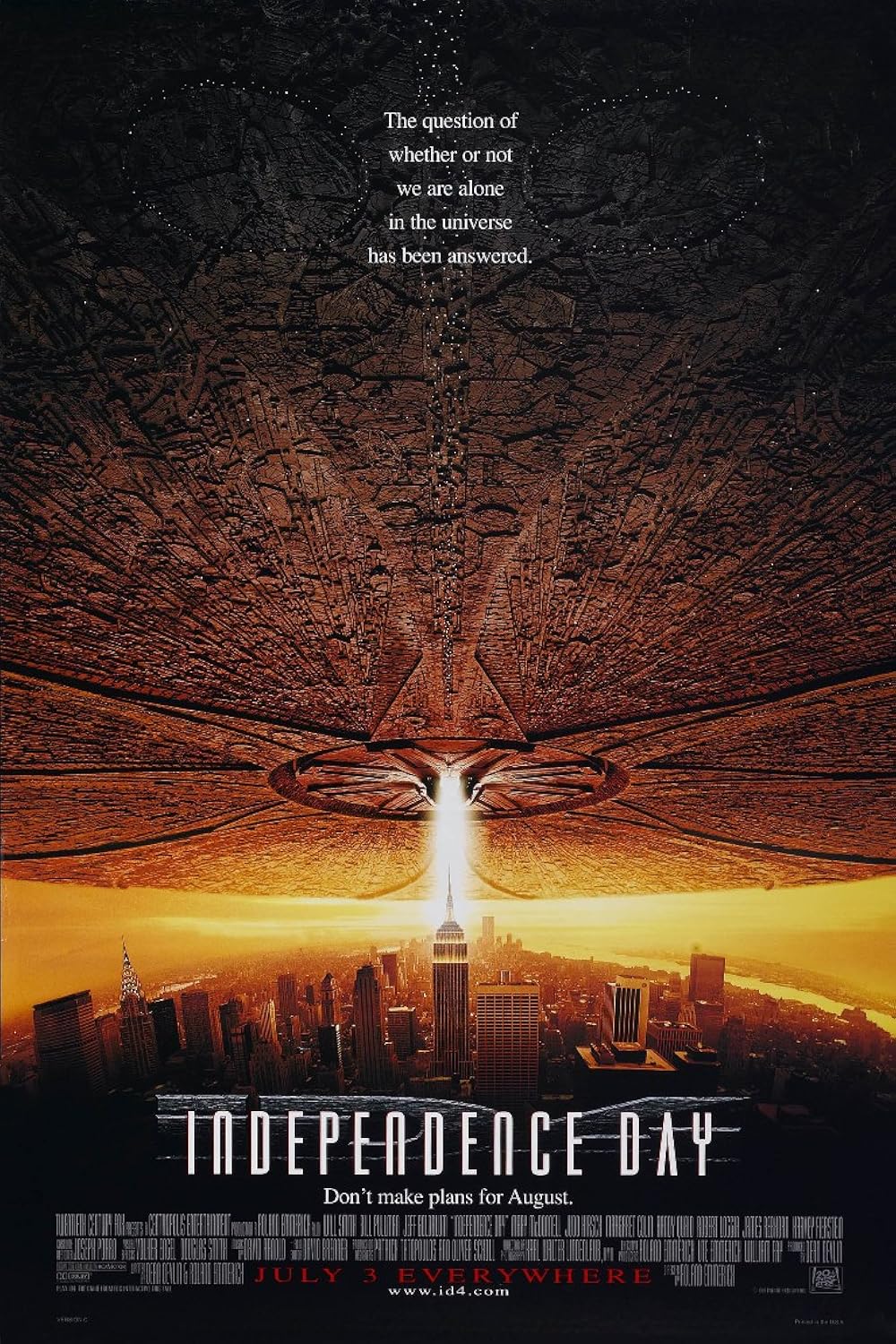
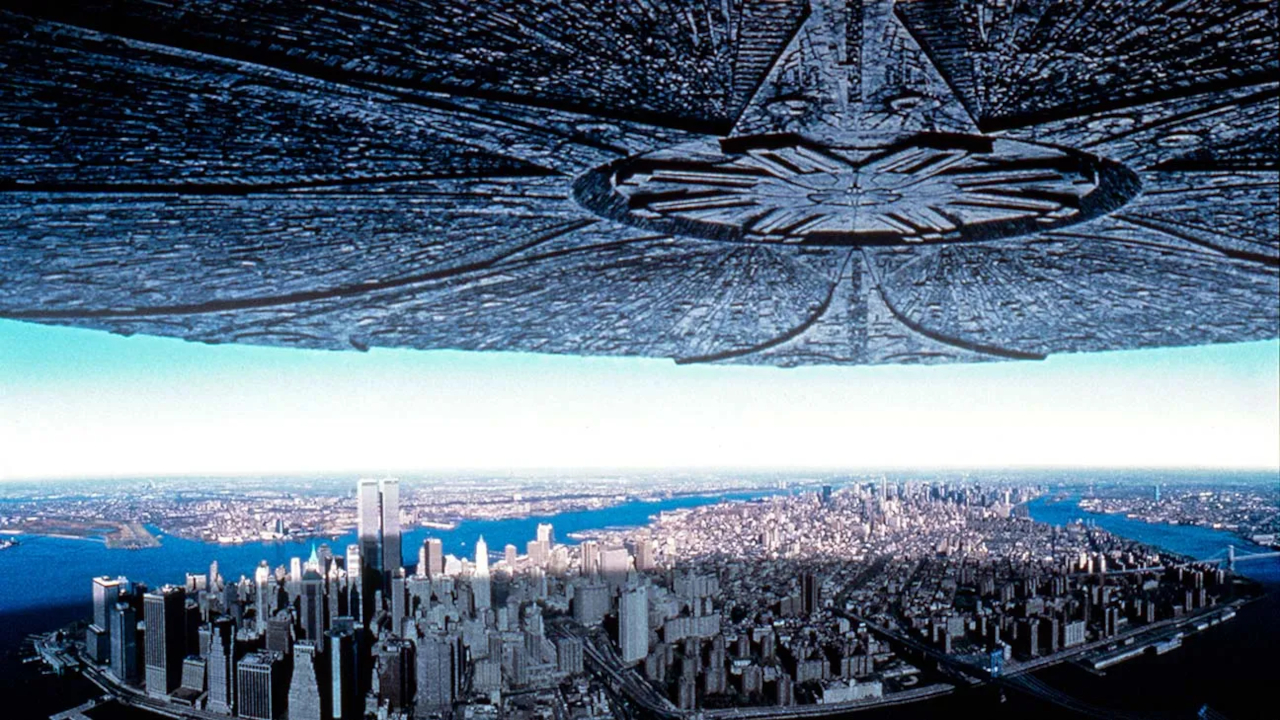
“Independence Day” didn’t need to be part of a major franchise to get noticed. The teaser trailers, with their carefully choreographed moments of tourist hotspot destruction, were enough for that, as was the brilliant sci-fi movie poster, which saw Manhattan dwarfed by a flying saucer. “The question of whether or not we are alone in the universe has been answered,” said the wonderfully doom-mongering tagline.
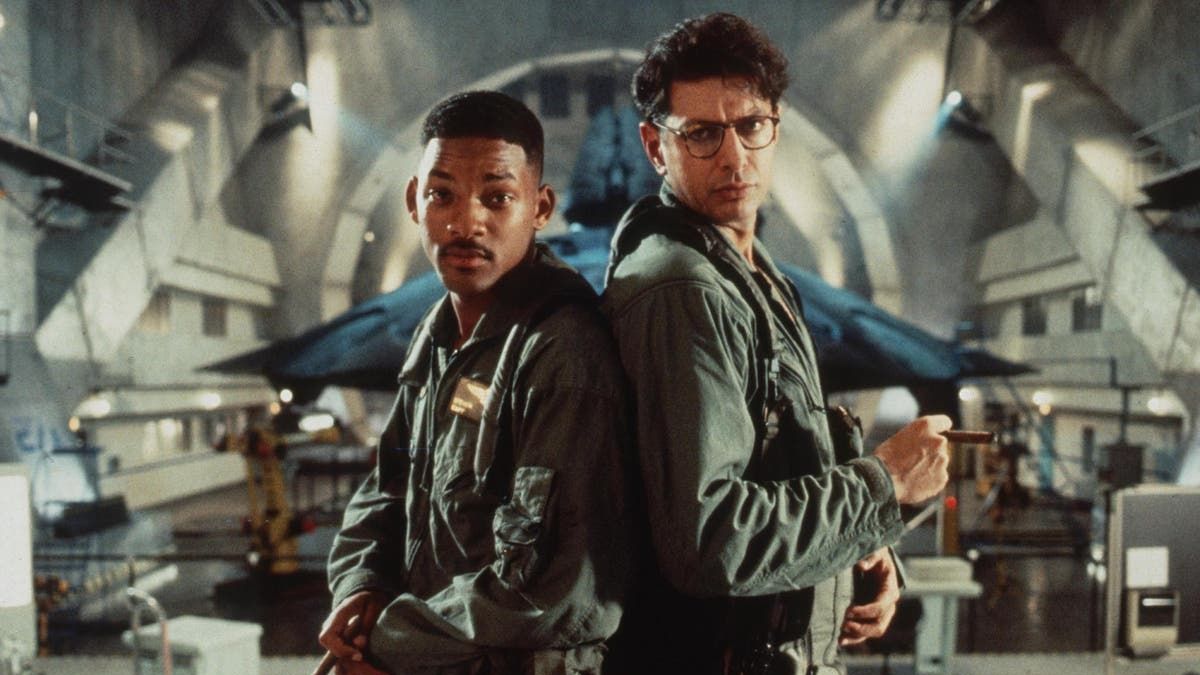
As with many of the other action movie classics of the era — not to mention the classic Irwin Allen disaster epics of the 1970s, such as “The Poseidon Adventure” and “The Towering Inferno” — “Independence Day” prioritized its cast over spectacle.
The biggest name on the roster was arguably Jeff Goldblum, who, thanks to the double whammy of “Jurassic Park” and “ID4”, briefly had the two highest-grossing films of all time on his resumé.
But Emmerich and Devlin also spotted the star power of Will Smith before he became a bona fide A-lister, and packed out the vast supporting cast with familiar — though not necessarily movie star — names: “Taxi”‘s Judd Hirsch as Goldblum’s dad, Bill Pullman as an idealistic POTUS, and Randy Quaid as a former pilot with a bone to pick with ET. They also boosted the film’s geek credentials by casting Brent Spiner (“Star Trek: The Next Generation”‘s Data) as Area 51‘s eccentric head of ET research.
Populating the film with quality actors paid big dividends, helping to ground a film whose script rarely shied away from the ridiculous. In a screenplay that shifts from gung-ho action to self-aware gags to over-earnest, tub-thumping presidential speeches (and back again), it certainly helps if your cast can play their roles as if they’re on stage at the Royal Shakespeare Company. In the same way, nobody could watch Ed Harris in “The Rock” or Gene Hackman in “Enemy of the State” and claim they were phoning it in.
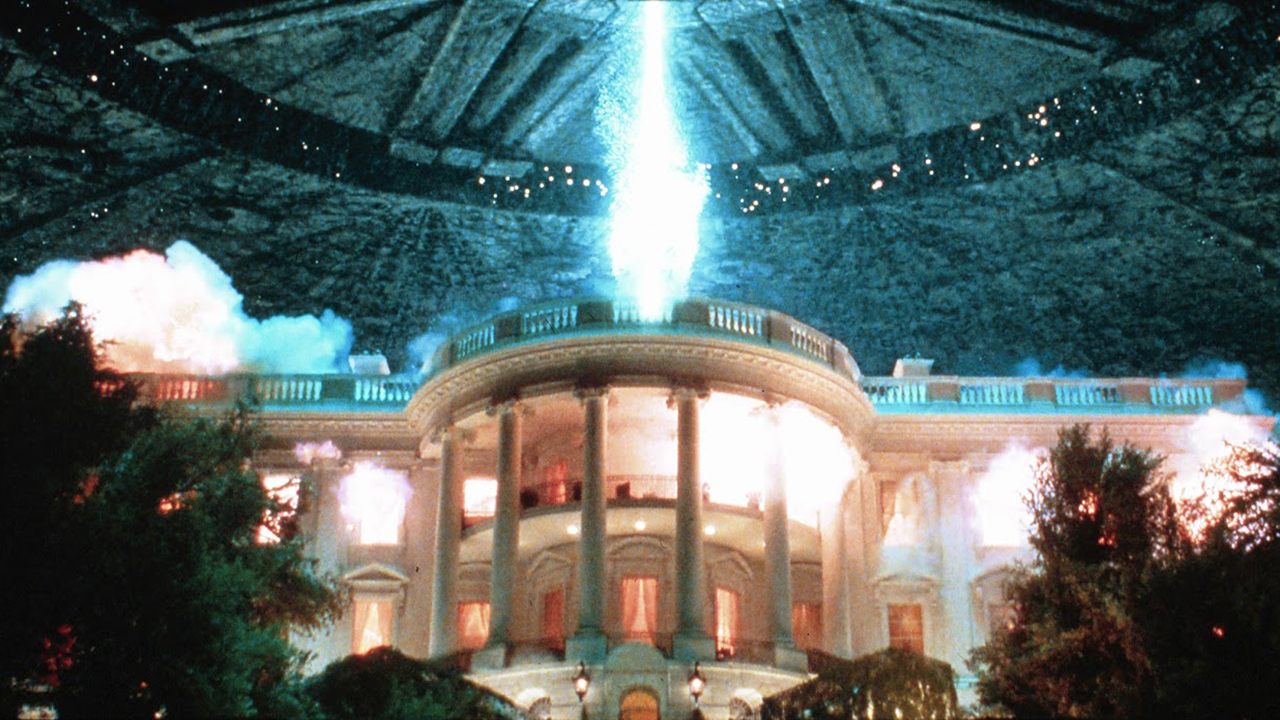
There’s also a lot to be said for the “Independence Day”‘s deployment of practical effects. The mid-’90s were a dangerous time to be a filmmaker, when many were tempted to use computer effects when they should have known better. Look at the best action movies of the era, however, and they tend to use the CG to enhance, rather than replace, more traditional techniques.
As groundbreaking as “Jurassic Park” was, Steven Spielberg was remarkably sparing with the digital moments, while “The Matrix” — a film whose bullet-time effects quickly became ubiquitous — hung its action credentials on its live-action fights and wire work.
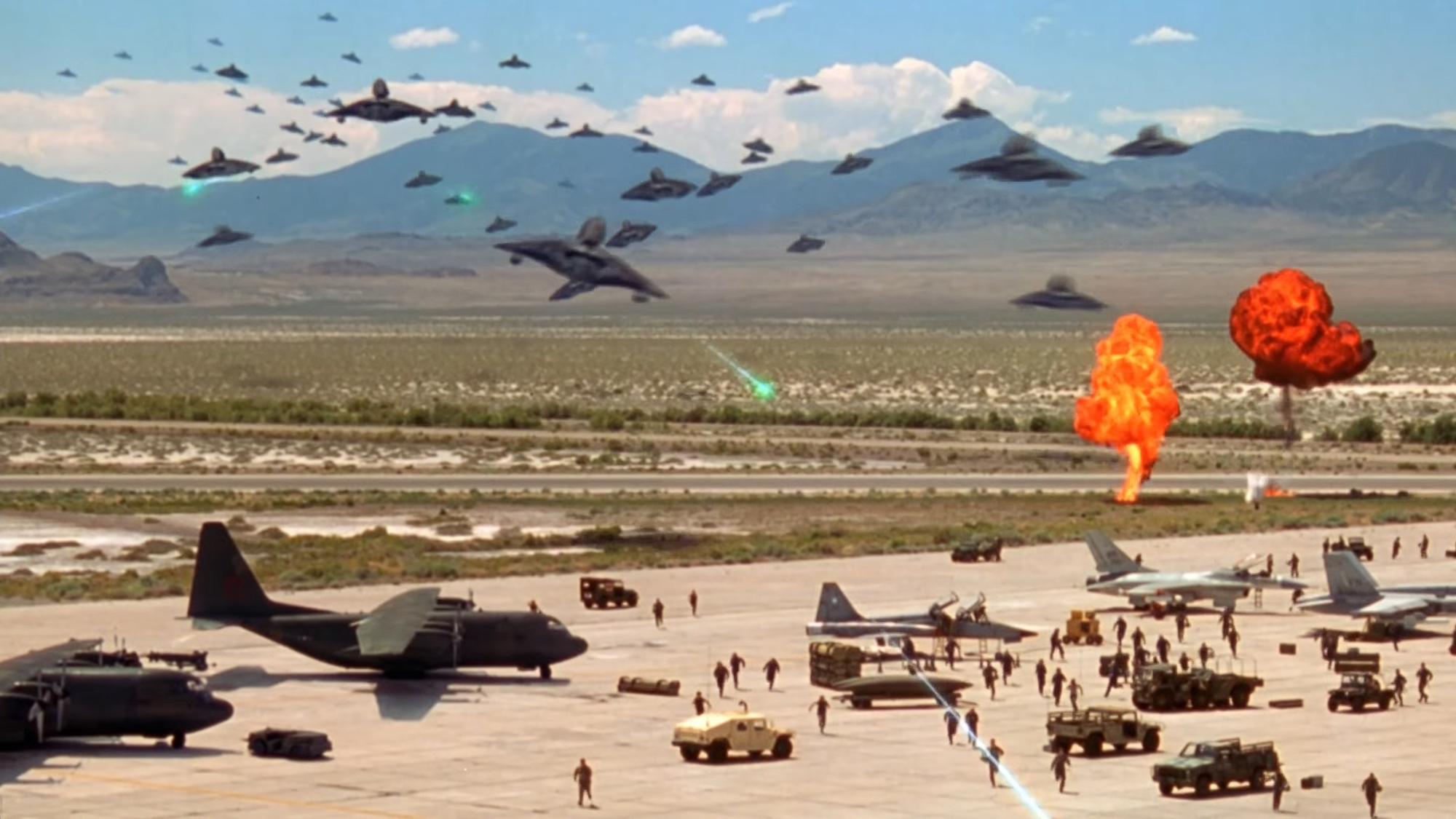
“Independence Day” was cut from the same cloth, using CG in the right places (most notably in its spectacular aerial dogfights) while also building (and subsequently blowing up) intricate practical models to deliver moments of pure, joyous cinematic carnage. These moments would undoubtedly be animated in a computer now, losing the tactile qualities — and the intrinsic gravity of the situation — you only capture in real life.
Thirty years on, “Independence Day” and its ’90s action brethren have come to feel like relics. Sure, superhero movies, their most obvious descendants, still set their eyes on top acting talent, and the best directors (most notably Christopher Nolan) tend to make a point of shooting practically when they can.
But, aside from the numerous “Die Hard” spin-offs, the ’90s generation were predominantly telling original stories, well away from the restrictions of franchise filmmaking, starting and finishing an entire story in roughly two hours. Indeed, it’s remarkable how few of the classics of the era were followed up by a successful sequel. (“Independence Day: Resurgence” took 20 years to arrive, and when it did, didn’t even make half as much at the box-office as its predecessor.)
And crucially, the action movies of the late 20th century were usually about people. Most of the time, they were ridiculous, over-the-top, broadly drawn, clichéd, cookie-cutter characters, but they also tended to — more or less — obey the laws of physics. Without superpowers or magic to fall back on, heroes had to rely on little more than implausible levels of ingenuity and resilience, a capacity to dodge bullets/laser fire, and a gift for making the right quip at the right time. “Independence Day” may just have been on to something.
“Independence Day” is available on Hulu in the US and Disney+ in the UK.

Watch Independence Day on Hulu:
Hulu with Ads: $11.99/month or $119.99/year
Premium (No Ads): $18.99/month