

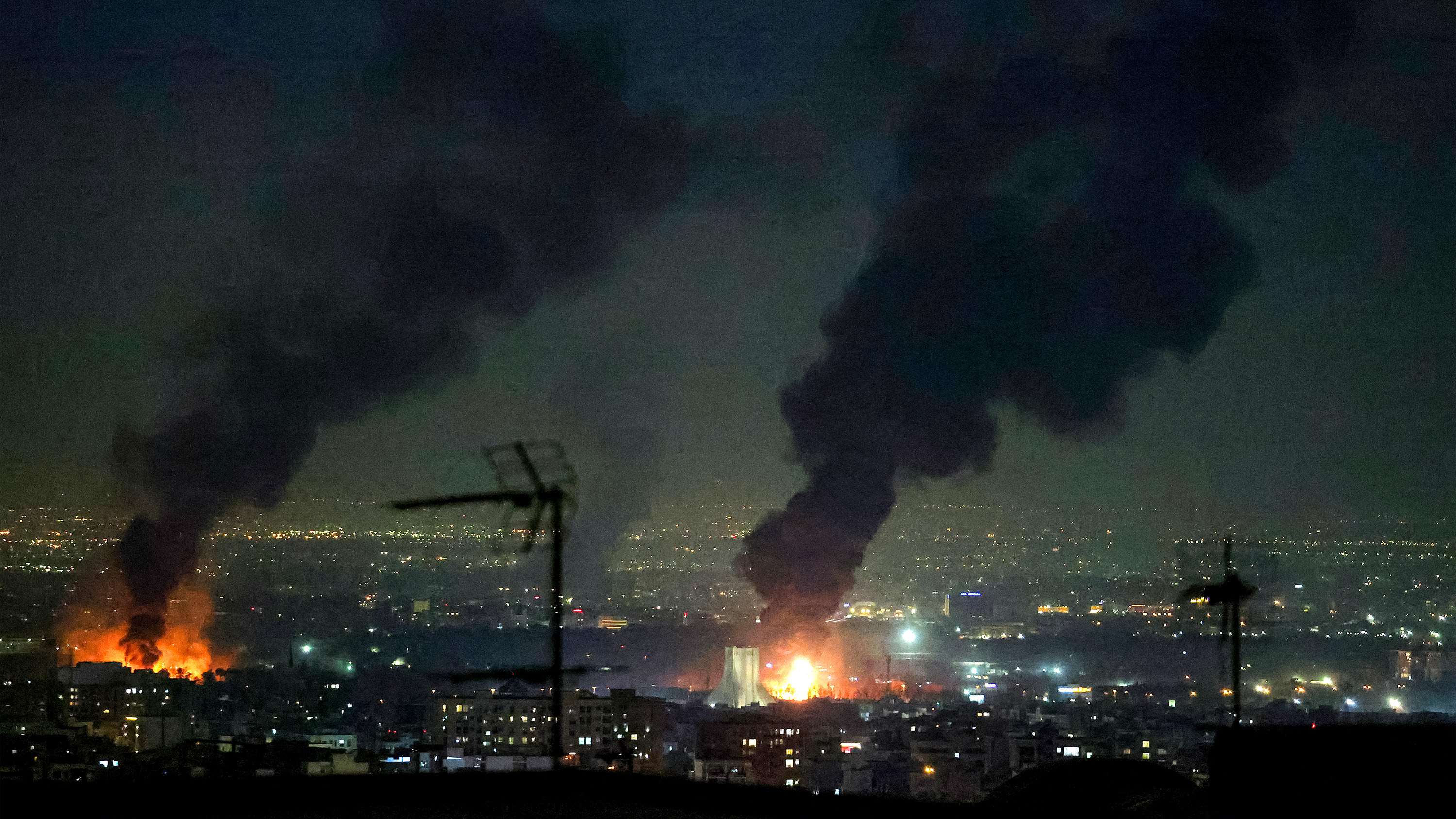
One evening, when I was 13, I came in from outside to find my parents watching TV. The screen was dotted with rockets scorching their way across a distant night sky, and the first United States invasion of Iraq was underway. As a child growing up in a relatively safe city, it had never seriously occurred to me until that night that war was still something that people did, much less something that people might desire to do.
Historians have long debated the wisdom of that invasion—and of the second one in 2003—with much of the discussion turning on the question of justice. Evaluations of a war’s justice are notoriously difficult because, by the measure of just war theory, each conflict must be assessed along many lines: the reason for pursuing war, the scope of action, the nature of military targets, and more.
This spring, considering another US war in the Middle East, this time in Iran, CT contributors have joined other writersin arguing for the just war tradition as a gift to Christian moral reason. As a Christian pacifist, I beg to differ about what kind of a gift the just war tradition is. But on this point, just warriors and pacifists can agree: Just war criteria offer Christians a way to try to remain Christian even amid the horrors of war. Christians in both camps are called to be formed by Christ, whatever the circumstance or epoch in which we find ourselves.
Indeed, the intent of the just war tradition is not only to make war more difficult to justify. It is to shape our character as Christians. By insisting that war must only be a last resort and may only be started when there is a reasonable probability of success, this tradition encourages us to temper our anger. By emphasizing the distinction between civilians and soldiers, just war reasoning restrains our desire for vengeance. By demanding legitimate authority in going to war, the theory teaches humility and fairness.
Of course, as others have noted, just war criteria are routinely ignored or misused to justify the wars we’ve already decided to wage. It is possible to apply this guidance with greater or lesser stringency. But lack of stringency is not the main reason that just war theory, for all its goods, continues to fail us. The true reason, I think, is that this tradition still speaks the now-alien vocabulary of virtue.
The original language of just war theory made clear its concern not only that war has rules, limits, and restraints, but that both the war and the warriors themselves be just. From Augustine, for example, one of the earliest Christian writers on this in the fourth century, we find this admonition:
When you are arming for battle, think first that even your bodily strength is a gift of God. In this way, you will not thinking of using the gift of God against God. When fidelity is promised it must be kept, even to an enemy. … Be a peacemaker, then, even by fighting, so that your victory you might bring those whom you defeat to the advantages of defeat.
Augustine here is far interested in rules of engagement than in what kind of people Christians should be, even in war.
But, ever so slowly, over the next millennium, the emphasis in these discussions shifted. Christians began to focus less on the people fighting to the conditions of war itself. By the time Hugo Grotius wrote his field-defining The Rights of War and Peace in 1625, attention was almost entirely on war as an event. Questions of character and virtue had slipped from view.
related

In the 20th century, just war theory left its birthplace in Christian moral reasoning and was enshrined as the basis of international statecraft. Many of the tradition’s demands were formalized in treaties and humanitarian conventions among nations, and in the process, the original Christian interest in a virtuous participant of war was even more obscured. In statecraft, the point was simply to set humane rules of war. Larger matters of goodness, truth, and beauty were irrelevant.
Beginning in 1949, the institutions of just war were formalized in the Geneva Conventions, which require humane treatment of enemy noncombatants and prisoners of war and prohibit torture and indiscriminate attacks on civilians. The conventions came on the heels of the Second World War, as both Axis and Allied powers realized the conflict had fallen far short of the just war tradition’s vision for justice. Millions of civilians in London, Dresden, and Hiroshima lay dead. Millions more civilian Jews were murdered in the Holocaust and the death camps. The inability of nuclear bomb to be a modest, measured weapon likewise promised to change the face of war forever.
All this concern for rules of war was well-intended. But it was also a long way from the tradition’s original and distinctively Christian interest in virtue.
That interest is hard for us to remember, for we live in a world that understands rightness in terms of rules and goodness according to what works. But the just war tradition points us toward an older way: an interest in what kind of souls we have.
This is (or should be) familiar territory for Christians. Scripture often reminds us that God wants us not only to do just things but to be just people—people who love the right things in the right way. God calls for the Law not just to be on our lips, but inscribed upon our hearts (Rom. 2:15), and for us to not just enact just policies, but to be the kind of people who desire and love that which is just.
The biblical language of justice is not about mere procedure. Scripture doesn’t give us a foolproof treaty template. It speaks to how we become people who are capable of living justly. This means evaluating things according to just standards, as the Bible tells us over and over again (Amos 8:3–6; Mic. 6:10–11).
related


But our evaluations of how to act justly depend on us being just people, seeing ourselves as under the same rule, and desiring justice even when it disadvantages us. This means worshiping God in praise and wonder, loving mercy and goodness, and conforming our lives to Christ. It is about who we are in war and peace alike.
Whatever else we might make of it, this is the soil in which just war theory grew. The tradition developed under the assumption that the rules of society and the character of the soul should be of a piece. It is because we live in such a disintegrated age that the criteria for just war feel cumbersome. Ours is a culture that long ago traded justice as a quality of the soul for justice as a process.
This is why the problem with just war theory today is not primarily about stringency. It’s that, culturally, we no longer understand justice as a matter of character. The language of virtue, so central to the Bible’s vision of the kind of people we are to be, has been replaced by the language of law. Worse, we see virtue as a kind of luxury, something that would be nice to pursue were the world not so terrible.
And so the just war tradition—meant to be a guide for Christian behavior, even in the worst of circumstances—now strikes us as an outmoded burden or an alien restraint. But that is one thing this tradition continues to do well: It reveals our moral poverty, how we’ve lost a deeply Christian language of justice and traded it for a shallow patter about rules.
Myles Werntz is the author of books including Contesting the Body of Christ: Ecclesiology’s Revolutionary Century. He writes at Taking Off and Landing and teaches at Abilene Christian University.
The post Just War Debates Reveal Our Moral Poverty appeared first on Christianity Today.