

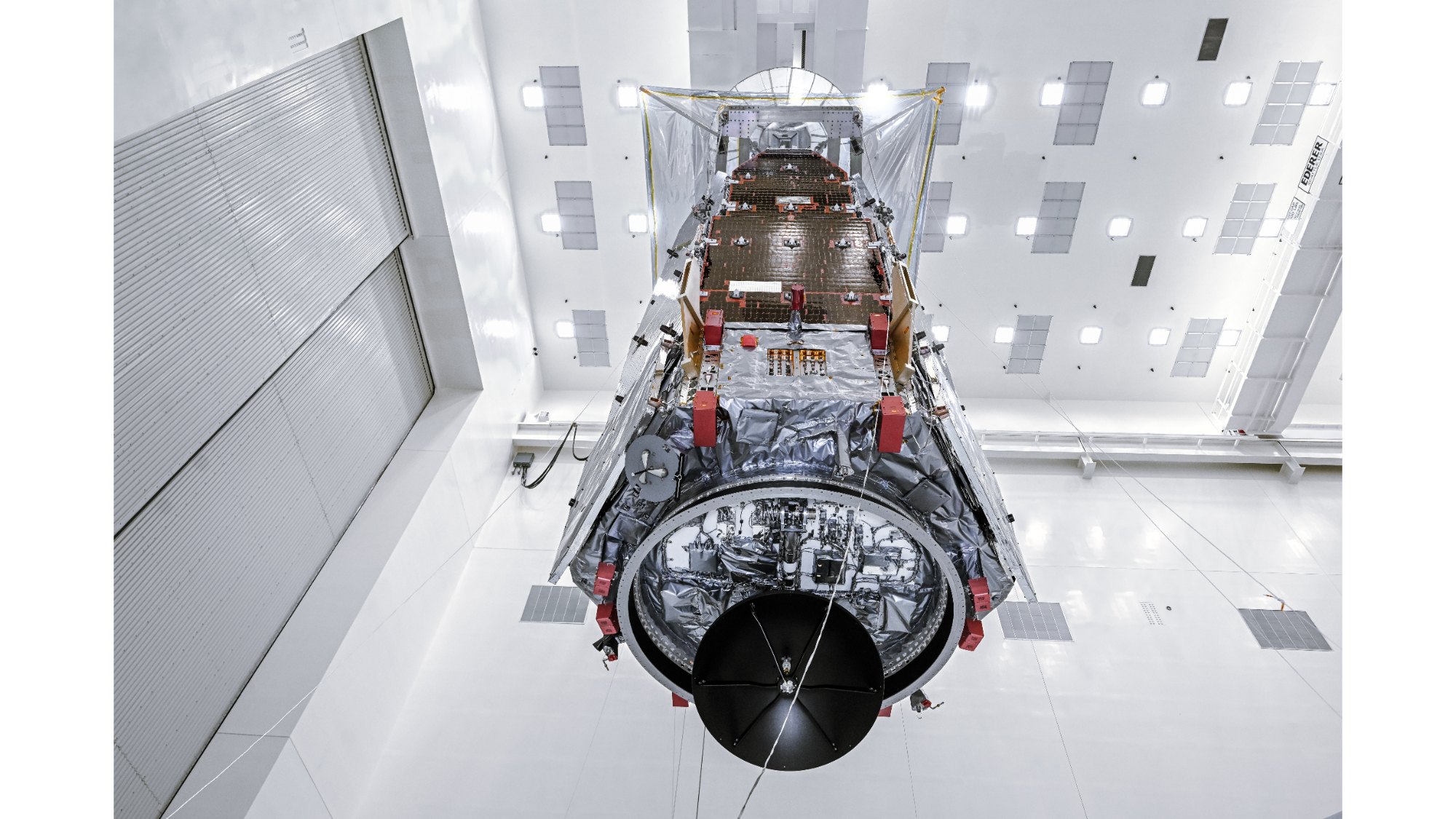
The next great American observatory in space is just one month away from leaving this planet.
NASA scientists got together Wednesday (July 29) to share a status update on the Nancy Grace Roman Space Telescope — the agency’s next great observatory that will soon join the ranks of absolute legends like the Hubble Space Telescope and the James Webb Space Telescope.
And that press conference was overflowing with good news. The $4 billion Roman Space Telescope is scheduled to launch on a SpaceX rocket on Aug. 30 at 7:26 a.m. EDT (1126 GMT). That’s nine months ahead of schedule according to the team.
I think of this as doing magic with physics.”
Julie McEnery, Roman senior project scientist
“In 30 days, we’re going to be launching Roman, testing it out, opening the deployable aperture cover, looking at the sky, and sending data down to the ground for the first time,” Jeremy Perkins, Roman’s telescope integration and test scientist, said during the press conference at NASA’s Goddard Space Flight Center in Greenbelt, Maryland.
Wednesday’s update comes just days after NASA announced Roman is loaded up with hydrazine fuel, a kind of fuel that’s known to be very efficient — though at the cost of being toxic and unstable. For that reason, the agency is looking for ways to move away from this kind of fuel, but it’s still used often until a suitable replacement becomes available.
And with Roman, a lot of hydrazine is necessary. This is for a few reasons, as Perkins explained.
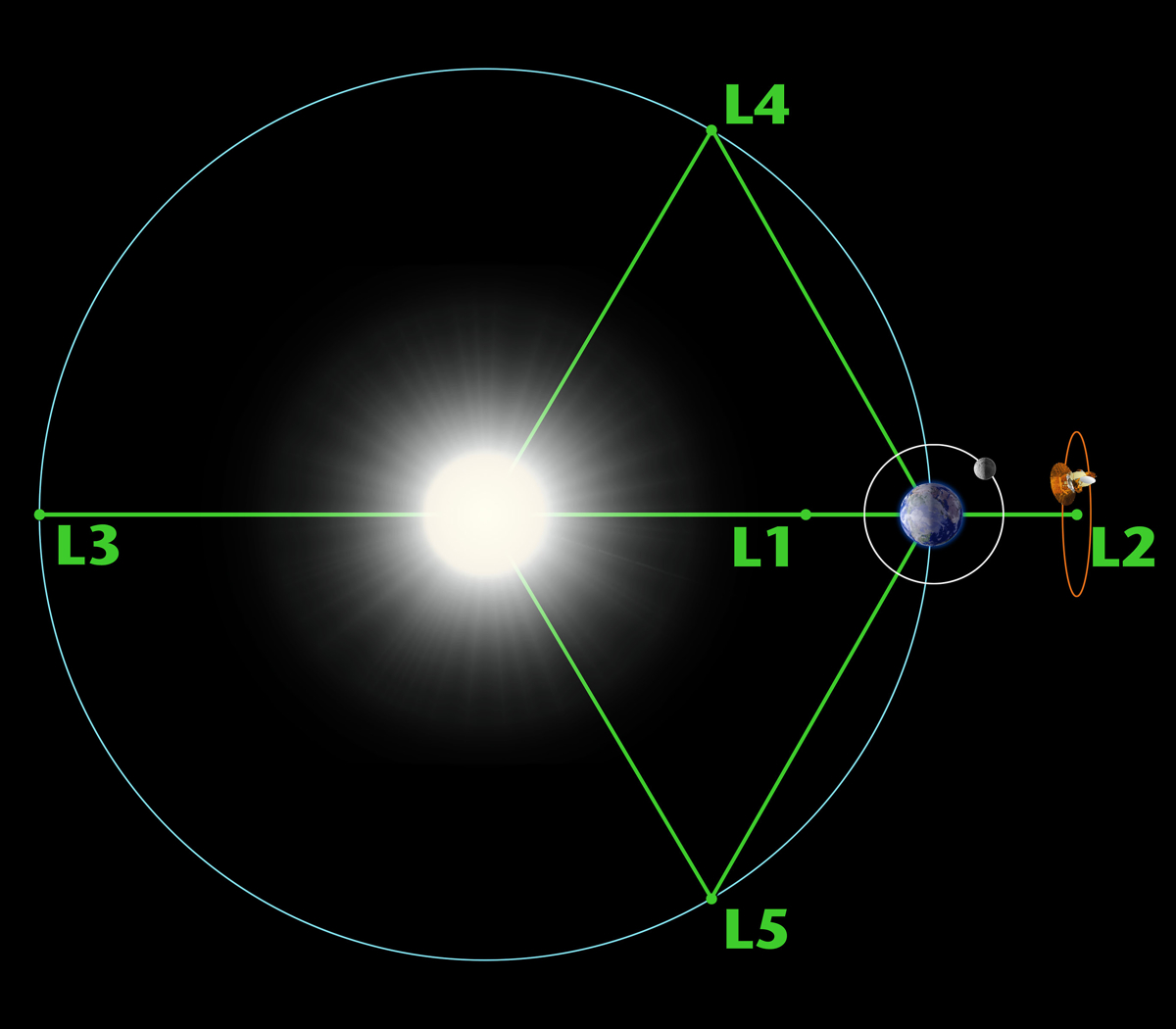
First, it’s important to know that Roman’s headed to what’s known as Lagrange Point 2, a gravitationally stable point a million miles away, between Earth and the sun. This is a popular location for observatories because it allows spacecraft to be oriented in such a way that their instruments remain safe from heat while their solar panels can still receive sunlight for power. The James Webb Space Telescope (JWST), for instance, is at L2 as well.
On the way to L2, Roman needs to use some its fuel to course correct and make sure it’s headed to the correct destination.
“We do a final orbit insertion around day 100 to get into our final orbit around L2,” Perkins said. “After that, we have enough fuel to do all of the momentum dumps and the station keeping maneuvers that we need to do for five years and more.”
Now that Roman’s fueled up, the next step will be to get it attached to the SpaceX Falcon Heavy rocket that’ll carry it beyond our planet.
“Encapsulation, which is when the observatory is installed into the fairing that will carry us to orbit, that happens in three short weeks,” Jackie Townsend, Roman’s project manager, said during the conference.
Townsend also added that, all in all, the whole Roman team is ready to go: “The Roman dream team continues to do mighty things, and I am delighted to say yet again, Roman is ready for launch.”
As for what comes after launch, well, there’s one way to put things into perspective.
To compare Roman to the Hubble Space Telescope, consider that scientists expect Roman to produce over 500 terabytes of data per year. In its approximately 35 years of service, Hubble has produced 400 terabytes of data in total.
“Roman has broadly the same sensitivity and sharpness of vision as Hubble, but we survey the sky much faster, so that one month of observations to survey our Milky Way galaxy would take about a century with with Hubble,” Julie McEnery, Roman’s senior project scientist said during the conference.
“We would need over half a million 4K TVs to fully display the single Roman image from our largest survey,” McEnery said. “To understand the scale, these TVs would cover 45 Manhattan city blocks.”
What about comparing Roman to the JWST? While the Roman Space Telescope does have some near-infrared capabilities, thanks to its impressive Wide-Field Instrument (WFI). However, it doesn’t quite stack up to the JWST’s ultrasensitive infrared sensors. Where it does have an advantage, though, is when it comes to its panoramic view. A Roman image would be about 50 times wider.
“Webb is designed to be able to probe very deeply and with exquisite sensitivity into the universe so we can find rare things in the early universe,” McEnery said of the JWST. “But you need Roman to find rare things in the more nearby universe.”
As an example, McEnery pointed out the “little red dots,” elusive objects that seem to repeatedly appear in JWST images of the ancient universe. The key to understanding what these objects are is to find as many as possible. However, with the JWST’s extremely zoomed in images focused on the deep, deep universe, it can’t exactly map that many at once. But Roman is built to do just that.
Once all this data is in hand, the possibilities for what we may find are endless. One of Roman’s instruments called a coronagraph is expected to revolutionize exoplanet research while WFI scans the cosmos to image around 2 billion galaxies during the telescope’s main survey.
“I think of this as doing magic with physics. We’re taking advantage of the wave properties of light to cancel out the light from a star, so that we can image planets next to it,” McEnery said.
Understanding the dynamics of as many galaxies as possible will help scientists decode the intricacies of dark matter and dark energy. We can’t see the dark universe, but we can see how it affects its observable counterpart. And these are just a few of the expected outcomes of Roman’s survey. As the team has continuously suggested — in fact, as most observatory teams tend to suggest — the best discoveries will be the surprises.
Even when you think about other technological advances, the principle holds true. When the internet was first invented, its inventors probably didn’t expect it to lead to innovations like Facebook or Spotify and when the first video game was invented, the concept of an open world RPG maybe seemed beyond our means.
“When we built Hubble and Webb, we were chasing far off galaxies in the farthest corners of the universe. But because we have a Hubble and Webb, we’re able to track asteroids that would pose a threat to Earth or to future lunar outposts on on the lunar surface,” Shawn Domagal-Goldman, director of the astrophysics division at NASA Headquarters said during the conference. “Those were impossibilities that are now just possible and sometimes routine.”
Perhaps whatever Roman has in store for us will lead to the next generation of its namesake, Townsend pondered.
Roman is named after Nancy Grace Roman, a pioneer in her field who was the first female executive at NASA as well as the agency’s first chief of astronomy. She’s sometimes called the “mother of Hubble” because of her major contributions to the telescope and is famous for breaking ground in research about satellites. She also helped form the foundation for exoplanet science decades before the first exoplanet discovery.
“The next Dr. Nancy Grace Roman, sitting in a classroom somewhere next year, will be studying our data and hopefully catch the science bug and go on to transform the world in the same way that Dr. Nancy Grace Roman did,” Townsend said.
“I could not be prouder to be part of this project.”