
NASA has formally invited India to participate in its effort to build a permanent base near the moon’s south pole, adding a new dimension to the deep-space cooperation between the two countries.
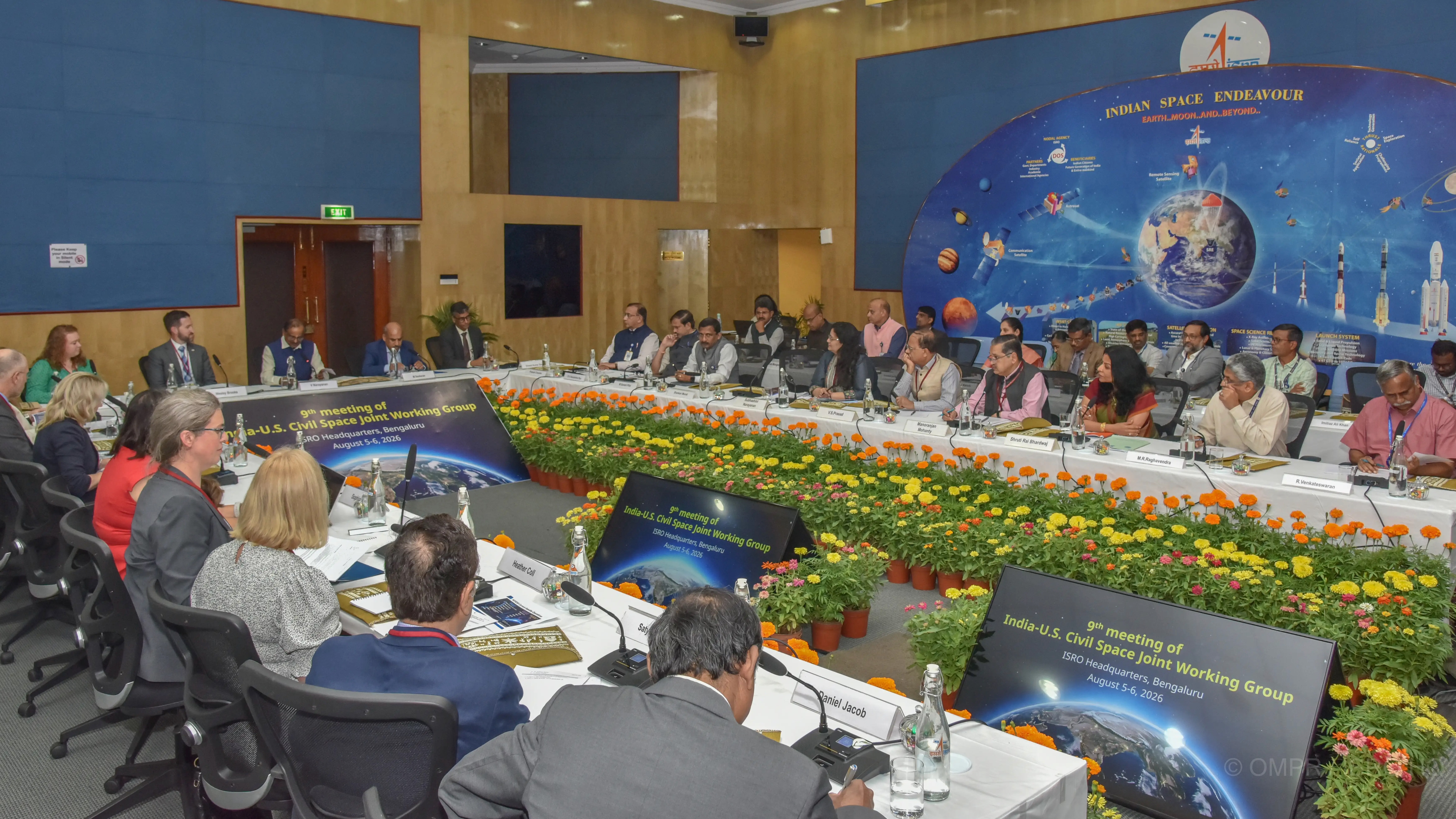
The invitation was extended last week at the Indian space agency ISRO‘s headquarters in Bengaluru during the ninth meeting of the U.S.-India Civil Space Joint Working Group. The CSJWG was established in 2005 as a mechanism for bilateral space cooperation and for addressing challenges and pursuing mutual spaceflight goals.
“Building on our successful collaboration in science, NASA reaffirmed its interest in @ISRO joining Moon Base. We’re going back to the moon to stay — and we’re bringing our partners with us,” NASA officials said via X on Tuesday (Aug. 11).
Building on our successful collaboration in science, NASA reaffirmed its interest in @ISRO joining Moon Base. We’re going back to the Moon to stay — and we’re bringing our partners with us. https://t.co/hU9ssn24FPAugust 11, 2026
Beyond the lunar base invitation, “the two sides also agreed to advance discussions for cooperation on open scientific data sharing under the Accords,” reads a Tuesday statement by the U.S. Embassy in India.
“The Accords” are the Artemis Accords, the U.S.-led diplomatic framework outlining principles for safe and responsible exploration of the moon and beyond. India signed on as the 27th signatory in 2023, joining a coalition that has now grown to 70 nations.
Official statements have provided few details on what India’s participation in the Moon Base program would entail in practice. The meeting, however, brought together senior space officials from both countries, including V. Narayanan, the chairman of ISRO and secretary of India’s Department of Space, and Sergio Gor, the U.S. Ambassador to India, who addressed the opening session, according to the statement.
The meeting was co-chaired by M. Sankaran, director of ISRO’s U.R. Rao Satellite Centre, on the Indian side, and two people on the U.S. side — Wesley Brooks, assistant secretary of state for the U.S. Department of State’s Oceans and International Environmental and Scientific Affairs, and Kathleen Karika, NASA associate administrator for International and Interagency Relations, the statement reads.
Over the coming decade, via its Artemis program, NASA plans to build out a sprawling, city-like base near the moon‘s south pole, a region of particular interest thanks to permanently shadowed craters there that are thought to contain substantial deposits of water ice.
Details of the planned architecture shared by NASA in May envision hilltop habitats to take advantage of sunlight and nuclear power systems located farther away to mitigate radiation risks. The space agency also plans to use small, hopping robots starting in 2028 to scout the south polar region ahead of moon base construction.
This effort to gather information and secure access to the surface is the first of three planned phases. Phase 2, from 2029-2032, is intended to establish the base’s initial operating capability. Phase 3, from 2032 onward, aims to achieve a semi-permanent crew presence on the lunar surface, NASA said during the May update.
To prioritize infrastructure that supports sustained operations on the moon’s surface, increase launch cadence and keep pace with China’s lunar ambitions, NASA earlier this year paused development of its long-planned Gateway space station.
For India, the invitation to join NASA’s Moon Base program comes as the country pursues its own ambitious lunar exploration and human spaceflight roadmap. Its plans for the 2040s include developing a moon base, establishing a space station in lunar orbit and sending Indian astronauts to the moon, with the broader goal of building long-term human presence beyond Earth.