


This piece was adapted from CT’s books newsletter. Subscribe here.
James K. A. Smith, Make Your Home in This Luminous Dark: Mysticism, Art and the Path of Unknowing (Yale University Press, 2026)
I will always be grateful for Jamie Smith. His trilogy of books on cultural liturgies, particularly Desiring the Kingdom, made a huge difference to the way I think about worship, discipleship, and culture. I read and enjoyed his Letters to a Young Calvinist when I was still a young Calvinist. I read Who’s Afraid of Postmodernism? and Who’s Afraid of Relativism? when I was still somewhat afraid of both, and they helped me enormously. I went through On the Road with Saint Augustine in my devotional times and still have You Are What You Love in my bedroom. Admittedly, I found How to Inhabit Time more puzzling—it felt as if I was no longer Smith’s intended audience—but I read it anyway, like a Beatles fan persevering through Let It Be.
With all that said, Make Your Home in This Luminous Dark was a struggle. The aim of the book is a good one: an invitation to mysticism, which Smith summarizes as “how to be when you don’t know.” Its flow—from anachoresis (solitude) to hesychia (silence), then docta ignorantia (unknowing), and finally mysterion (wonder)—is illuminating. But reading each chapter is like hacking through dense jungle. We move from the medieval mystics to lengthy descriptions of modern art via Marcel Proust and James Joyce, and from the philosophy of Edmund Husserl, Emmanuel Levinas, and Jean-Luc Marion to elaborate accounts of contemporary movies where very little happens—all the while encountering plenty of sentences like “I began to understand how I could live as both question and answer” and “Do I even know anything anymore?” Maybe this is what we should expect from a book with the word unknowing in the subtitle. Maybe it is “evidence of my own thickheadedness or lack of empathy,” as Smith says of his own experience reading a short story in The New Yorker. But at times it verges on the impenetrable.
Mysticism has clearly helped Smith “imagine a future for my faith after a season of anger and embarrassment at the dogmatism of both my youth and my co-religionists.” Mysticism may or may not be for everyone. But this particular call to it was not for me.
Unfolding Redemption: The Heart of the Gospel in the Story of Old Testament History
IVP Academic
192 pages
Ian Vaillancourt, Unfolding Redemption: The Heart of the Gospel in the Story of Old Testament History (IVP Academic, 2026)
Biblical theology is back in vogue, which is great news. Even better news is that much of it is being written at an accessible level and published in manageably short volumes by InterVarsity Press, Zondervan, and Crossway, not just in dense tomes by academic publishers.
Unfolding Redemption is a good example. The writing is clear, and the flow is well considered. The focus—the history books of the Old Testament—is narrow without being niche. The charts are well presented. The level of detail is about right, which enables us to engage meaningfully with sticky passages like the conquest of Canaan, the end of Nehemiah, and the genealogies of Chronicles without getting totally lost in the weeds. Occasionally the illustrations are a bit clunky, but the insights in each chapter are frequently compelling, and the biblical, theological, and Christological connections are well observed and nicely handled.
In particular, Vaillancourt gets more value than I would have expected from the decision to take the history books in their original Hebrew order rather than the order we generally use today. Reading Ruth immediately before the Psalter puts a whole new spin on the way the nations, or Gentiles, appear in the Psalms. It makes a difference when you read Daniel just before Esther rather than surrounded by prophetic books. Ending the Old Testament with 1 and 2 Chronicles sets up the beginning of Matthew in fascinating ways. The chapter on Esther is a real highlight, including the double banquets which bookend the story, the echoes of 1 Samuel 15 in the central plot, and the explanations for the book’s famous omission (or is it?) of God. All in all, this is a clear, accessible primer on the history books of the Old Testament and their contribution to biblical theology.
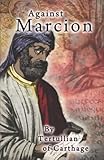
Tertullian, Against Marcion (around 208)
It is striking that if we were to list the greatest Christian writings between the end of the New Testament and the Council of Nicaea, three of them would have titles that begin with the word against. That tells us a lot about the way our theology was formed. Gnostic errors prompted Irenaeus to write Against Heresies (around 180), which has been a bulwark of orthodoxy ever since. Origen wrote Against Celsus around 248 to respond to a pagan philosopher, anti-Christian controversialist, and troll, providing us with numerous apologetic arguments which we still use today. And in between, the North African theologian Tertullian wrote my favorite of the three (around 208), carefully (and often pungently) debunking the heretic Marcion. Like all the greatest works of church history, it resonates powerfully today.
Much of its resonance stems from the fact that a form of Marcionism—essentially, the idea that the God of the Old Testament is different from the God revealed in Jesus—is still with us. Few people today follow Marcion in every detail. His views on Creation, matter, the biblical canon, and the nature of salvation have barely survived, not least through the influence of Tertullian’s critique. But the argument that there is an inconsistency between Old and New Testament theology—the God of Israel versus the God of the Gentiles, or the judgmental giver of the law versus the gracious giver of the gospel—is common in progressive circles and is familiar in some form to most of us.
That is what makes Against Marcion so timeless. Tertullian defends the oneness of God (books I–II), the incarnation of Christ (book III) and the canon of Scripture (books IV–V), while showing that both gracious love and holy judgment are integral to God’s character under both Old and New Covenants. “Christ, therefore, is the Creator’s Christ,” he concludes, “as Christ’s law is the Creator’s law. ‘You are deceived; God is not mocked.’ … But Marcion’s god can be mocked; for he knows not how to be angry, or how to take vengeance.” Well said.
Andrew Wilson is teaching pastor at King’s Church London and author of Remaking the World: How 1776 Created the Post-Christian West. Follow him on X @AJWTheology.
The post Getting Lost in the Luminous Dark appeared first on Christianity Today.