

ATHENS, GREECE — Jesus told his followers to “go and make disciples of all nations” (Matthew 28:10).
But in this modern European capital with biblical roots, the nations come to them, often as refugees.
Known as a bridge to Europe, Greece is the easiest country for refugees from Africa and the Middle East to access. Hundreds of thousands of people of different nationalities pass through the country each year. This presents the opportunity for Churches of Christ to reach many people.
The Glyfada Church of Christ adapted to the variety of people by offering nine services during the week in five languages: Greek, Russian, English, Farsi and Albanian.
Some refugees stay in Athens for years, while others are only in the city for months. This transitory pattern changed how the ministers and missionaries at the congregation approached ministry.
“You’re going to think about, ‘I have this short time so I need to be prepared,’” said Ebrahim Fatahi, a member who helps lead the Farsi and Greek services. “How to approach them, how to bring them to the church, how to teach them enough that they can understand what is the plan of salvation, to be saved. Then when they leave, to tell them it’s important to be part of the church and then find them a church in other parts of Europe.”

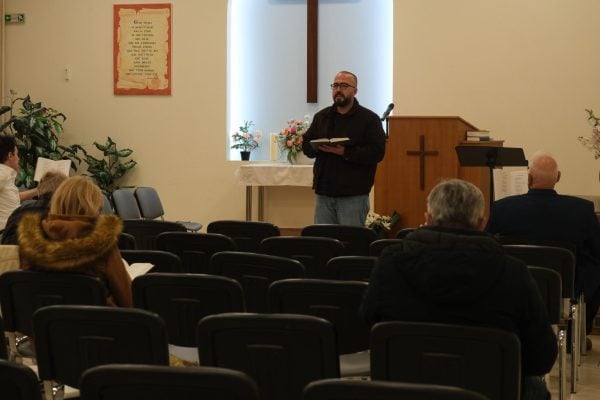
Ebrahim Fatahi helps lead the Farsi and Greek services at the Glyfada Church of Christ.
Fatahi arrived in Greece in 2017 through Samos Island as a refugee from Iran. Through worshiping and now ministering at the Glyfada congregation, he experienced the effects of the changing number of refugees firsthand. When Fatahi started worshiping with the church, he said anywhere from 80 to 150 people attended the Farsi-speaking service.
He said attendance — and the general population of Farsi-speaking refugees in Athens — decreased in 2019 partially because many refugees from the 2015 European migrant crisis received papers to move to other countries. Today, Fatahi added, the average attendance at the Farsi service is between 30 and 40 members.

Dino Roussos, minister for the Glyfada Church of Christ, sings from a Greek hymnal.
Fatahi said that when refugees who become Christians leave for other countries, it is a bittersweet experience for the preachers at Glyfada. They do not witness firsthand the growth of new believers, but they do hear about what those Christians are doing when they settle in other countries.
“It’s a joy, and it’s sad, and sometimes it’s strange,” Fatahi said.
Overcoming challenges and change
Missionaries Keith and Tricia Young, who worship at the Glyfada congregation, learned to adapt to the flow of refugees through Athens when they arrived in October 2021. The couple expected to work exclusively with Farsi-speaking refugees, but when they arrived, there were a lot of Ukrainian refugees because of the Russia-Ukraine conflict.
The Youngs adapted and began working with the Ukrainian refugees at the church. They later connected with nonprofit Hellenic Ministries and began serving Farsi-speaking refugees in the community.
“We never dreamed that we’d be working with the Ukrainian outreach and the Farsi,” Tricia said. “The Ukrainian outreach has taken off so much with so many people being baptized and starting to learn more about Jesus.”

Missionaries Tricia and Keith Young sit in a tree as they explore Athens with friends.
The couple attends the Greek, Russian/Ukrainian and Farsi-speaking worship services but said it has been hard for all the small groups to feel like one congregation. However, Young said that since the COVID-19 pandemic, leaders have encouraged interaction between the ethnic groups, and there is more crossover now. The smallest group at Glyfada is actually the Greek population, but Young said this gives the church more opportunities to evangelize.
“It gives the ministers here other audiences that might be more receptive,” Young said. “The refugee population has been the most receptive, especially the Iranian population. They were unhappy with what they had at home and they’re looking for something better.”
“It was traumatic for them when we talked about Jesus. This is the story they know, having to travel, going to Egypt to be in a safe place. They knew that story. It was their story, too.”
Young’s wife, Tricia, who teaches the children’s class during the Farsi service, said some of the children were receptive to the lessons because they could relate to the Bible stories.
“It was traumatic for them when we talked about Jesus,” Tricia said. “This is the story they know, having to travel, going to Egypt to be in a safe place. They knew that story. It was their story, too.”
The ebb and flow of refugees
The refugees with whom Fatahi and the Youngs work are some of hundreds of thousands of people seeking refuge in Greece. According to the International Rescue Committee, there are 214,000 refugees and 20,000 asylum-seekers in the country this year.
Major world events influence the number of refugees — and the countries from which they primarily come. Fatahi first saw the effects of the 2015 European migrant crisis, when over 821,000 refugees arrived in Europe through Greece.

A sign notes the Greek and English meeting times for the Glyfada Church of Christ.
A few years later, when the COVID-19 pandemic hit, Athens Institute for Education and Research President Gregory T. Papanikos said the government implemented strict border controls, temporarily reducing the flow of refugees and migrants.
Next, the Ukrainian refugee population in Greece increased with the escalation of the Russia-Ukraine war. Papanikos wrote in an October 2022 paper that the Greek government welcomed large numbers of Ukrainian refugees — about 32,600 arrived from January to May 2022.
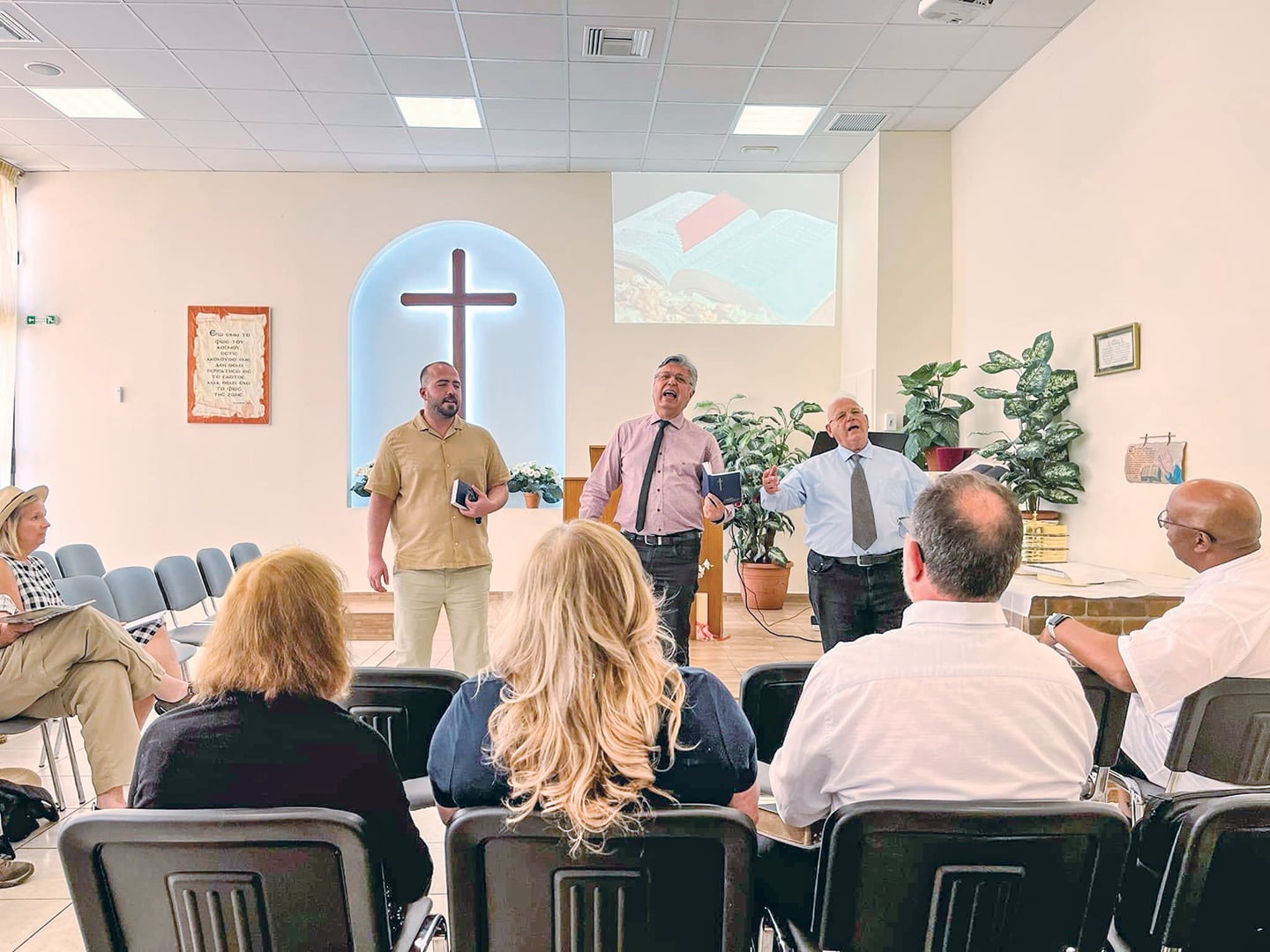
Ministers for the Glyfada Church of Christ in Athens, Greece, sing during a worship service. From left, they are Ebrahim Fatahi, Dimitrios Argyropoulos and Dino Roussos.
However, that meant the number of refugees accepted from other countries decreased.
One of the most recent world conflicts that could affect refugees in Greece is the war between Iran and the joint U.S.-Israeli forces. However, data from the Ministry of Migration in Asylum does not indicate a significant increase in Iranian refugees.

Leonid Ivanov
“To my knowledge, there is no clear evidence of (Iranian outmigration because of the war) or at least no official record,” Papanikos said. “Current reports from international organizations suggest that, despite significant internal displacement within Iran, there has not been a major cross-border exodus so far.”
Leonid Ivanov, Hellenic Ministries’ director of compassion ministry, has served with the nonprofit since 2017 and also observed the flow of refugees through working in the community. Ivanov, who came to Athens as a refugee from eastern Ukraine, said he remembered the years when refugees in Athens were primarily Farsi-speaking, and the nonprofit served over 500 meals daily. Then, he said, the majority were African refugees, and today, there are many Ukrainian refugees.
“The most rewarding (thing) about ministering to the refugee community is to see the transformation in the lives of refugees,” Ivanov said. “Of course, I mean first the spiritual transformation. … It’s great to see how Muslims become Christian. It’s good to see how people can integrate into society, into Athens.”
“The most rewarding (thing) about ministering to the refugee community is to see the transformation in the lives of refugees.”
If refugees choose to stay in Greece, like Fatahi, or if they only stay for a few months, the ministers at Glyfada serve however they can — by helping with housing accommodations, food distribution and of course, sharing the Gospel.
“Here, they find fellowship,” Glyfada minister Dino Roussos said. “It’s not just salvation for eternity, which is the most important, but while we’re on this earth, we need to have good fellowship and a good place. This is a refuge for those who are hurting and trying to find the truth.”
KENZIE JAMES is a senior multimedia journalism major at Harding University in Searcy, Ark., and a returning Christian Chronicle intern. James grew up in Tallahassee, Fla., where she attended the Timberlane Church of Christ. Contact kenzie@christianchronicle.org.