

DICKSON, TENN. — The sound of victory echoed throughout the halls of Nashville’s Vanderbilt-Ingram Cancer Center on May 7 as Chris McCurley pulled the rope and rang the gold bell, ending eight weeks of radiation treatment.
For many cancer patients, ringing the bell signals the end of their journey. But it marked another milestone in an ongoing battle for McCurley, minister for the Walnut Street Church of Christ in Dickson, 40 miles west of Nashville.
The preacher has spent the past two years navigating prostate cancer, a journey that led to a diagnosis of stage four metastatic disease. In its most advanced stage, the cancer spread outside of its original location earlier this year. While radiation successfully targeted tumors, his treatment continues through hormone therapy and medication.
Yet throughout daily chemotherapy treatments and hour-long commutes to Nashville, McCurley has embraced a phrase that has shaped his outlook: “Cancer can be a ministry.”
“I don’t believe God gave me cancer, but I certainly believe he’s used it,” the husband and father of three said.
‘Why am I scared?’
McCurley’s cancer journey began in February 2024, when rising prostate-specific antigen levels signaled to doctors that a malignant growth could be developing. An MRI and biopsy confirmed a small cancerous tumor, measuring about 1 millimeter in diameter, or about the tip of a needle.
Doctors offered the 49-year-old preacher several treatment options, including radiation and proton therapy. He ultimately chose radical prostate surgery to remove the tumor.
“To me, I had cancer and I wanted it out,” McCurley said. “And it wasn’t hard to convince me.”

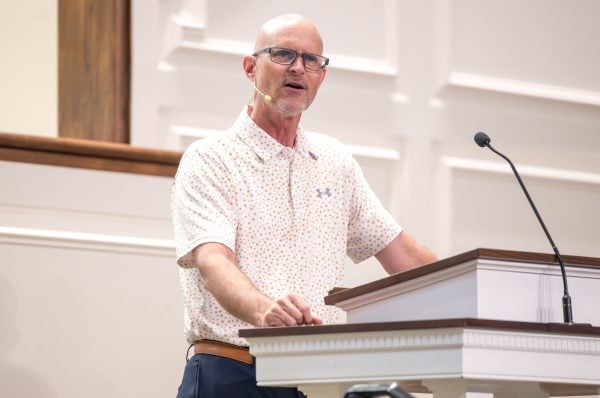
Chris McCurley preaches at the Walnut Street Church of Christ.
Although the surgery appeared successful, post-operation pathology revealed that the growth extended beyond the prostate capsule. Still, for nearly a year and a half, McCurley’s prostate-specific antigen levels remained undetectable.
In early 2026, as he prepared for the birth of his second grandchild, doctors found that the cancer had returned and progressed to stage four metastatic prostate cancer.
“I was scared. And I feel bad about that. I’m a man of faith. I’m a preacher. Why am I scared?”
“I was scared. And I feel bad about that,” McCurley said. “I’m a man of faith. I’m a preacher. Why am I scared?”
As the cancer spread to the bones, including the spine, femur and iliac bone, McCurley said he found peace in his relationship with God, leaning on a saying: “It’s you and me, no matter what, and it’s going to be OK.”
From that point forward, the diagnosis — and the faith that came along with it — became a daily reality, defined by chemotherapy treatments, long drives to Nashville and what he describes as unseen opportunities to share his faith.
‘This is life now — you’re a cancer patient’
After the stage four diagnosis, McCurley said the challenge shifted from treatment decisions to daily endurance. Working out at a higher intensity and taking naps on the couch in his church office became part of a new daily rhythm.
“This is life now,” he said. “You’re a cancer patient.”
For eight weeks, McCurley’s routine began early in the morning, with coffee and Bible reading before departing his Dickson home for the Vanderbilt-Ingram Cancer Center. There, he underwent a series of 10- to 15-minute radiation treatments.

Chris McCurley walks down the driveway holding the hand of his granddaughter, Ash Jobe.
Waiting for him at many of those appointments was Trace Pierce, a radiation therapist at Vanderbilt and a fellow member of the Walnut Street church. Pierce first reached out after watching McCurley announce his diagnosis on Facebook, offering support and connections with medical resources at the hospital. As treatment progressed, the two developed a strong bond.
“The hardest part sometimes is just waking up every day and driving in for 39 treatments,” Pierce said. “That takes a toll in itself.”
As the weeks passed, McCurley began to feel the side effects of radiation on his body. But even on days when the preacher wasn’t feeling his best, Pierce said, few people in the waiting room and during his treatments would have known.
“He’d still come in, talk to everybody, ask how they were doing and offer to pray with them,” Pierce said. “That’s just who he is as a person.”
Those interactions became an unexpected blessing in a new season of life. McCurley said he does not miss the radiation, but he does miss the fellowship shared in waiting rooms and hospital hallways.

Chris McCurley and his wife, Libby, pose for a picture during a University of Arkansas baseball game.
“There is a sense where I’m going to miss these because you develop these friendships,” he said. “You sit in the lobby and meet these people who are there every day that had a brain tumor removed, and you get to sit there and counsel with them and do ministry, and they do ministry with you.”
The same openness that led McCurley in forming relationships at Vanderbilt reinforced a belief that had guided him throughout his walk: Even cancer can be a ministry.
“Cancer has been such a big blessing to me in so many ways,” he said. “There are things I would never have experienced if not for this diagnosis.”
‘This is a God story’
For the Walnut Street minister, that ministry did not end when he left Vanderbilt’s waiting room. Even with stage four metastatic cancer and ongoing hormone therapy through medication, McCurley continues preaching the glory of God. The cancer and an uncertain future remain, but so does his trust in faith, family and his belief that “God wins.”
Between treatments and sermon preparations, McCurley avoided turning his cancer journey into the focus of his mission. Instead, he documented every step through a series of Facebook posts, providing updates and showing appreciation for prayers.
What started as simple updates became a lifeline for many members of his congregation looking for ways to support their preaching minister.
“The videos keep us informed so we know how to pray for him,” said Joanne Brown, who has attended Walnut Street since 1976. “He’s definitely seeing that love and support full-fledged because of what he’s going through.”
The updates also reflect a philosophy that, church leaders say, has defined McCurley’s ministry since he joined the congregation in 2022, long before his diagnosis.
“It’s a story about how God has navigated Chris McCurley through cancer, and how Chris McCurley is going to win because God wins.”
“Ministry is not a thing you do on Sundays. It’s your life,” Walnut Street shepherd Brian Reagan said of McCurley, who’s authored multiple books and hosted over 200 episodes of the “Dear Church” podcast.. “Chris has extended that into speaking in very real, transparent terms about what’s going on in his life.”
Even as the possibility of recurrence remains, McCurley said he does not view his story as one defined by illness but by faith. The bell at Vanderbilt marked the end of his radiation treatment but not of his ministry.
“This is not a Chris McCurley cancer story. This is a God story,” he said. “It’s a story about how God has navigated Chris McCurley through cancer, and how Chris McCurley is going to win because God wins.”
EPHRAIM RODENBACH, a sports journalism major at Middle Tennessee State University in Murfreesboro, Tenn., is a Christian Chronicle intern. Contact ephraim@christianchronicle.org.