
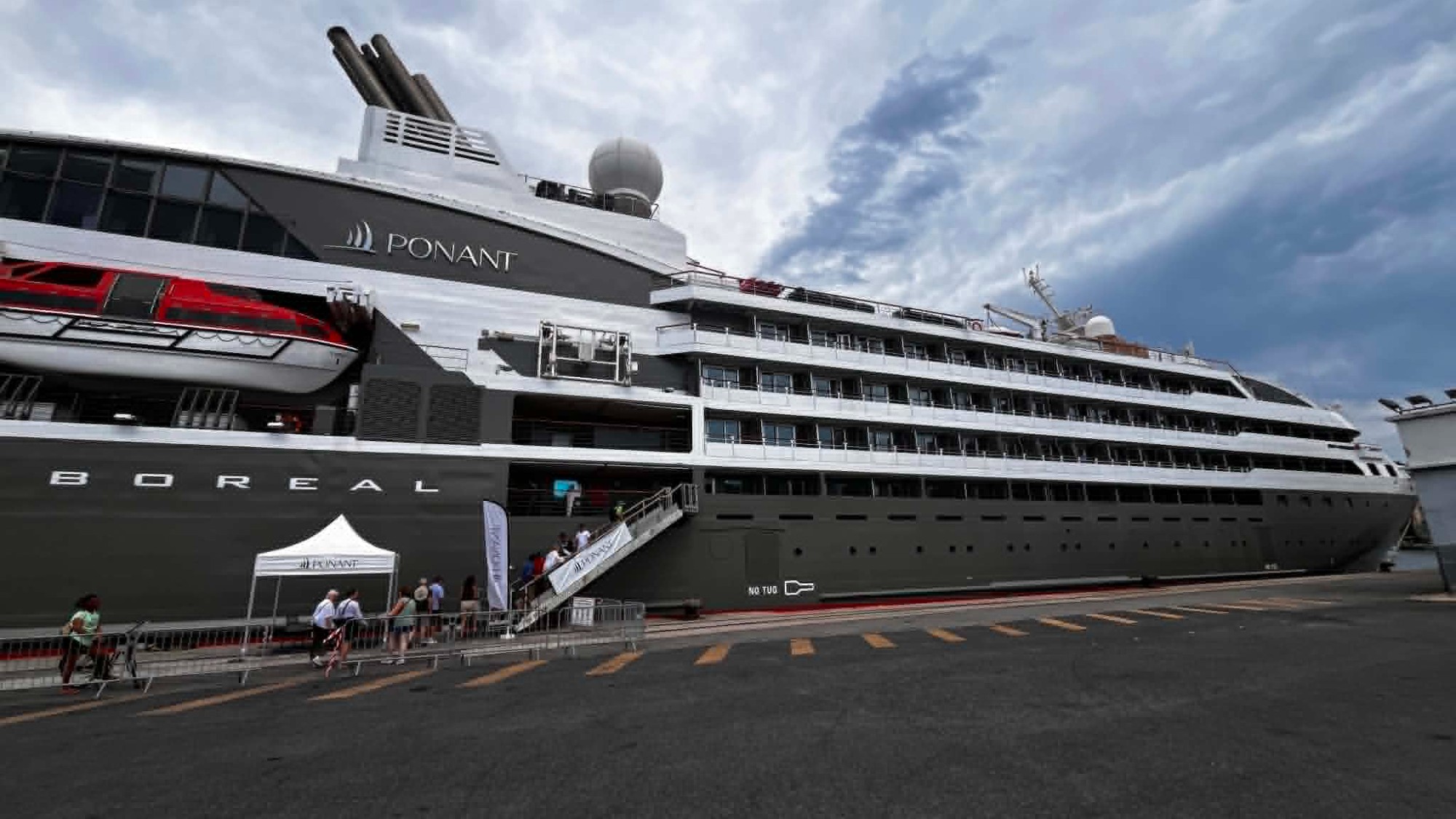
When the 11,000-ton cruise ship Le Boréal set sail from Nice, France, on Thursday, Aug. 6, its 205 passengers and 136 crew members began a voyage whose success would depend not only on careful planning, but also on the ship’s ability to outmaneuver clouds at the last critical hour.
The ship is owned and operated by the French cruise line Compagnie du Ponant. This eclipse cruise was the result of more than a year’s planning by Ponant, and most of those who signed on were there specifically to witness the celestial spectacle; that shared purpose heightened the drama of the eclipse itself.
This was going to be a sunset eclipse, with the sun no more than three degrees above the horizon. To picture that height, make a fist and hold it out at arm’s length. Place the bottom of your fist on the horizon; the top of your fist measures about ten degrees. During totality, the sun would appear only about one-third of a fist-width above the horizon. Even if the sky overhead was clear, clouds could still gather near the horizon, leaving open the possibility that the sun might be hidden at the critical moment.
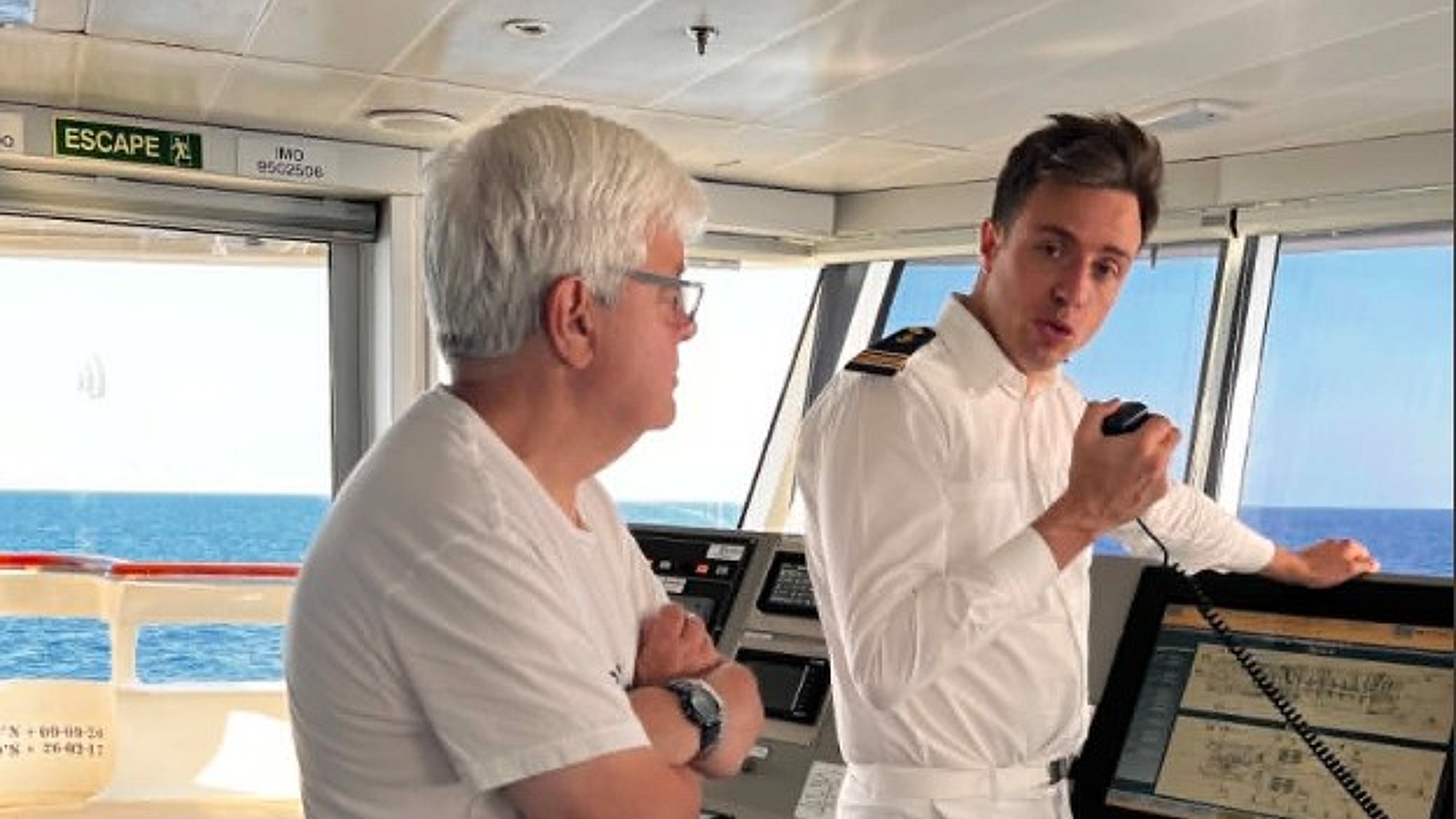
I was on board Le Boréal as both a lecturer and the ship’s onboard meteorologist. The main advantage of using a cruise ship to view an eclipse is its two-dimensional mobility, allowing it to maneuver around potential cloud cover. In practice, that meant working with Captain Mathieu Tsingrilaras to position Le Boréal on eclipse day in a location free of any clouds that might otherwise obscure the total eclipse.
Although the Iberian Peninsula and the adjacent waters of the Balearic Sea — a body of water between mainland Spain’s eastern coast and the Balearic Islands — typically enjoy warm, dry, clear weather in August, the circumstances of this eclipse could still prove problematic.
Also serving as a lecturer for the cruise was Serge Brunier, a well-known French photographer, reporter, and writer who has specialized in popular depictions of astronomical subjects. He is also the co-author of the beautiful coffee-table book, Glorious Eclipses.
Serge would accommodate the French-speaking passengers onboard. Early in the cruise, as we were speaking with each other, a French passenger came up to Serge and asked, “Le temps sera-t-il dégagé pour l’éclipse?” (“Will we have clear weather for the eclipse?”). Serge nodded toward me and replied: “Il faudra demander à Joe ; c’est lui qui s’occupe de la météo.” (“You will have to ask Joe; he is in charge of the weather.”)
Our itinerary took us to many different places during our eight-day cruise, including two towns in Corsica (Calvi and Bonifacio), the French cities of Marseille and Port-Vendres as well as Spain where we stopped at Barcelona and Palma de Mallorca in the Balearic Islands. Through it all, we experienced weather that was mainly sunny, very warm and quite humid. An upper-level ridge of high pressure acted as a heat dome over much of Europe.
Weather threat on eclipse day
The first warning came on Aug. 10, when a minor disturbance rippled through the heat ridge and produced widespread clouds, showery rains and thunderstorms across eastern Spain, spilling into the eclipse zone over the adjacent Balearic Sea. Had the eclipse taken place that day, no amount of mobility would have brought us a clear view. Fortunately, the disturbance quickly moved east, allowing high pressure to build back over the region.
By eclipse day, Aug. 12, conditions appeared to have turned in our favor. The day began beautifully sunny and continued that way into the afternoon. Our ship was docked at Palma de Mallorca, then set sail at 4 p.m. Central European Summer Time (CEST) for our preselected viewing location, heading west-northwest along the center line of the path of totality.
Shortly after departure, images from EUMETSAT, a geostationary weather satellite looking down from 22,000 miles (35,400 km) above Europe, revealed the problem we had been trying to avoid.
A large convective cloud — formed when warm, damp air rises into colder air above — began to rapidly evolve over part of Spain’s coastline just inland from the Gulf of Valencia. It soon became apparent that if we did not alter course, that cloud would almost certainly block our view of the total eclipse.
After consulting with Captain Tsingrilaras, we decided to take Le Boréal southwest. That maneuver would cause the cloud, then directly ahead of us, to shift to the right of the sun as it descended the west-northwest sky, improving our odds for viewing totality.
That course correction became the turning point of the voyage.
Totality at sea
As the eclipse began, other cruise ships apparently stayed their original courses. Le Boréal’s course change, however, kept us clear of significant cloudiness, aside from a few thin clouds that occasionally crossed the sun but did little to hinder the show. At 7:37 p.m. CEST, the moon took its first bite out of the lower right limb of the sun.
At 8 p.m., Captain Tsingrilaras oriented Le Boréal, so that the back of the ship (the stern) faced directly toward the sun. Crowds gathered on the top three decks of the ship, observing the sun through special eclipse glasses that had been distributed the previous evening.
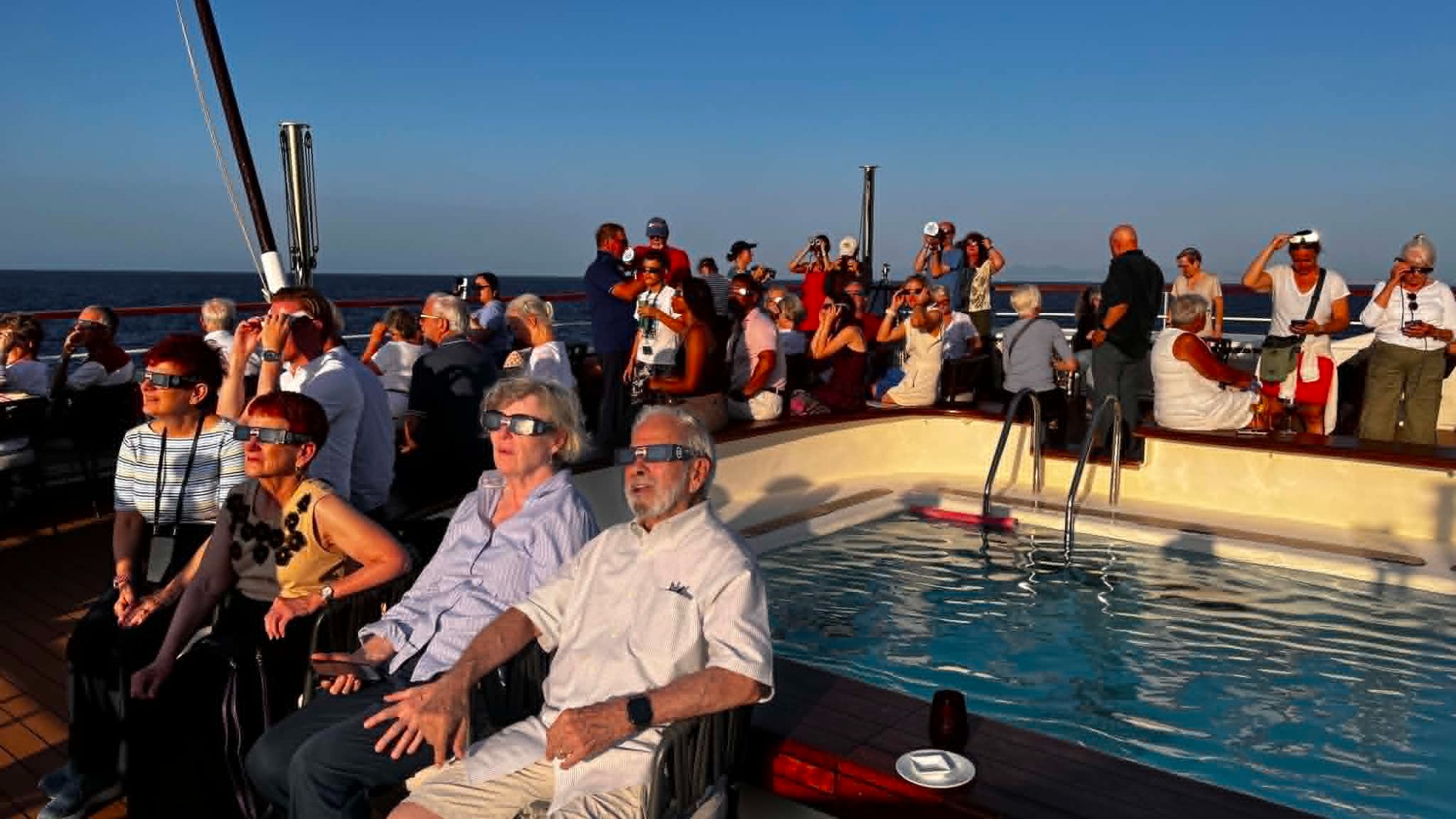
Moments before totality, when only a sliver of sun remained, I told passengers that I had been asked since the start of the day about what our chances were for seeing the total eclipse. “I think our chances of seeing it are now 100 percent!” That comment was met with a resounding cheer.
What was particularly striking was the approach of the moon’s shadow; a diffuse darkening accompanied by a rapid west-to-east sweep of darkness. The onset of totality was marked by a dazzling diamond ring effect which lasted a couple of seconds, then a circular corona appeared around the darkened solar disk; it appeared somewhat yellowish in color as opposed to pearly white, likely due to a layer of haze near the horizon.
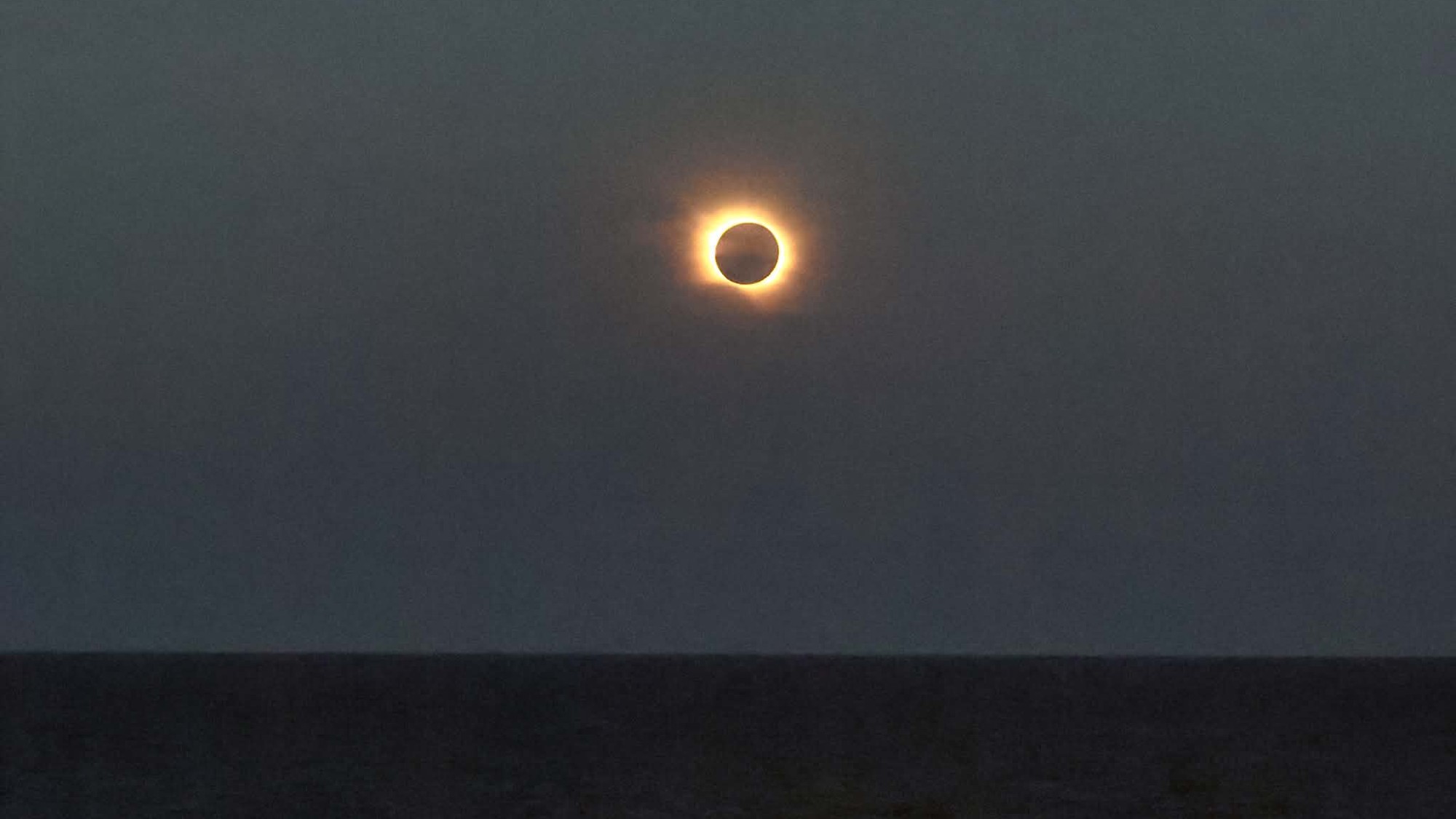
An unusually large and brilliant red prominence, readily visible even with the unaided eye, appeared at the 9 o’clock position. Because the sun was so low in the sky, the famous moon illusion caused it to appear especially large. This only added to the beauty of the spectacle.
Totality lasted 95 seconds. Even at its midpoint the overall light never became so dim that the second hand on a watch was hard to see. The only other object that was plainly visible in the sky was Venus, well off to the upper left of the eclipsed sun. The air temperature did not change much, probably due to the thermal inertia of the surrounding water.
The terminal diamond ring was perhaps even more stunning than the first. The corona could be kept in view for several seconds by blocking out the emerging crescent of sunlight with one’s thumb. It seems that no shadow bands were observed either before or after totality.
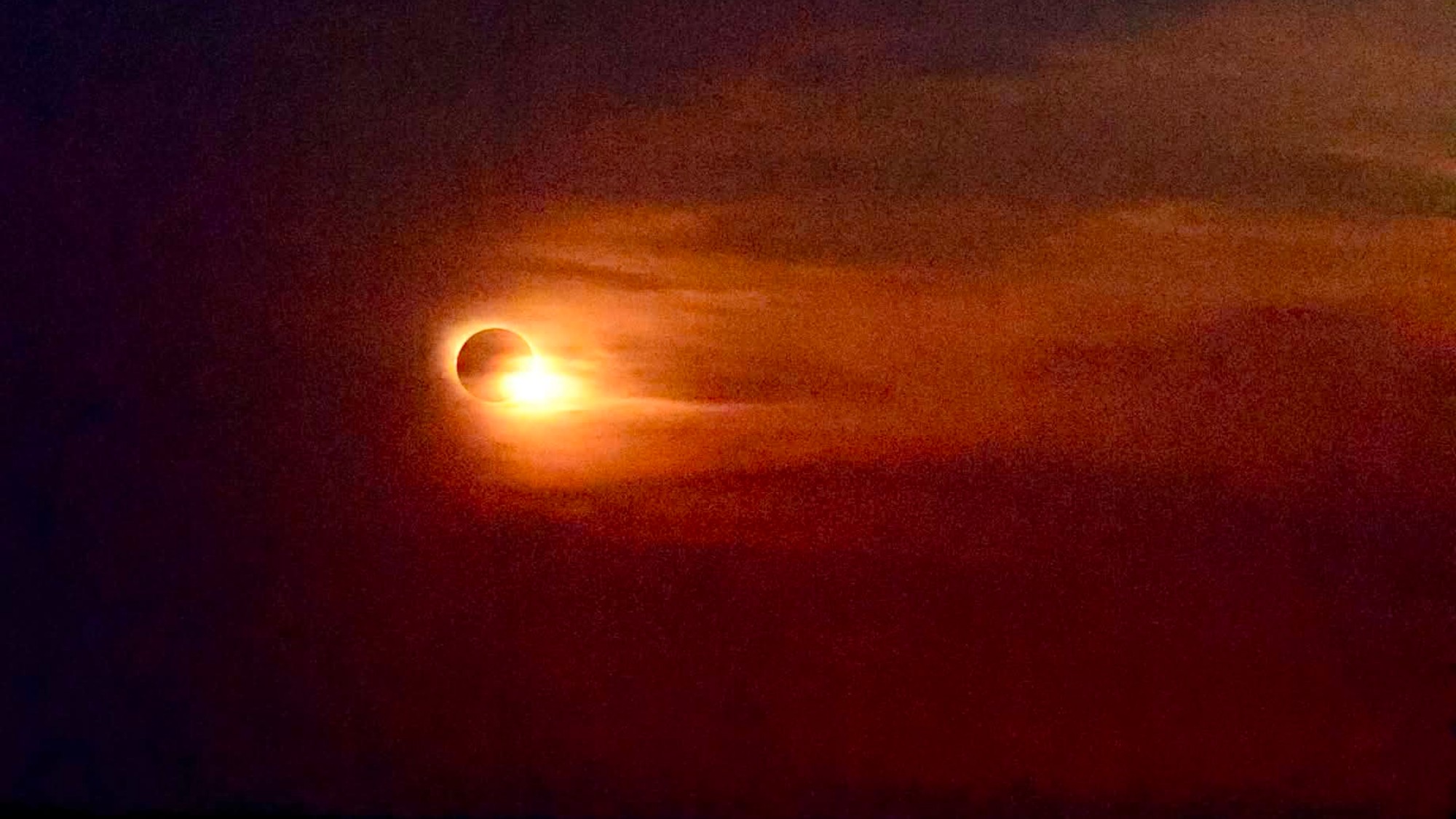
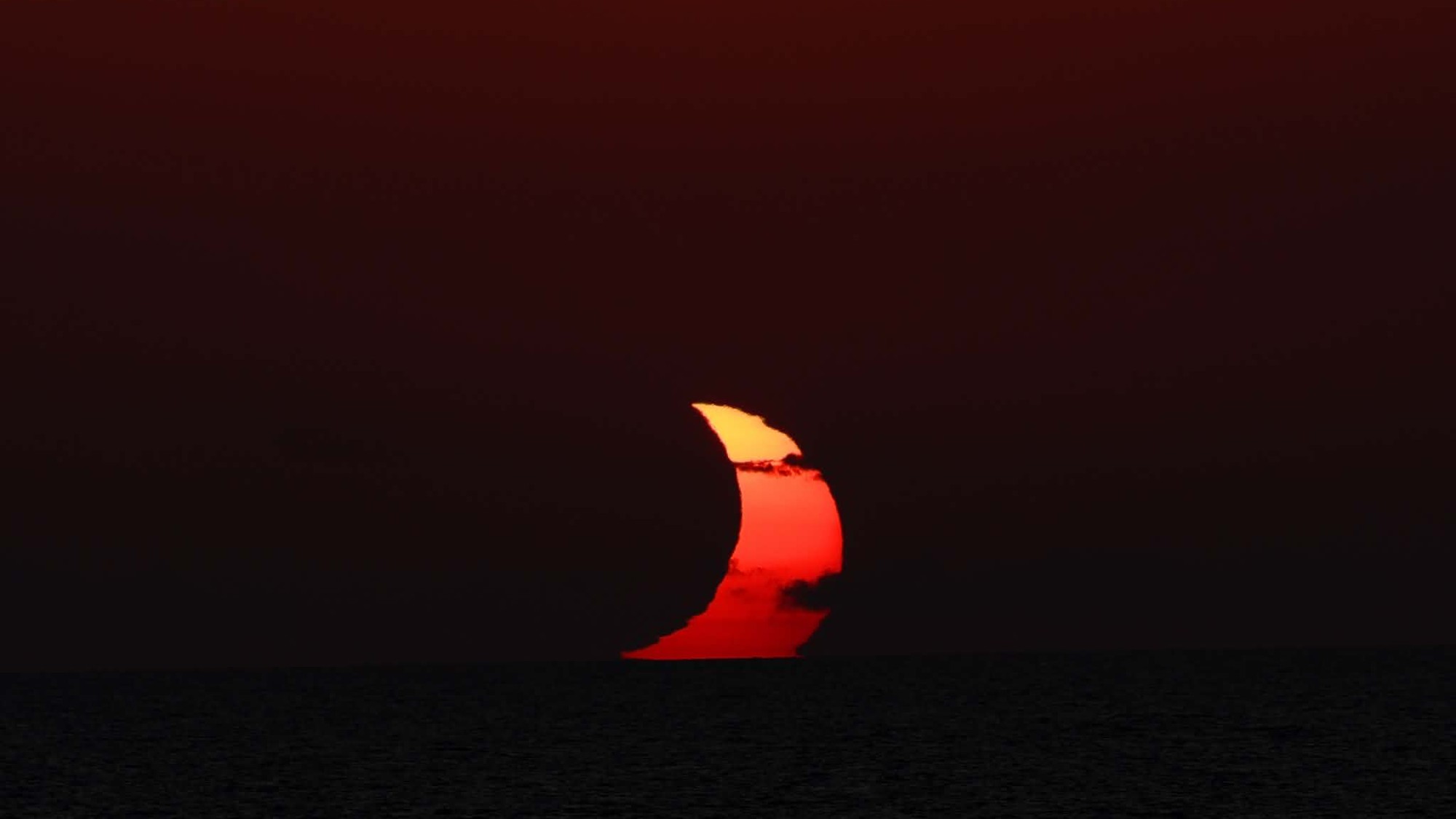
As the sun gradually emerged from behind the moon, it sank lower in the sky and was still about two-thirds covered when it took on the shape of an orange-red shark fin disappearing beyond the horizon — a fitting final image for a spectacular eclipse at sea.
Nothing succeeds like success
In the end, Le Boréal’s successful eclipse viewing was a reminder that even the most carefully planned astronomical event still depends on swift judgment and adaptability. By combining advance preparation with a timely course correction, the voyage transformed a looming weather threat into an unforgettable view of totality.
I would also like to thank my wife, Renate, who accompanied me on this amazing adventure and for reading so much for reading my first draft of this article and to my daughter Maria and Scott Zimmerman for assisting me with my video and image selections.
Joe Rao serves as an instructor and guest lecturer at New York’s Hayden Planetarium. He writes about astronomy for Natural History magazine, Sky and Telescope, The Old Farmer’s Almanac and other publications.