

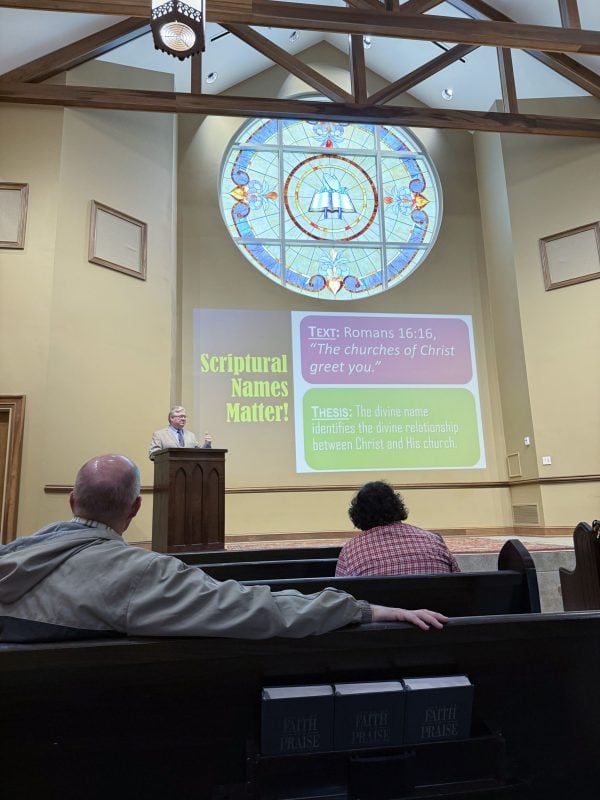
MONTGOMERY, ALA. — Sectarian label or divine ownership? What does it mean to be called Churches of Christ?
“That divine name identifies that sacred relationship between Christ and his church,” said Mark Posey, minister for the Winfield Church of Christ in Alabama.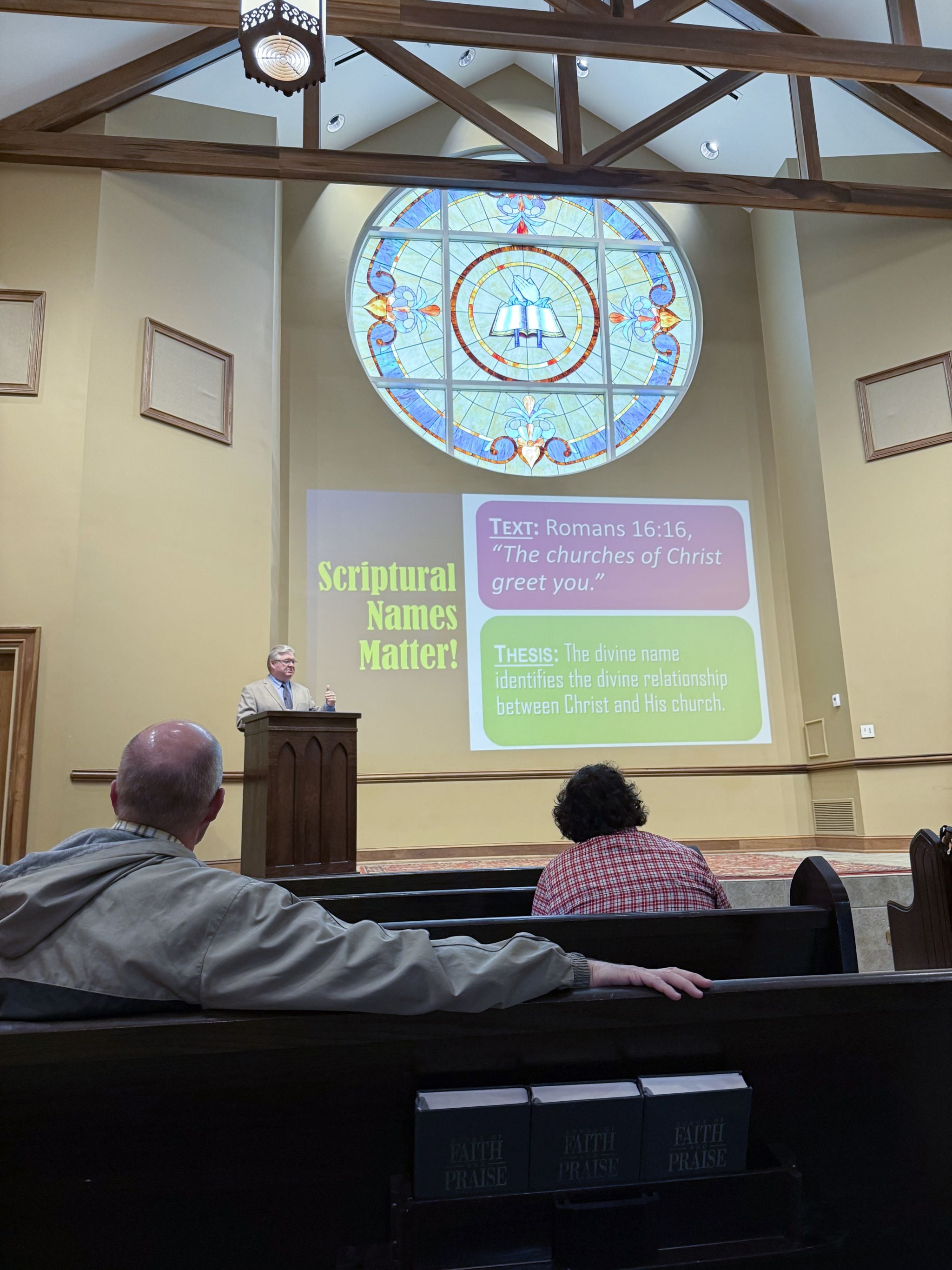
“The church, it belongs to Christ,” Posey added in a recent lecture at Faulkner University in Montgomery. “Therefore it should wear only names that glorify Christ, reflect Scripture and certainly preserve our unity. “
“I understand it descriptively,” echoed Charles Teddington, who preaches for the Vintage Park Church of Christ in Elk Grove, Calif.
“It’s not a title, like a corporate title. It’s not a denominational name. It’s a relational statement, and it’s a declaration of ownership.”
“It’s not a title, like a corporate title. It’s not a denominational name. It’s a relational statement, and it’s a declaration of ownership.”
The description “churches of Christ” has its origins in Scripture. The apostle Paul wrote in Romans 16, the closing salutations of his letter to the church in Rome, “All the churches of Christ send greetings.”
This is part of a series exploring the identity of Churches of Christ. Read more here.
But the 19th century American Restoration Movement popularized the use of the identifier, along with “Christian Church” and “Disciples of Christ.”
For a group of believers intent on being “Christians only” with “no creed but Christ” — as popular phrases in the movement went — it was a rejection of denominational names in favor of biblical descriptors.
“When Scripture calls it either the churches of Christ plural or we see the emphasis in regard to the church our Lord and Savior Jesus Christ built, it reflects and declares those that are called out that belong to Christ,” Posey said.
“Not to Luther, not to Wesley … not to Campbell, not to Stone,” he added, referring to the Protestant Reformation figure Martin Luther, Methodist Church founder John Wesley and Restoration Movement leaders Alexander Campbell and Barton Stone.
Not just ‘the right denomination’
“Church of Christ” eventually became the “the more common name for more doctrinally conservative congregations,” noted John Young, a Restoration Movement scholar at Amridge University in Montgomery.
Teddington said he believes many Christians have misunderstood the name.
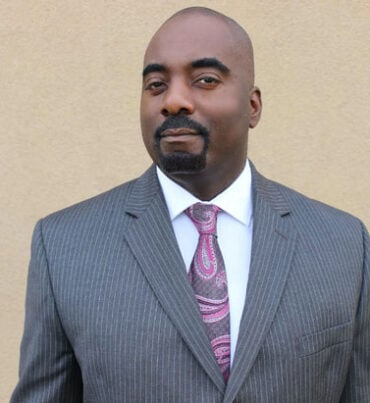 “I would say that it’s very plausible that it almost seems to be like a brand,” the California minister told The Christian Chronicle. “I don’t personally see it that way, but … it seems like the lack of understanding of what Christ was saying has made this a brand, maybe even unintentionally.”
That tension between Scriptural descriptor and denominational label is not a new one.
In a 1964 issue of the Chronicle, M. Norvel Young — then-president of Pepperdine University in Malibu Calif., which is associated with Churches of Christ — lamented a growing misconception.
“As the plea for non-denominational New Testament Christians becomes more popular and is accepted by more people it is easy for those who make the plea to accommodate themselves to thinking of the church as ‘the right denomination’ rather than the non-denominational Kingdom, the body of Christ, which includes all those through the ages who have obeyed the gospel and who have been added by the Lord. …
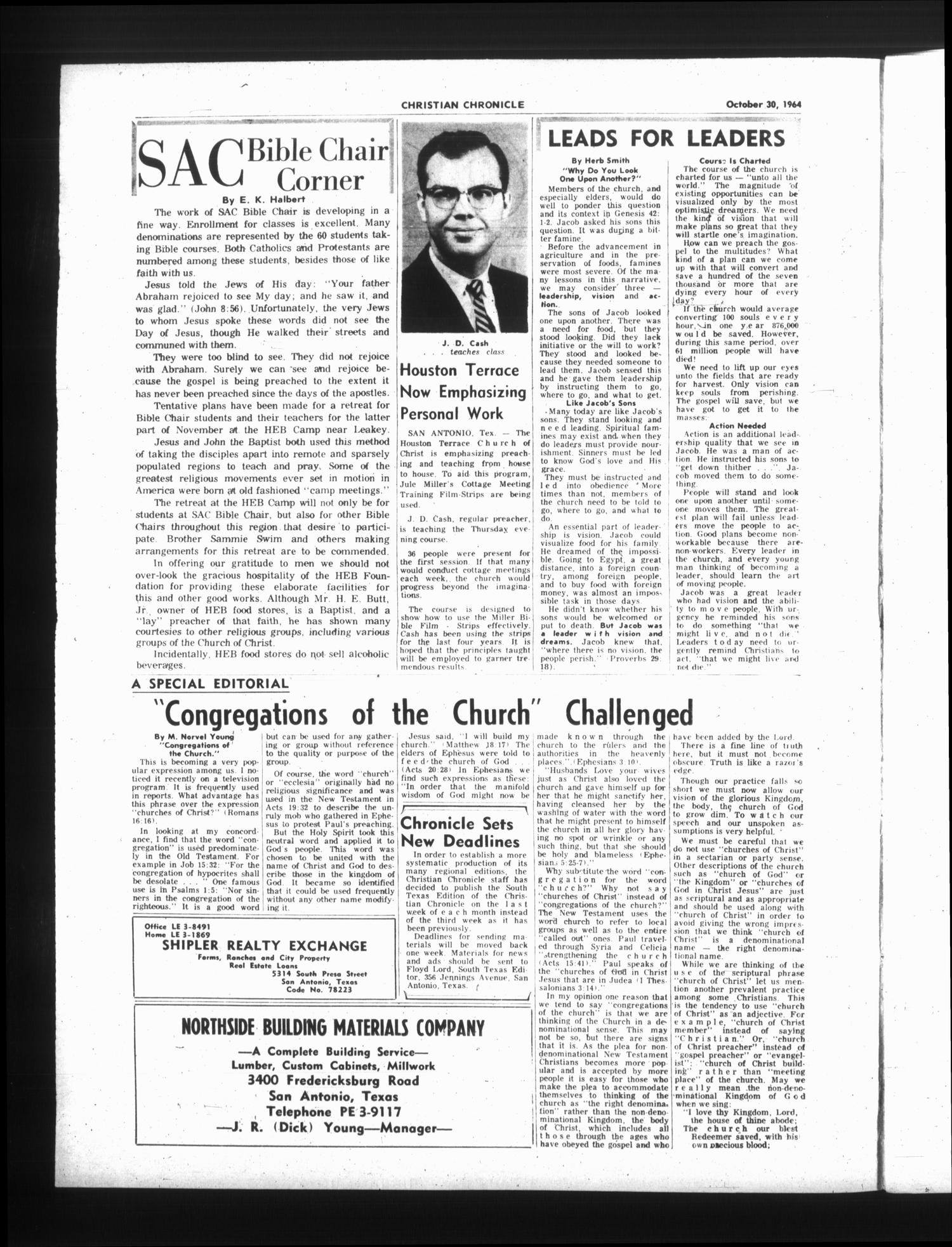
In the Oct. 30, 1964, issue of The Christian Chronicle, M. Norvel Young writes a special editorial on “Congregations of the Church.”
“We must be careful that we do not use ‘churches of Christ’ in a sectarian or party sense,” Norvel Young added. “Other descriptions of the church such as ‘church of God’ or ‘the Kingdom’ or ‘churches of God in Christ Jesus’ are just as Scriptural and as appropriate and should be used along with ‘church of Christ’ in order to avoid giving the wrong impression that we think ‘church of Christ is a denominational name.”
About 20 years ago, The Christian Chronicle began using the capitalized “Churches of Christ,” in keeping with The Associated Press Stylebook’s recommendation for news reporting.
Some readers object to the practice, expressing concern that capitalizing “Church” and using the fellowship’s name as a modifier (as in “Church of Christ preacher”) is tantamount to identifying the fellowship as a denomination.
‘A secret handshake’
Jeff Brown, minister for the Woodmont Hills Church in Nashville, Tenn., said “Church of Christ,” like denominational names, has become for many a “shorthand for sorting people in groups” with specific expectations. Woodmont Hills considers itself a Church of Christ, though it no longer prominently uses the name.

Jeff Brown
“I grew up in Oklahoma in Churches of Christ, and it did often feel like it was like a secret handshake,” Brown told the Chronicle. “If somebody said, you know, I am a member of the church, it’s like, oh, they’re part of a Church of Christ. That was like the wink and the nod that they’re one of us.”
The Tennessee preacher noted, too, that the phrase “Church of Christ” means different things to different people.
“What I have discovered it means to people has a lot to do with where they came from. … I think it depends a lot on what your first experiences were, whether they were good or bad,” Brown said.
When the a cappella Northside Church of Christ and instrumental Sunrise Church of Christ in Spokane, Wash., merged in 2024, perceptions were a major factor as leaders discussed whether their new name should include “Church of Christ.”
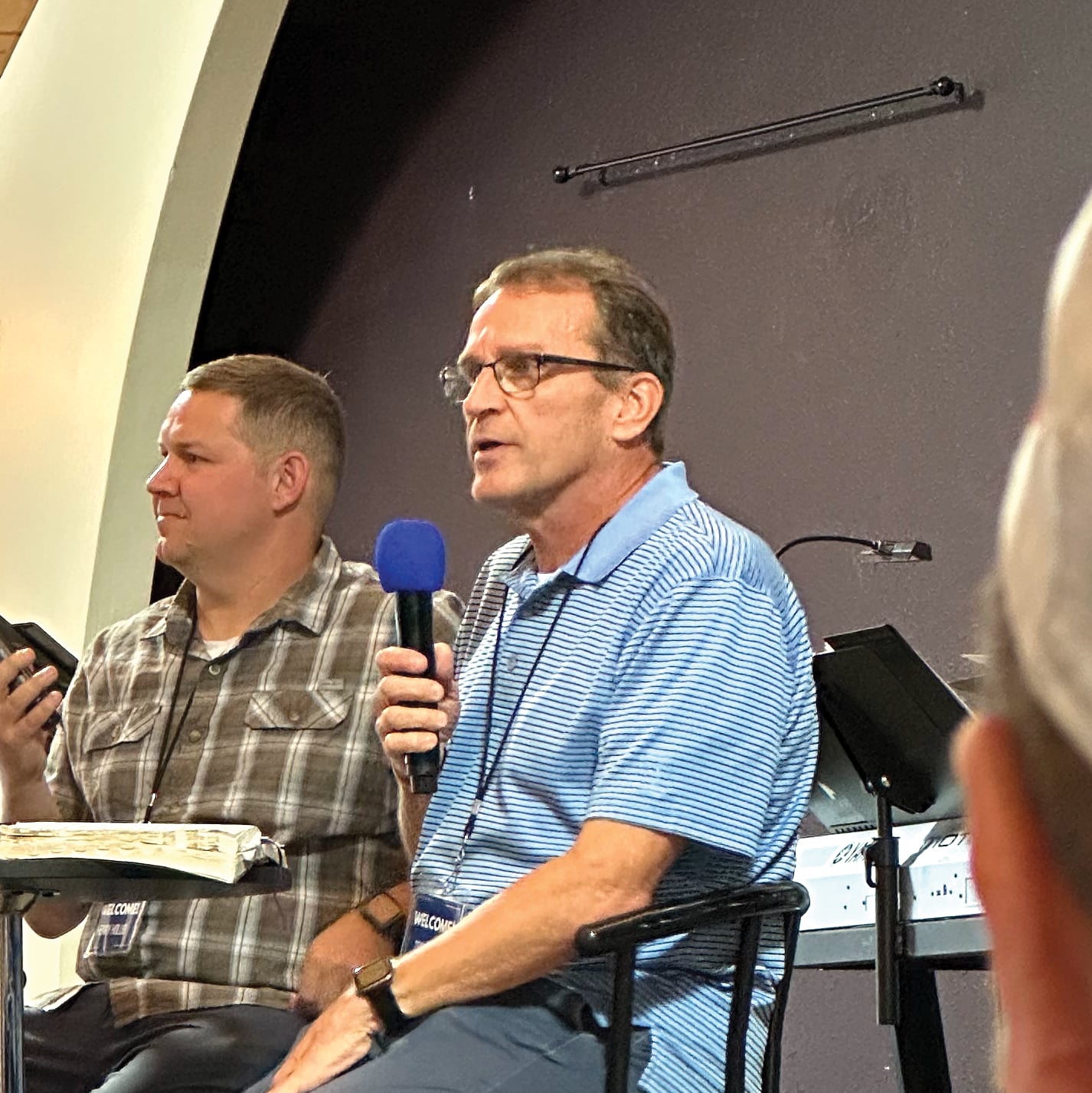
Troy Burns, right, and Henry Holub preach at the CityLight Church’s first service.
Most Christians associated with Churches of Christ would expect an a cappella congregation, said Troy Burns, preacher for the merged church, called CityLight Church: A Church of Christ Family.
Despite having preached for the instrumental Sunrise church previously, Burns said even he primarily associates “Church of Christ” with a cappella worship.
At the same time, others in the region would associate the phrase with The Church of Jesus Christ of Latter-day Saints, also known as the Mormon church.
And for the unchurched members of the surrounding neighborhoods, “the name ‘Church of Christ’ doesn’t necessarily mean anything,” Burns added.

Park Linscomb
Still, the history and tradition associated with the name was important to many members, especially those from the former Northside church.
“There’s a number of people that it was really difficult for them to think about us not having that name included,” Burns told the Chronicle.
Dropping the designation can say as much as including it, said Park Linscomb, minister for the Rock Hill Church of Christ in Frisco, Texas.
“These days, deliberately omitting ‘Church of Christ’ from public advertising is almost always a way of saying that the congregation has left the brotherhood’s doctrines of a cappella music, baptism and/or male leadership,” Linscomb said.
‘Scriptural names’
So does the name on the sign even matter?
No — but yes, said several ministers.
“To think that somebody selected a different name, and they’re somehow ruled out from being in the body of Christ — I just don’t see any evidence at all in Scripture that God is concerned, that God requires or desires a specific name on the sign,” said Brown, the Nashville preacher.
“I just don’t see any evidence at all in Scripture that God is concerned, that God requires or desires a specific name on the sign.”
It’s not the name but the fruit that shows whether a church body belongs to Christ, he added: “Let’s look deeper than the name on the sign or even the printed order of worship on a Sunday morning — to look for evidence of the work of God, for the fruit of the Holy Spirit.”
Teddington, the California preacher, went even further: “Do you need a name on the building at all? You don’t.
“And how do you tell that someone is subscribing to New Testament doctrine?” he added. “By what they’re teaching and by what they’re practicing based upon what they’re teaching. And the first century church didn’t have this problem because the only Christian movement was Christ.”
Still, Teddington and other preachers emphasized that if a name — or description — is used, it must be biblical.

Clint Davison
“I don’t believe the specific name ‘Church of Christ’ is a mandatory thing, as long as a group uses a biblical name which identifies who the worshipers truly are — the church, the assembly, the called-out, who belong to Jesus,” said Clint Davison, associate minister for the Linder Road Church of Christ in Meridian, Idaho.
“Congregations should guard against titles or slogans that detract from the cross,” Posey said in his lecture, titled “The Lord’s Church Wears Scriptural Names.”
He recalled what his father, Glenn Posey, a longtime preacher in Churches of Christ, told him: “Remember, the Church of Christ wears his name because it bears his cross.”
CALVIN COCKRELL is Managing Editor for The Christian Chronicle and serves as the young adult minister for the North Tuscaloosa Church of Christ in Alabama. Reach him at calvin@christianchronicle.org.