
Half a century after first putting hardware down on Mars, NASA is looking to explore the Red Planet’s skies.
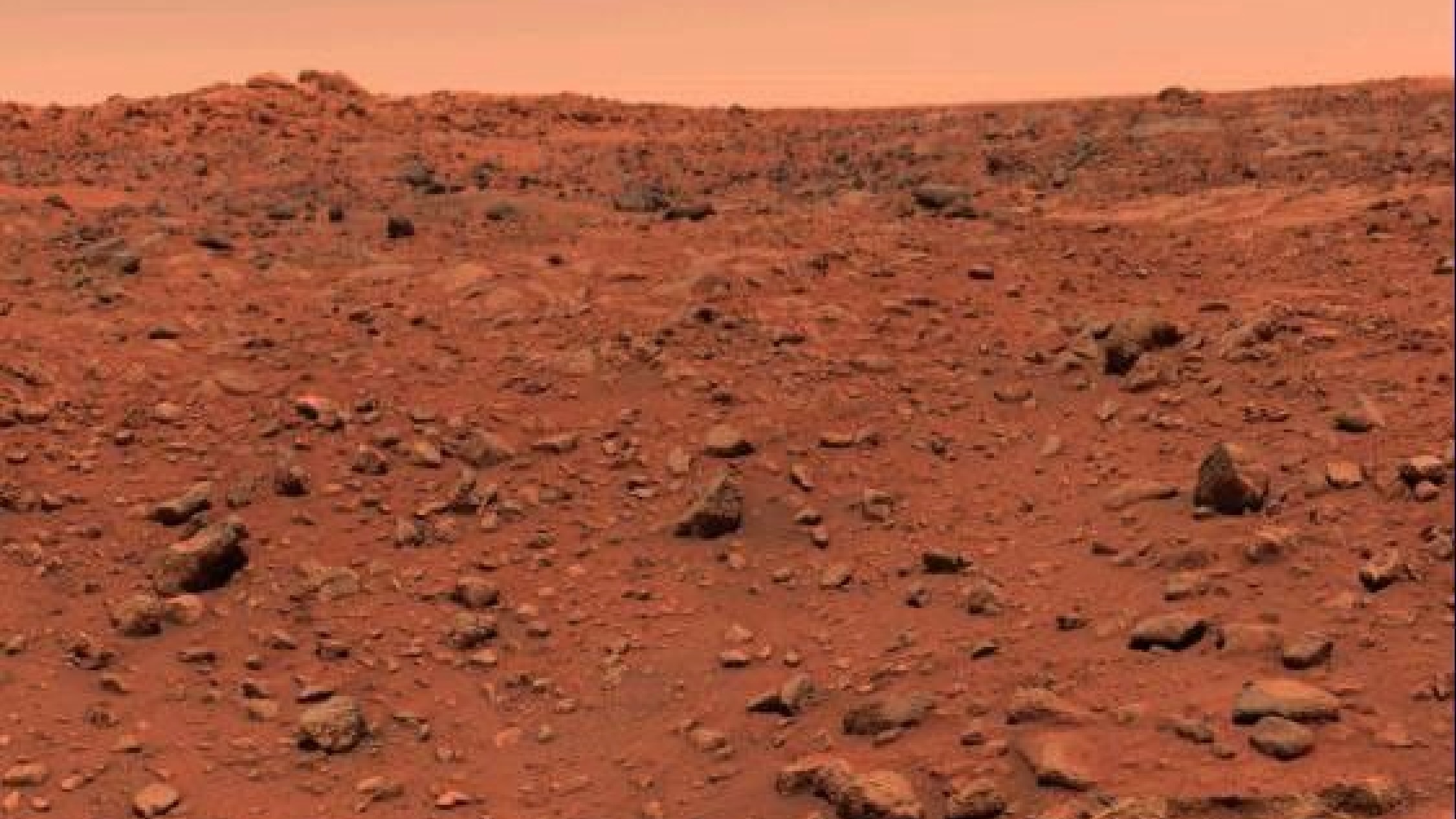
On July 20, 1976, the Viking 1 lander touched down in the western reaches of Chryse Planitia (the “Golden Plain”), a large circular landform that lies 22.5 degrees north of the Martian equator.
It was the first-ever Mars landing for NASA. Viking 1, along with its twin Viking 2, went on to conduct the first fully successful mission on the Red Planet’s surface. (The Soviet Union’s Mars 3 probe survived its touchdown attempt on Dec. 2, 1971 but died less than two minutes later.) And those missions have left a rich and intriguing legacy.
Viking 1 and Viking 2 — which touched down in a different Red Planet region on Sept. 3, 1976 — were sent to the surface to search for signs of life on Mars. (Each mission also featured an orbiter, which studied the planet from above.)
The landers did this using three different experiments, two of which returned negative results. But the third, called Labeled Release (LR), was different. LR observed a steady stream of carbon dioxide gas coming from dirt into which it had introduced nutrients — a possible sign of microbial metabolism.
Some scientists deemed the LR results a likely life detection. But most disagreed, ascribing them to abiotic reactions and stressing that, overall, the Viking data paint a picture of a dead planet.
That disagreement illustrates one of the main legacies of the Viking program: It showed researchers that hunting for extraterrestrial life is a complicated business, and they needed to learn more about Mars before attempting the search again on the Red Planet.
NASA didn’t send a surface craft to Mars for another two decades, a hiatus caused in part by the Vikings’ ambiguous results and high price tag, as well as a shifting of funds to the nascent space shuttle program.
The dry spell was broken in July 1997, when the agency’s Pathfinder lander touched down in Chryse Planitia, about 530 miles (850 kilometers) from Viking 1. The main goals of Pathfinder’s mission were to demonstrate a new “faster, better, cheaper” method of Mars exploration, prove out a new airbag-based landing system and get a mobile robot onto the red dirt.
Pathfinder achieved all of these objectives, notching the third by deploying a small rover named Sojourner. The little wheeled robot stumbled across rounded pebbles — strong evidence that they had been exposed to flowing water.
This discovery helped shape a new NASA Mars exploration strategy, one that aims to make an informed search for alien life after “following the water.” Life as we know it depends on water, so the agency built rovers designed to hunt for signs of past liquid water and potentially habitable environments.
The twin golf-cart-sized rovers Spirit and Opportunity landed in 2004, and the car-sized Curiosity followed suit in August 2012. Then came Perseverance, which landed inside Mars’ Jezero Crater in February 2021.
All of these wheeled explorers found evidence of past aqueous environments. Curiosity and Perseverance — with their more extensive and sophisticated scientific payloads — delved even deeper, discovering complex organic molecules that may have been produced by life as we know it.
The two latter rovers are continuing their work; both remain active on the Red Planet. (Pathfinder and Sojourner operated for about three months; Spirit was declared dead in 2010 and Opportunity fell victim to a Mars dust storm in 2018.)
Perseverance has collected a variety of Mars samples, which NASA wants to return to Earth for detailed study. As the Vikings’ experience suggests, such a level of intense scrutiny may be necessary to make a definitive detection of life on Mars, if it indeed exists. (Getting those samples home is not a foregone conclusion, however; NASA’s original plan was deemed too expensive, and it’s now looking into a new return strategy.)
Perseverance also carried a little robotic companion, which heralded a new phase of Red Planet exploration — the Ingenuity helicopter.
Ingenuity was a technology demonstration, designed to show that rotorcraft could effectively ply the thin Red Planet skies. (Mars’ atmosphere is just 1% as dense as that of Earth at sea level.)
The $80 million mission was a rousing success. The 4-pound (1.8 kilograms) Ingenuity was expected to make just five short hops on Mars but ended up flying 72 times over the course of nearly three years of activity. (Its first flight occurred on April 19, 2021, and its last was on Jan. 18, 2024.)
So NASA aimed higher, drawing up plans for future helicopter missions that could collect valuable scientific data. And such a mission is on course to launch in 2028, if all goes according to plan: Skyfall, which will send three Ingenuity-like choppers to Mars on a nuclear-powered rocket.
“Equipped with a suite of scientific instruments, these aerial scouts will map hidden ice deposits and analyze weather patterns,” NASA officials wrote in a description of Skyfall. “The mission will also demonstrate how aerial vehicles can generate wide terrain and subsurface maps to identify safe and resource-rich destinations for future American astronauts venturing to Mars.”
And Skyfall could be just another step toward even more ambitious aerial exploration on the Red Planet. NASA’s Jet Propulsion Laboratory in Southern California, which built and operated Ingenuity, is looking into larger, more capable Mars helicopters that could do a wider variety of work on the Red Planet.
This is all part of Viking 1’s legacy. That historic touchdown on Mars half a century ago lifted exploration up — all the way into the skies of another world.