

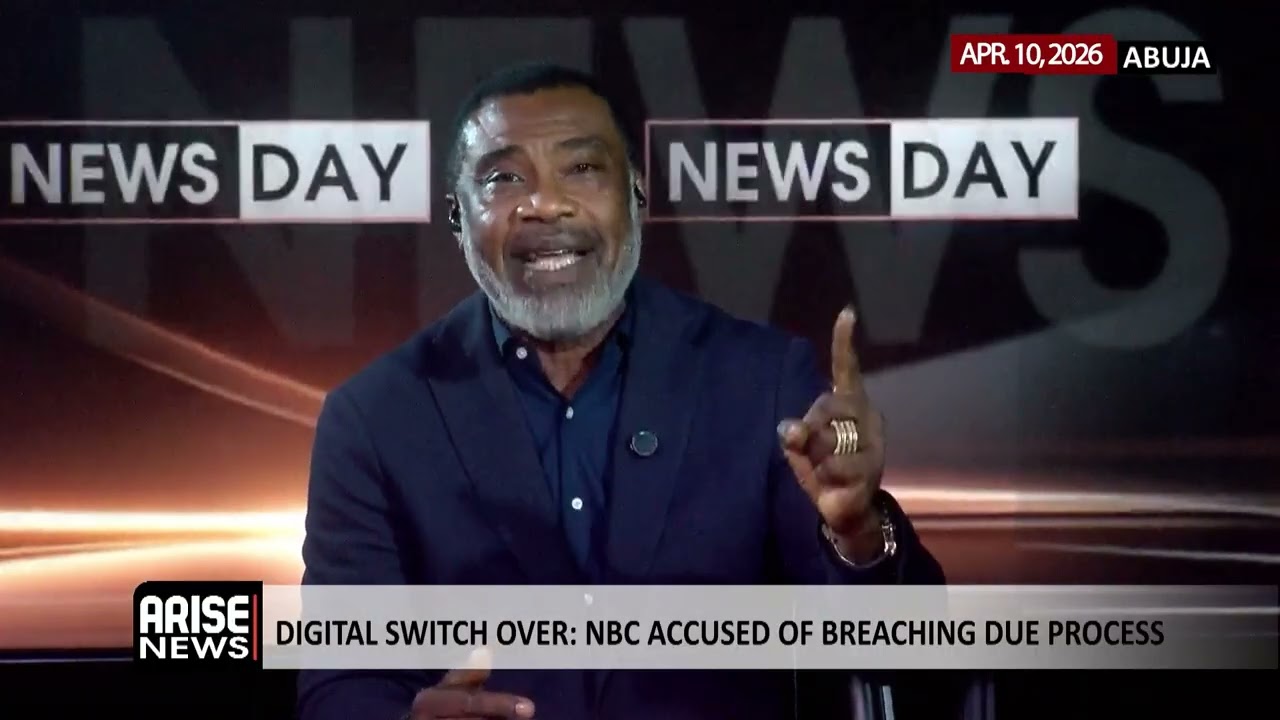
Chairman of the Association of Licensed Set-top Box Manufacturers of Nigeria, Godfrey Ohabunwa, has accused the National Broadcasting Commission (NBC) of derailing Nigeria’s long-delayed digital switchover programme, saying regulatory inconsistency and deviation from approved government policy are responsible for the 17-year delay.
Speaking in an interview with ARISE News on Friday, Ohabunwa said the Nigerian Digital Switchover White Paper, approved by the Federal Government in 2015 after years of committee deliberations, clearly laid out the implementation framework, yet NBC has failed to follow it.
“The delay is because of One: Inconsistency in policy. Two: People who manage the DSO program probably do not or have not read the document. Three: Some selfish ambition,” he said.
According to him, the Federal Government fulfilled its responsibilities by approving policy, licensing operators, and investing heavily in infrastructure, but NBC, as regulator and custodian of the programme, has continued to undermine progress.
Ohabunwa explained that the DSO policy was designed to migrate Nigeria from analogue to digital terrestrial broadcasting in line with International Telecommunication Union standards, freeing spectrum space for broadband and improving broadcast efficiency.
He noted that between 2016 and 2018, the programme recorded measurable progress, with eight states switched on, transmission companies deploying infrastructure nationwide, and manufacturers investing millions in decoder production.
However, he said the process stalled because NBC has refused to switch off analogue transmission, making full implementation impossible despite billions already invested.
“But since then to today, NBC has refused to switch off the analog. Thereby making it difficult for the full implementation of the DSO,” he stated.
Ohabunwa also criticised NBC’s reported decision to abandon Digital Terrestrial Television (DTT) in favour of Direct-to-Home (DTH) satellite broadcasting, arguing that such a shift contradicts the original government-approved framework.
He stressed that DTH is not new technology in Nigeria, pointing out that providers like MultiChoice, GOtv, and StarTimes have operated satellite television services for years, making NBC’s new direction unnecessary and disruptive.
“What NBC is doing negates the Federal Government policy,” he said.
He warned that abandoning DTT would render over 250,000 manufactured set-top boxes worth more than $10 million useless, while also jeopardising loans, infrastructure investments, and government spending estimated at over ₦60 billion.
Ohabunwa concluded by urging the Federal Government to compel NBC to return to the approved White Paper and implement the original digital switchover roadmap, insisting that regulators must not override established national policy.
By Triumph Ojo